Department of Biochemistry and Molecular Biology, University of Chicago, Chicago, Illinois, USA.
Nat Struct Mol Biol. 2011 Sep 11;18(10):1159-63. doi: 10.1038/nsmb.2113.
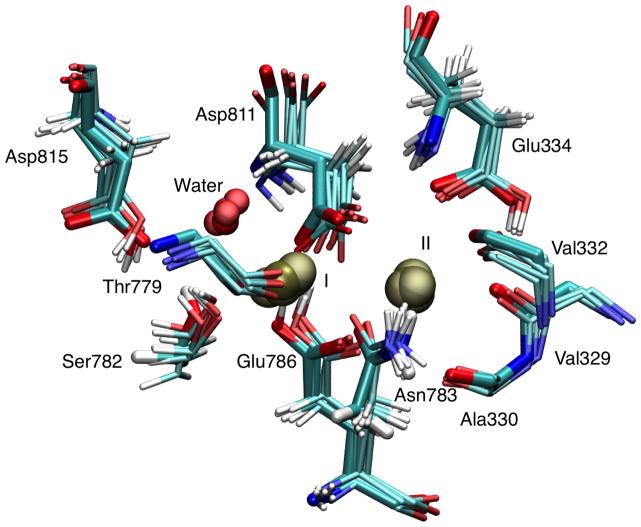
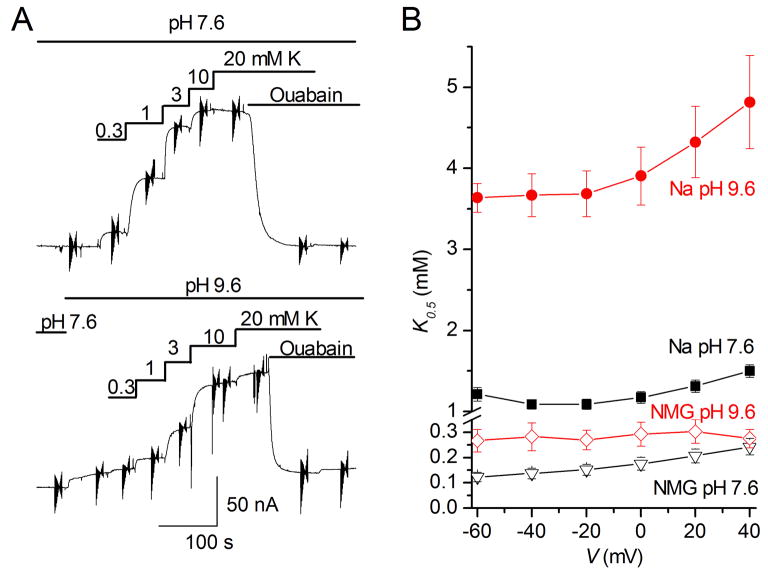
The sodium-potassium (Na/K) pump is a P-type ATPase that generates Na(+) and K(+) concentration gradients across the cell membrane. For each hydrolyzed ATP molecule, the pump extrudes three Na(+) and imports two K(+) by alternating between outward- and inward-facing conformations that preferentially bind K(+) or Na(+), respectively. Remarkably, the selective K(+) and Na(+) binding sites share several residues, and how the pump is able to achieve the selectivity required for the functional cycle is unclear. Here, free energy-perturbation molecular dynamics (FEP/MD) simulations based on the crystal structures of the Na/K pump in a K(+)-loaded state (E2·P(i)) reveal that protonation of the high-field acidic side chains involved in the binding sites is crucial to achieving the proper K(+) selectivity. This prediction is tested with electrophysiological experiments showing that the selectivity of the E2P state for K(+) over Na(+) is affected by extracellular pH.
钠钾(Na/K)泵是一种 P 型 ATP 酶,可在细胞膜两侧产生 Na(+) 和 K(+)浓度梯度。对于每个水解的 ATP 分子,泵通过交替向外和向内构象来将三个 Na(+)排出并将两个 K(+)导入,这两种构象分别优先结合 K(+)或 Na(+)。值得注意的是,选择性的 K(+)和 Na(+)结合位点共享几个残基,而泵如何能够实现功能循环所需的选择性尚不清楚。在这里,基于晶体结构的能量微扰分子动力学(FEP/MD)模拟表明,参与结合位点的高场酸性侧链的质子化对于实现适当的 K(+)选择性至关重要。这一预测通过电生理实验得到了检验,该实验表明 E2P 状态对 K(+)的选择性相对于 Na(+)受到细胞外 pH 值的影响。