Han Eun Chun, Cho Sung Bin, Ahn Keun Jae, Oh Sang Ho, Kim Jihyun, Kim Dong Soo, Lee Kwang Hoon, Bang Dongsik
Department of Dermatology and Cutaneous Biology Research Institute, Seoul, Korea.
Ann Dermatol. 2011 Aug;23(3):313-20. doi: 10.5021/ad.2011.23.3.313. Epub 2011 Aug 6.
S100A12 is a member of the S100 family of calcium-binding proteins and is secreted either in inflamed tissues or in the bloodstream by activated neutrophils. Expression of S100A12 has been reported in various diseases, especially non-infectious inflammatory diseases, such as Kawasaki disease, giant cell arteritis and inflammatory bowel disease.
This study was conducted to determine both the tissue expression and the serum levels of S100A12 in Behçet's disease (BD) patients and the correlation of the S100A12 serum level with disease activity of BD.
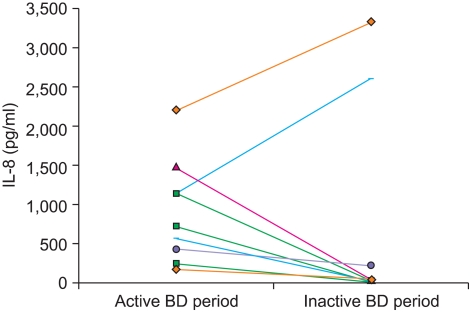
We included in this study ten BD patients who fulfilled the criteria for diagnosis, according to the International Study Group for BD. The activity of BD was calculated using the BD Current Activity Form. The serum concentrations of both S100A12 and interleukin-8 were measured by the enzyme-linked immunosorbent assay, before and after treatment. Immunohistochemical studies were also performed to detect S100A12 expression in the skin.
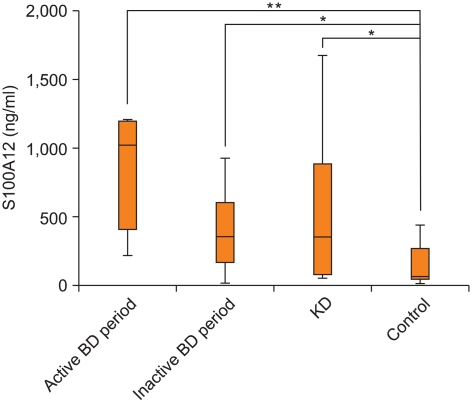
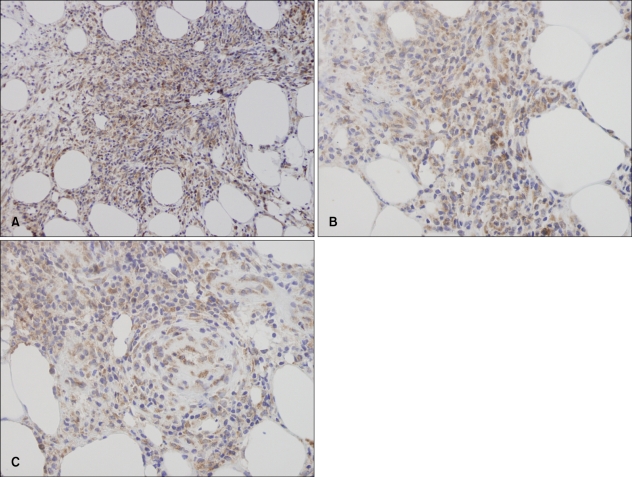
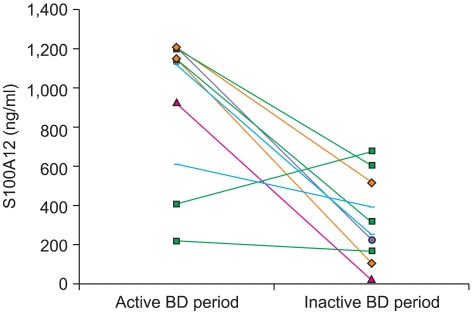
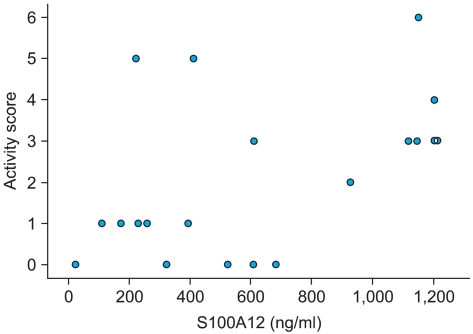
The serum S100A12 level was significantly increased in the active BD period (p<0.001), in the inactive BD period (p=0.041) and in patients with active Kawasaki disease (p=0.028), compared with the serum level in the healthy controls. The serum S100A12 level decreased significantly from baseline, compared to post-treatment (p=0.017). The activity score of BD was significantly correlated with the serum level of S100A12 (Spearman's coefficient=0.464, p=0.039). Immunohistochemical studies showed that S100A12 was strongly expressed in the erythema nodosum-like skin lesions of patients.
S100A12 contributes to the pathogenesis of BD related to neutrophil hyperactivity and reflects the disease activity in BD patients.
S100A12是钙结合蛋白S100家族的成员,由活化的中性粒细胞分泌至炎症组织或血液中。已有报道称S100A12在多种疾病中表达,尤其是非感染性炎症性疾病,如川崎病、巨细胞动脉炎和炎症性肠病。
本研究旨在测定白塞病(BD)患者的S100A12组织表达和血清水平,以及S100A12血清水平与BD疾病活动度的相关性。
根据白塞病国际研究组的诊断标准,本研究纳入了10例符合诊断标准的BD患者。使用BD当前活动表计算BD的活动度。在治疗前后,采用酶联免疫吸附测定法测量S100A12和白细胞介素-8的血清浓度。还进行了免疫组织化学研究以检测皮肤中S100A12的表达。
与健康对照者的血清水平相比,活动期BD患者(p<0.001)、非活动期BD患者(p=0.041)和活动期川崎病患者(p=0.028)的血清S100A12水平显著升高。与治疗后相比,血清S100A12水平较基线显著降低(p=0.017)。BD的活动评分与S100A12的血清水平显著相关(斯皮尔曼系数=0.464,p=0.039)。免疫组织化学研究表明,S100A12在患者的结节性红斑样皮肤病变中强烈表达。
S100A12参与了与中性粒细胞活性亢进相关的BD发病机制,并反映了BD患者的疾病活动度。