Diabetes Center, Department of Medicine, University of California, San Francisco, San Francisco, California, United States of America.
PLoS Biol. 2011 Sep;9(9):e1001143. doi: 10.1371/journal.pbio.1001143. Epub 2011 Sep 6.
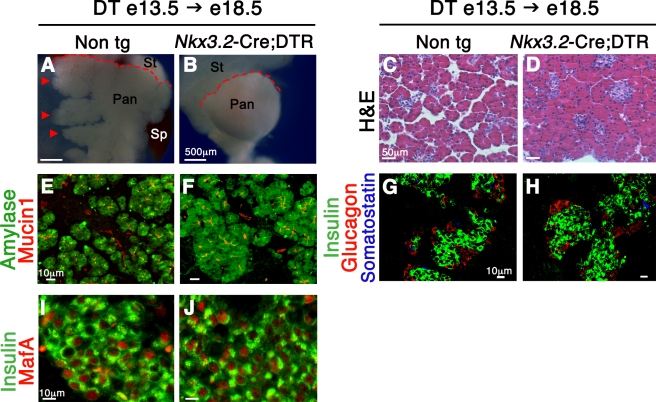
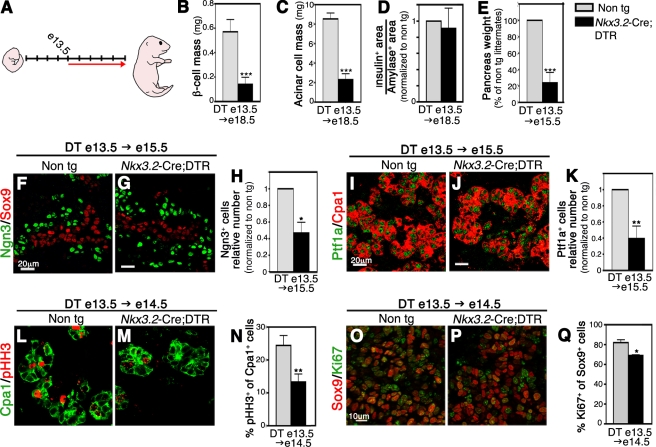
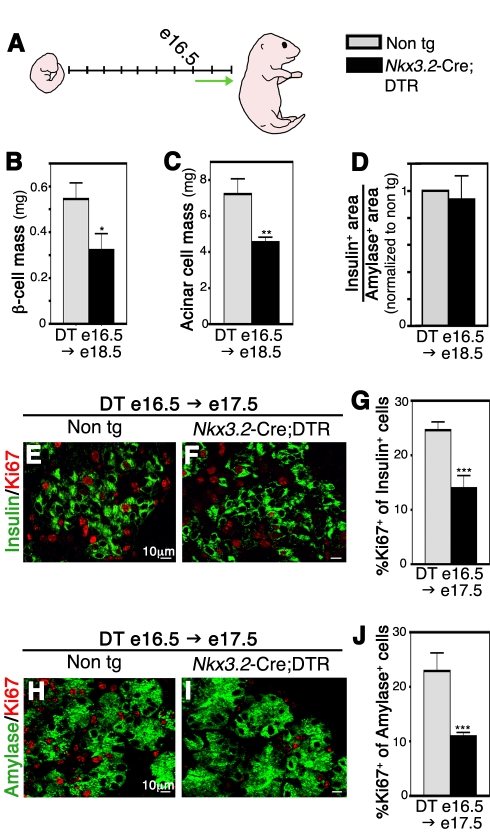
The developing pancreatic epithelium gives rise to all endocrine and exocrine cells of the mature organ. During organogenesis, the epithelial cells receive essential signals from the overlying mesenchyme. Previous studies, focusing on ex vivo tissue explants or complete knockout mice, have identified an important role for the mesenchyme in regulating the expansion of progenitor cells in the early pancreas epithelium. However, due to the lack of genetic tools directing expression specifically to the mesenchyme, the potential roles of this supporting tissue in vivo, especially in guiding later stages of pancreas organogenesis, have not been elucidated. We employed transgenic tools and fetal surgical techniques to ablate mesenchyme via Cre-mediated mesenchymal expression of Diphtheria Toxin (DT) at the onset of pancreas formation, and at later developmental stages via in utero injection of DT into transgenic mice expressing the Diphtheria Toxin receptor (DTR) in this tissue. Our results demonstrate that mesenchymal cells regulate pancreatic growth and branching at both early and late developmental stages by supporting proliferation of precursors and differentiated cells, respectively. Interestingly, while cell differentiation was not affected, the expansion of both the endocrine and exocrine compartments was equally impaired. To further elucidate signals required for mesenchymal cell function, we eliminated β-catenin signaling and determined that it is a critical pathway in regulating mesenchyme survival and growth. Our study presents the first in vivo evidence that the embryonic mesenchyme provides critical signals to the epithelium throughout pancreas organogenesis. The findings are novel and relevant as they indicate a critical role for the mesenchyme during late expansion of endocrine and exocrine compartments. In addition, our results provide a molecular mechanism for mesenchymal expansion and survival by identifying β-catenin signaling as an essential mediator of this process. These results have implications for developing strategies to expand pancreas progenitors and β-cells for clinical transplantation.
发育中的胰腺上皮细胞产生成熟器官的所有内分泌和外分泌细胞。在器官发生过程中,上皮细胞从覆盖的间充质中接收必要的信号。以前的研究集中在离体组织外植体或完全敲除小鼠上,已经确定了间充质在调节早期胰腺上皮祖细胞的扩增中的重要作用。然而,由于缺乏专门针对间充质表达的遗传工具,这种支持组织在体内的潜在作用,特别是在指导胰腺器官发生的后期阶段,尚未阐明。我们使用转基因工具和胎儿手术技术,通过 Cre 介导的在胰腺形成时的间充质表达白喉毒素 (DT),以及在后期发育阶段通过向在该组织中表达白喉毒素受体 (DTR)的转基因小鼠的宫内注射 DT,来消融间充质。我们的结果表明,间充质细胞通过分别支持前体细胞和分化细胞的增殖,调节早期和晚期发育阶段的胰腺生长和分支。有趣的是,虽然细胞分化不受影响,但内分泌和外分泌区室的扩张都同样受到损害。为了进一步阐明间充质细胞功能所需的信号,我们消除了 β-连环蛋白信号,并确定它是调节间充质存活和生长的关键途径。我们的研究首次提供了体内证据,证明胚胎间充质在整个胰腺器官发生过程中向上皮细胞提供关键信号。这些发现是新颖而相关的,因为它们表明间充质在内分泌和外分泌区室的后期扩张过程中起着关键作用。此外,我们的结果通过确定β-连环蛋白信号作为该过程的重要介质,为间充质扩张和存活提供了分子机制。这些结果对于开发扩大胰腺祖细胞和β细胞用于临床移植的策略具有重要意义。