Department of Environmental Microbiology, Swiss Federal Institute of Aquatic Science and Technology (Eawag), Dübendorf, Switzerland.
PLoS One. 2011;6(9):e24350. doi: 10.1371/journal.pone.0024350. Epub 2011 Sep 1.
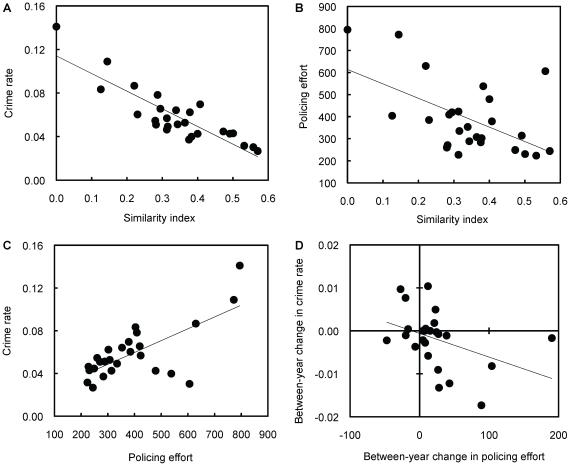
In social groups where relatedness among interacting individuals is low, cooperation can often only be maintained through mechanisms that repress competition among group members. Repression-of-competition mechanisms, such as policing and punishment, seem to be of particular importance in human societies, where cooperative interactions often occur among unrelated individuals. In line with this view, economic games have shown that the ability to punish defectors enforces cooperation among humans. Here, I examine a real-world example of a repression-of-competition system, the police institutions common to modern human societies. Specifically, I test evolutionary policing theory by comparing data on policing effort, per capita crime rate, and similarity (used as a proxy for genetic relatedness) among citizens across the 26 cantons of Switzerland. This comparison revealed full support for all three predictions of evolutionary policing theory. First, when controlling for policing efforts, crime rate correlated negatively with the similarity among citizens. This is in line with the prediction that high similarity results in higher levels of cooperative self-restraint (i.e. lower crime rates) because it aligns the interests of individuals. Second, policing effort correlated negatively with the similarity among citizens, supporting the prediction that more policing is required to enforce cooperation in low-similarity societies, where individuals' interests diverge most. Third, increased policing efforts were associated with reductions in crime rates, indicating that policing indeed enforces cooperation. These analyses strongly indicate that humans respond to cues of their social environment and adjust cheating and policing behaviour as predicted by evolutionary policing theory.
在个体间关联性较低的社会群体中,合作通常只能通过抑制群体成员之间竞争的机制来维持。抑制竞争的机制,如监管和惩罚,在人类社会中似乎尤为重要,因为合作互动通常发生在没有亲缘关系的个体之间。这一观点与经济博弈的结果一致,即惩罚破坏者的能力可以促进人类之间的合作。在这里,我研究了竞争抑制系统的一个现实例子,即现代人类社会中常见的警察机构。具体来说,我通过比较瑞士 26 个州的警察工作力度、人均犯罪率和公民之间的相似性(用作遗传关联性的替代指标)的数据,检验了进化警察理论。这一比较完全支持了进化警察理论的所有三个预测。首先,在控制警察工作力度的情况下,犯罪率与公民之间的相似性呈负相关。这与以下预测一致,即高相似度导致更高水平的合作自我约束(即更低的犯罪率),因为它使个人的利益保持一致。其次,警察工作力度与公民之间的相似性呈负相关,这支持了这样的预测,即在相似度较低的社会中,需要更多的警察来执行合作,因为个体的利益分歧最大。第三,增加警察工作力度与犯罪率的降低相关,表明警察确实执行了合作。这些分析强烈表明,人类对其社会环境的线索做出反应,并根据进化警察理论调整欺骗和警察行为。