Jacob R J, Morse L S, Roizman B
J Virol. 1979 Feb;29(2):448-57. doi: 10.1128/JVI.29.2.448-457.1979.
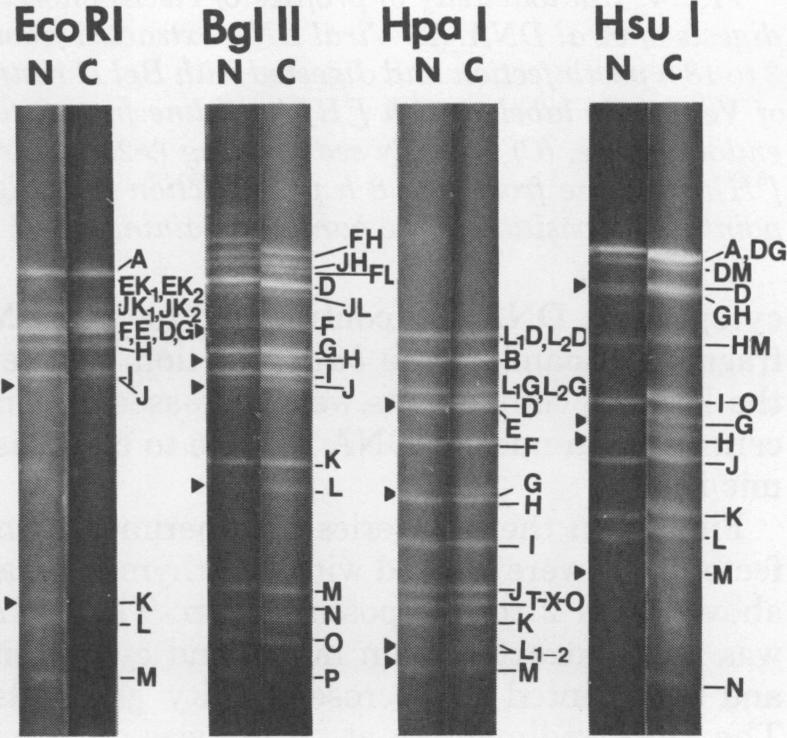
Previous reports (H. Delius and J. B. Clements, J. Gen. Virol. 33:125-134, 1976; G. S. Hayward, R. J. Jacob, S. C. Wadsworth, and B. Roizman, Proc. Natl. Acad. Sci. U.S.A. 72:4243-4247, 1975; B. Roizman, G. S. Hayward, R. Jacob, S. W. Wadsworth, and R. W. Honess, Excerpta Med. Int. Congr. Ser. 2:188-198, 1974) have shown that herpes simplex virus DNA extracted from virions accumulating in the cytoplasm of infected cells consists of four populations of linear molecules differing in the orientation of the covalently linked large (L) and small (S) components relative to each other. Together, these four isomeric arrangements of viral DNA display four different termini and four different L-S component junctions. In the studies reported in this paper, we analyzed with restriction endonucleases the newly replicated viral DNA shortly after the onset of viral DNA synthesis, the progeny DNA accumulating in the nuclei late in infection, and rapidly sedimenting DNA present in nuclei of infected cells at 8 h after infection. In each instance the nuclear viral DNA contained a decreased concentration of all four terminal fragments and an increase in the concentration of fragments spanning the junction of L and S components relative to the concentration of other DNA fragments. The results are consistent with the hypothesis that the viral DNA accumulating in the nuclei consists of head-to-tail concatemers arising from the replication of DNA by a rolling-circle mechanism. A model is presented for generation of all four isomeric arrangements of herpes simplex virus DNA from one arrangement based on excision and repair of unit length DNA from head-to-tail concatemers and known features of the sequence arrangement of viral DNA.
先前的报告(H. 德利乌斯和J. B. 克莱门茨,《普通病毒学杂志》33:125 - 134,1976年;G. S. 海沃德、R. J. 雅各布、S. C. 沃兹沃思和B. 罗伊兹曼,《美国国家科学院院刊》72:4243 - 4247,1975年;B. 罗伊兹曼、G. S. 海沃德、R. 雅各布、S. W. 沃兹沃思和R. W. 霍尼斯,《医学文摘国际会议系列》2:188 - 198,1974年)表明,从感染细胞胞质中积累的病毒粒子提取的单纯疱疹病毒DNA由四种线性分子群体组成,这些群体中通过共价连接的大(L)和小(S)成分彼此之间的方向不同。这四种病毒DNA的异构体排列一起显示出四个不同的末端和四个不同的L - S成分连接点。在本文所报告的研究中,我们用限制性内切酶分析了病毒DNA合成开始后不久新复制的病毒DNA、感染后期在细胞核中积累的子代DNA以及感染后8小时感染细胞核中快速沉降的DNA。在每种情况下,核病毒DNA中所有四个末端片段的浓度都降低了,并且相对于其他DNA片段的浓度,跨越L和S成分连接点的片段浓度增加了。这些结果与以下假设一致:积累在细胞核中的病毒DNA由通过滚环机制复制DNA产生的头对头串联体组成。基于从头对头串联体中切除和修复单位长度DNA以及病毒DNA序列排列的已知特征,提出了一个从一种排列生成单纯疱疹病毒DNA所有四种异构体排列的模型。