Department of Pediatrics, Samsung Medical Center, Sungkyunkwan University School of Medicine, Seoul, Korea.
J Korean Med Sci. 2011 Sep;26(9):1165-72. doi: 10.3346/jkms.2011.26.9.1165. Epub 2011 Sep 1.
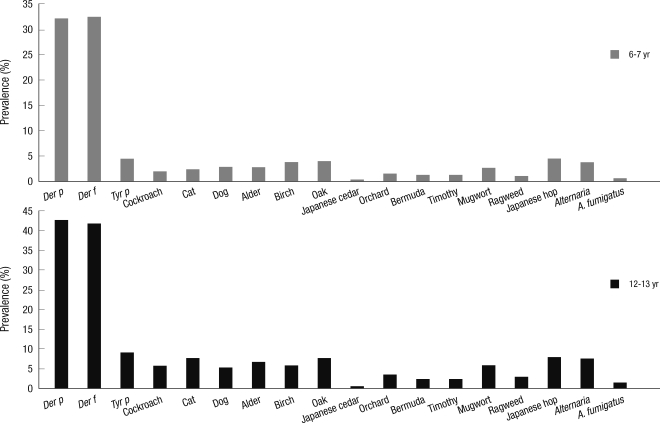
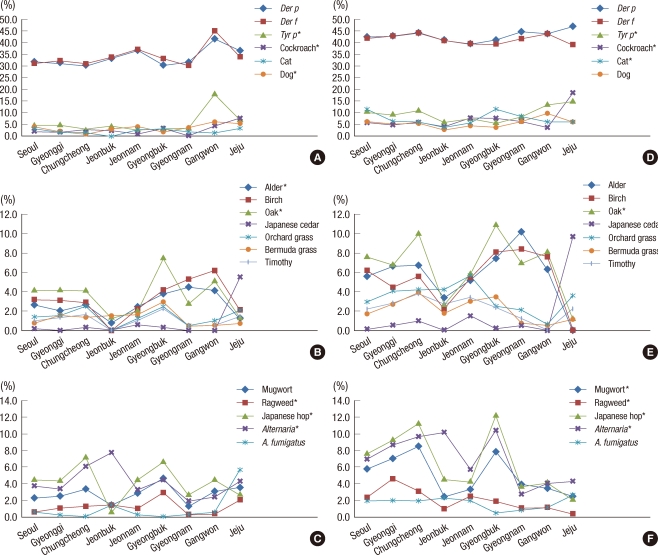
We performed this study to assess the prevalence of sensitization to aeroallergens and to analyze the difference between prevalence rates according to children's ages and residential areas. In this nationwide cross-sectional study, first grade students of 45 elementary schools and 40 middle schools were randomly selected, and skin prick tests were performed for 18 inhalant allergens between October and November 2010. Of 7,829 analyzed subjects, 3,753 (47.9%) were sensitized to at least one aeroallergen. Sensitization to Dermatophagoides farinae was found to be the most prevalent in elementary schoolchildren (32.4%), followed by Dermatophagoides pteronyssinus, Tyrophagus putrescentiae, Japanese hop, and oak. In middle schoolchildren, D. pteronyssinus yielded the highest prevalence (42.7%), followed by D. farinae, T. putrescentiae, Japanese hop, and cat. In middle schoolchildren, the sensitization rate to aeroallergens in metropolitan, urban, and rural areas was 57.2%, 54.3%, and 49.8%, respectively (P = 0.019). In this age group, the sensitization rate in low, middle, high, and very high income groups was 53.8%, 51.8%, 59.0%, and 59.6%, respectively (P = 0.002). In conclusion, the sensitization rate is 47.9% and house dust mite is the most prevalent allergen in the pediatric population in Korea. The rate is higher in metropolitan areas and the highest income group than in rural areas and low income groups.
我们进行了这项研究,以评估气传变应原致敏的流行率,并分析根据儿童年龄和居住地区的流行率差异。在这项全国性的横断面研究中,我们随机选择了 45 所小学和 40 所中学的一年级学生,并于 2010 年 10 月至 11 月对 18 种吸入性变应原进行了皮肤点刺试验。在分析的 7829 名受试者中,有 3753 名(47.9%)对至少一种气传变应原过敏。在小学生中,粉尘螨的致敏率最高(32.4%),其次是屋尘螨、腐食酪螨、豚草和栎属。在中学生中,屋尘螨的致敏率最高(42.7%),其次是粉尘螨、腐食酪螨、豚草和猫。在中学生中,大都市、城市和农村地区的气传变应原致敏率分别为 57.2%、54.3%和 49.8%(P=0.019)。在该年龄组中,低收入、中收入、高收入和极高收入组的致敏率分别为 53.8%、51.8%、59.0%和 59.6%(P=0.002)。总之,在韩国儿科人群中,致敏率为 47.9%,屋尘螨是最常见的过敏原。大都市地区和最高收入组的比率高于农村地区和低收入组。