LTSI, INSERM U642, Université Rennes 1, France.
Phys Med Biol. 2011 Oct 21;56(20):6635-47. doi: 10.1088/0031-9155/56/20/008. Epub 2011 Sep 23.
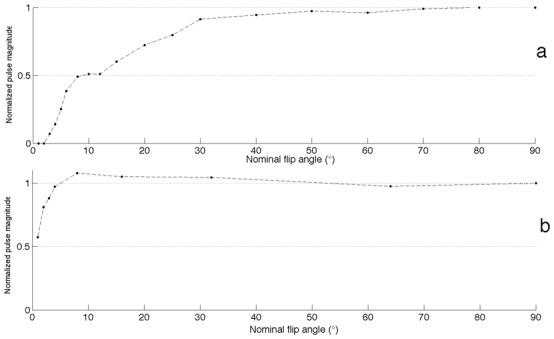
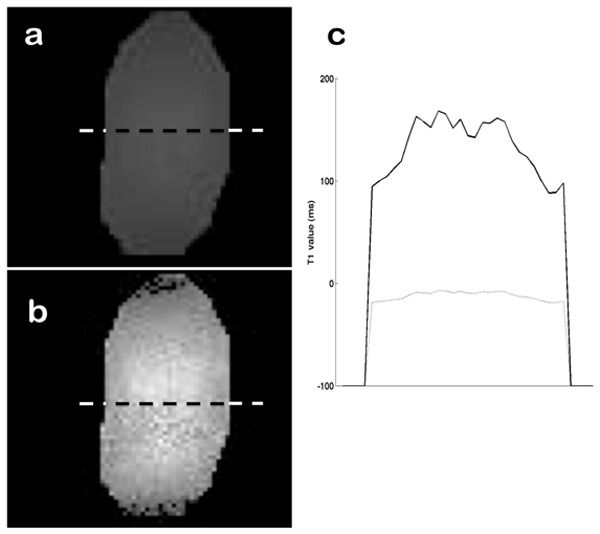
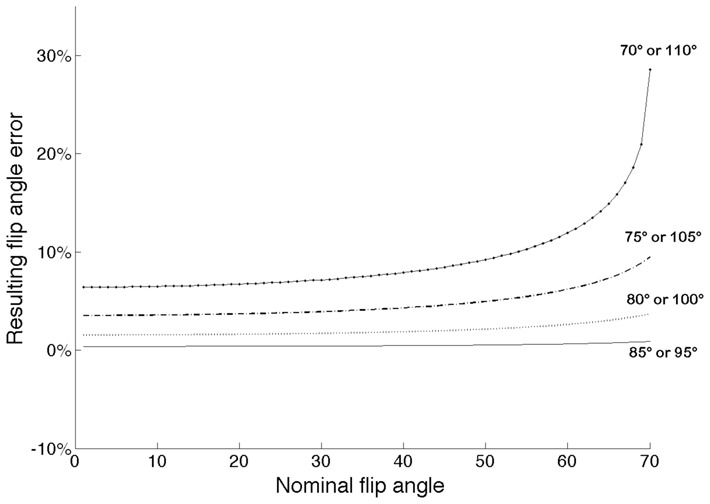
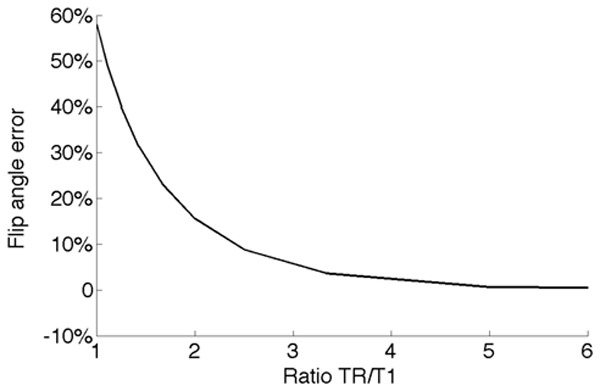
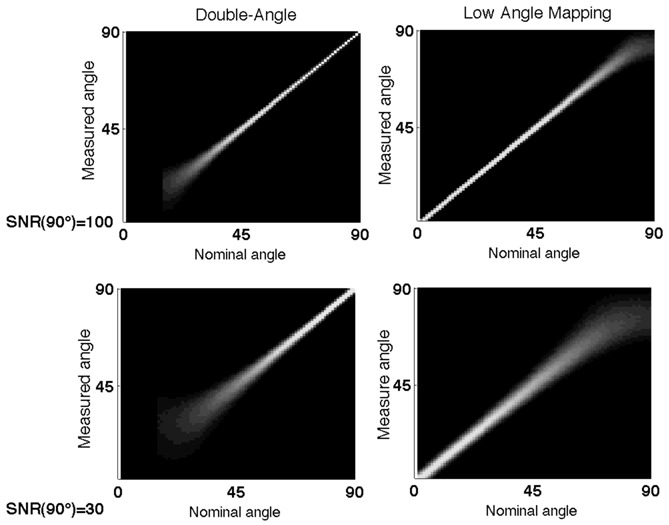
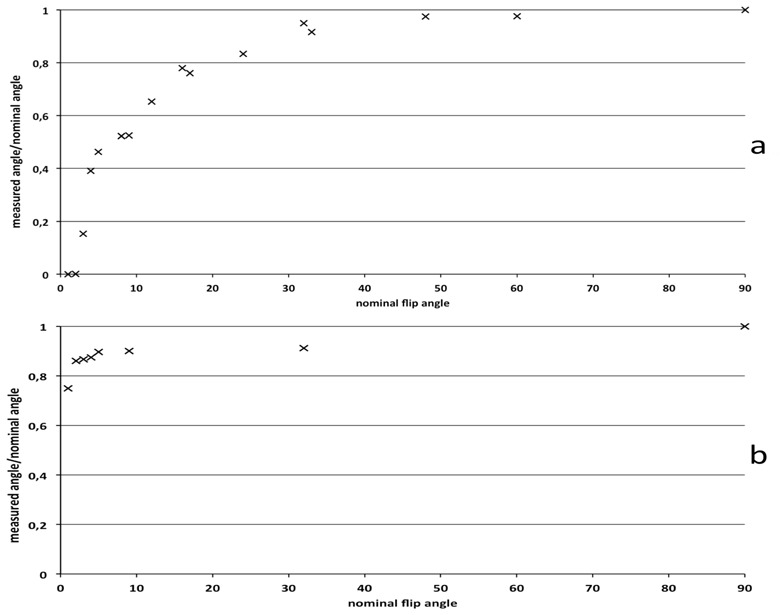
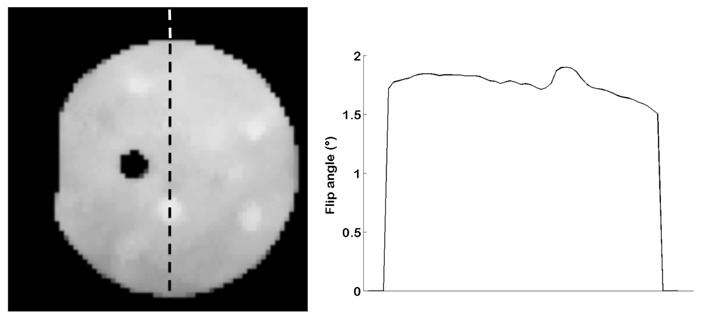
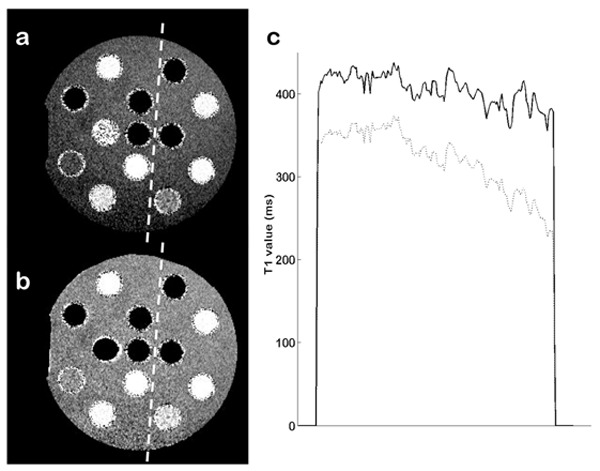
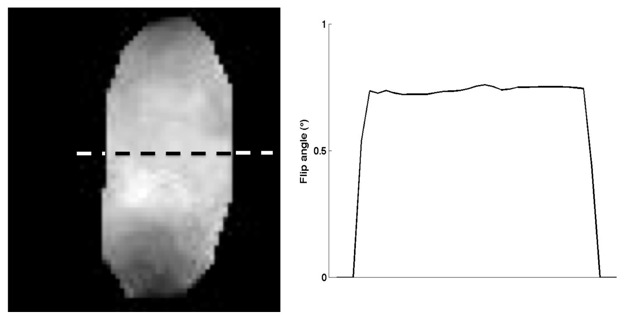
Errors in the flip angle have to be corrected in many magnetic resonance imaging applications, especially for T1 quantification. However, the existing methods of B1 mapping fail to measure lower values of the flip angle despite the fact that these are extensively used in dynamic acquisition and 3D imaging. In this study, the nonlinearity of the radiofrequency (RF) transmit chain, especially for very low flip angles, is investigated and a simple method is proposed to accurately determine both the gain of the RF transmitter and the B1 field map for low flip angles. The method makes use of the spoiled gradient echo sequence with long repetition time (TR), such as applied in the double-angle method. It uses an image acquired with a flip angle of 90° as a reference image that is robust to B1 inhomogeneity. The ratio of the image at flip angle alpha to the image at a flip angle of 90° enables us to calculate the actual value of alpha. This study was carried out at 1.5 and 4.7 T, showing that the linearity of the RF supply system is highly dependent on the hardware. The method proposed here allows us to measure the flip angle from 1° to 60° with a maximal uncertainty of 10% and to correct T1 maps based on the variable flip angle method.
在许多磁共振成像应用中,必须纠正翻转角的误差,特别是在 T1 定量方面。然而,尽管在动态采集和 3D 成像中广泛使用,现有的 B1 映射方法却无法测量较低的翻转角值。在这项研究中,研究了射频(RF)发射链的非线性,特别是对于非常低的翻转角,提出了一种简单的方法,可以准确确定 RF 发射器的增益和低翻转角的 B1 场图。该方法利用具有长重复时间(TR)的扰动脉冲回波序列,如双角度方法中所应用的。它使用翻转角为 90°的图像作为参考图像,该图像对 B1 不均匀性具有鲁棒性。翻转角为 alpha 的图像与翻转角为 90°的图像的比值使我们能够计算出 alpha 的实际值。这项研究在 1.5 和 4.7T 下进行,结果表明,RF 电源系统的线性度高度依赖于硬件。这里提出的方法允许我们以最大不确定度为 10%测量 1°至 60°的翻转角,并根据可变翻转角方法校正 T1 图。