Department of Neurology, Universitätsmedizin Mainz, Langenbeckstraße 1, 55131 Mainz, Germany.
Parkinsons Dis. 2011;2011:897586. doi: 10.4061/2011/897586. Epub 2011 Sep 18.
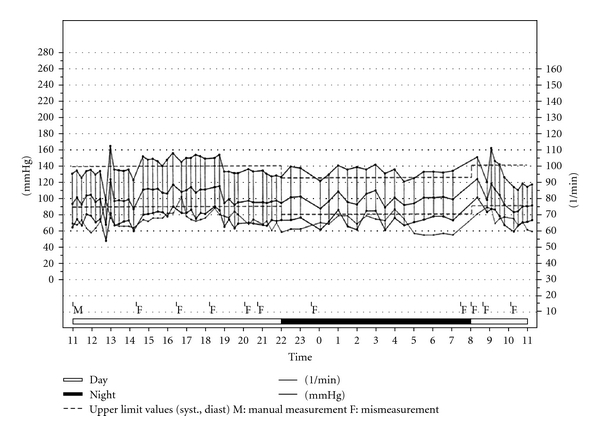
Objective. The aim of this study was to identify patients with Parkinson's disease who showed loss or decrease of nocturnal blood pressure fall (nondipper patients) as a marker of autonomic dysfunction. Presence or absence of orthostatic hypotension was considered to investigate whether alterations in circadian blood pressure pattern are associated with posture-related dysregulation of blood pressure. Methods. 40 patients with Parkinson's disease underwent 24-hour blood pressure monitoring. 21 patients were diagnosed with arterial hypertension and received anti-hypertensive drugs. Nondipper patients were defined as having nocturnal decrease of mean systolic and diastolic blood pressure less than 10%. Presence or absence of orthostatic hypotension was determined by Schellong's test. Results. We identified 35 nondipper patients (88%). Nondipping was detected in 20 patients with orthostatic hypotension (95%) and in 15 patients without orthostatic hypotension (79%). 18 patients with hypertensive and 22 patients with normal blood pressure values were detected. Conclusions. In conclusion 24-hour blood pressure monitoring showed a high prevalence of nondipping in 40 patients with Parkinson's disease with and without orthostatic hypotension independent of coexisting arterial hypertension and antihypertensive treatment. 24-hour blood pressure monitoring may be useful to identify non-dipping as a marker of autonomic dysfunction in patients with Parkinson's disease.
目的。本研究旨在识别帕金森病患者中表现出夜间血压下降丧失或减少(非杓型患者)的患者,作为自主神经功能障碍的标志物。体位性低血压的存在与否被认为是为了研究昼夜血压模式的改变是否与与姿势相关的血压调节障碍有关。
方法。40 名帕金森病患者接受了 24 小时血压监测。21 名患者被诊断为高血压并接受了抗高血压药物治疗。非杓型患者被定义为夜间平均收缩压和舒张压下降小于 10%。通过 Schellong 试验确定体位性低血压的存在与否。
结果。我们发现 35 名非杓型患者(88%)。在 20 名存在体位性低血压的患者(95%)和 15 名不存在体位性低血压的患者(79%)中检测到非杓型。检测到 18 名高血压患者和 22 名血压正常的患者。
结论。总之,24 小时血压监测显示,40 名帕金森病患者中无论是否存在体位性低血压,非杓型的患病率均较高,与并存的高血压和抗高血压治疗无关。24 小时血压监测可用于识别非杓型作为帕金森病患者自主神经功能障碍的标志物。