Clinical and Experimental Neuroscience Group/Biomedical Research Institute of Murcia (NiCE-IMIB)/Institute for Aging Research, School of Medicine, University of Murcia, 30100 Murcia, Spain.
Department of Pharmacology, School of Medicine, Biomedical Research Institute of Murcia (IMIB), University of Murcia, 30100 Murcia, Spain.
Int J Mol Sci. 2021 Dec 16;22(24):13488. doi: 10.3390/ijms222413488.
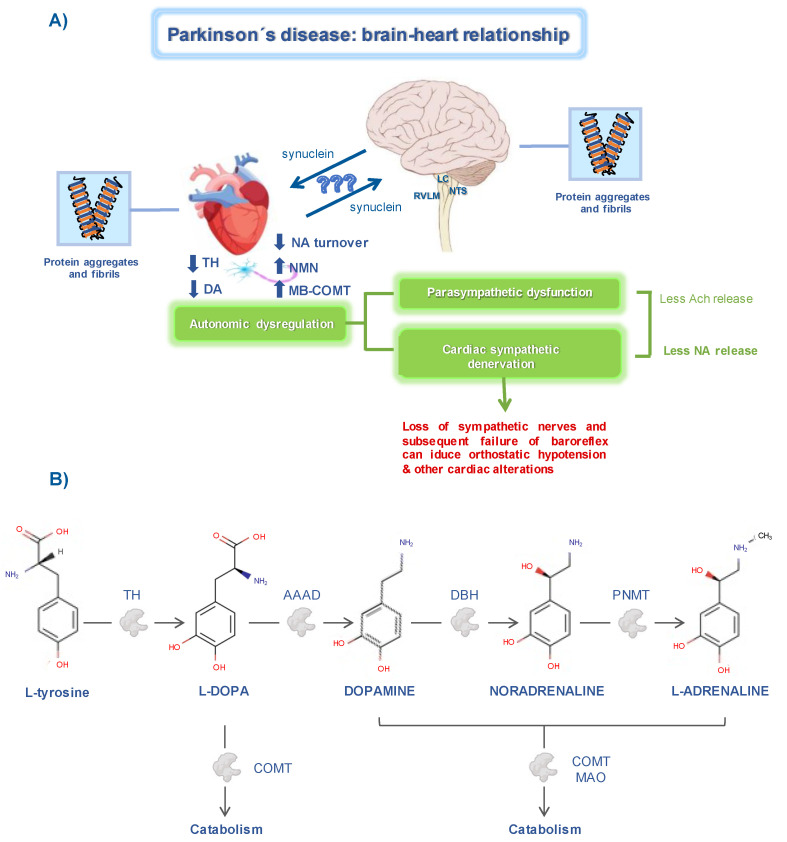
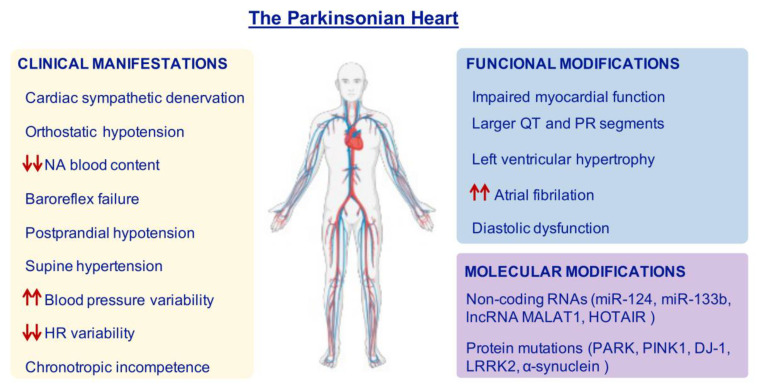
Dysautonomia is a common non-motor symptom in Parkinson's disease (PD). Most dysautonomic symptoms appear due to alterations in the peripheral nerves of the autonomic nervous system, including both the sympathetic and parasympathetic nervous systems. The degeneration of sympathetic nerve fibers and neurons leads to cardiovascular dysfunction, which is highly prevalent in PD patients. Cardiac alterations such as orthostatic hypotension, heart rate variability, modifications in cardiogram parameters and baroreflex dysfunction can appear in both the early and late stages of PD, worsening as the disease progresses. In PD patients it is generally found that parasympathetic activity is decreased, while sympathetic activity is increased. This situation gives rise to an imbalance of both tonicities which might, in turn, promote a higher risk of cardiac damage through tachycardia and vasoconstriction. Cardiovascular abnormalities can also appear as a side effect of PD treatment: L-DOPA can decrease blood pressure and aggravate orthostatic hypotension as a result of a negative inotropic effect on the heart. This unwanted side effect limits the therapeutic use of L-DOPA in geriatric patients with PD and can contribute to the number of hospital admissions. Therefore, it is essential to define the cardiac features related to PD for the monitorization of the heart condition in parkinsonian individuals. This information can allow the application of intervention strategies to improve the course of the disease and the proposition of new alternatives for its treatment to eliminate or reverse the motor and non-motor symptoms, especially in geriatric patients.
自主神经功能障碍是帕金森病(PD)的常见非运动症状。大多数自主神经功能障碍症状是由于自主神经系统的外周神经改变引起的,包括交感神经和副交感神经系统。交感神经纤维和神经元的变性导致心血管功能障碍,这在 PD 患者中非常普遍。体位性低血压、心率变异性、心电图参数改变和压力反射功能障碍等心脏改变可在 PD 的早期和晚期出现,并随着疾病的进展而恶化。在 PD 患者中,通常发现副交感神经活动减少,而交感神经活动增加。这种情况导致两种紧张度的不平衡,这可能反过来通过心动过速和血管收缩增加心脏损伤的风险。心血管异常也可能作为 PD 治疗的副作用出现:左旋多巴可因对心脏的负性肌力作用而降低血压并加重直立性低血压。这种不良的副作用限制了左旋多巴在患有 PD 的老年患者中的治疗用途,并可能导致住院人数增加。因此,对于帕金森氏症患者的心脏状况监测,定义与 PD 相关的心脏特征至关重要。这些信息可以允许应用干预策略来改善疾病的进程,并提出新的治疗替代方案以消除或逆转运动和非运动症状,尤其是在老年患者中。