Wellcome Trust Centre for Human Genetics, University of Oxford, Roosevelt Drive, Oxford, United Kingdom.
Genet Epidemiol. 2011 Dec;35(8):800-8. doi: 10.1002/gepi.20629. Epub 2011 Sep 21.
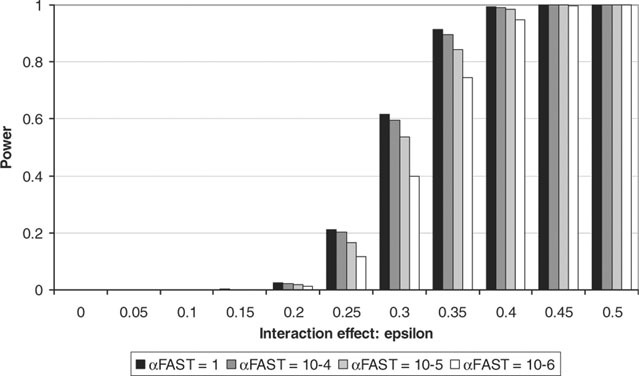
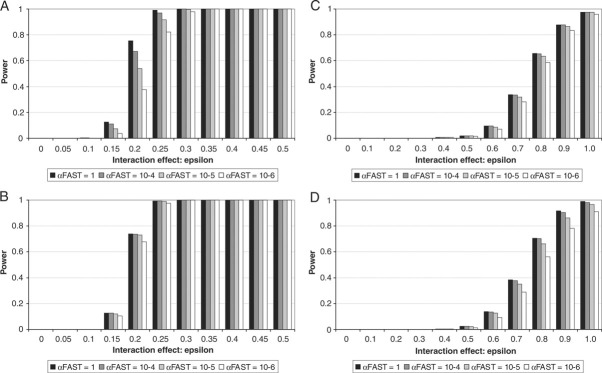
Genome-wide association (GWA) studies have been extremely successful in identifying novel loci contributing effects to a wide range of complex human traits. However, despite this success, the joint marginal effects of these loci account for only a small proportion of the heritability of these traits. Interactions between variants in different loci are not typically modelled in traditional GWA analysis, but may account for some of the missing heritability in humans, as they do in other model organisms. One of the key challenges in performing gene-gene interaction studies is the computational burden of the analysis. We propose a two-stage interaction analysis strategy to address this challenge in the context of both quantitative traits and dichotomous phenotypes. We have performed simulations to demonstrate only a negligible loss in power of this two-stage strategy, while minimizing the computational burden. Application of this interaction strategy to GWA studies of T2D and obesity highlights potential novel signals of association, which warrant follow-up in larger cohorts.
全基因组关联 (GWA) 研究在鉴定对广泛的复杂人类特征有影响的新基因座方面取得了巨大成功。然而,尽管取得了这一成功,但这些基因座的联合边际效应仅占这些特征遗传力的一小部分。传统的 GWA 分析通常不考虑不同基因座之间的变异相互作用,但正如在其他模式生物中一样,这些相互作用可能解释了人类遗传力的一些缺失。在进行基因-基因相互作用研究时,面临的一个关键挑战是分析的计算负担。我们提出了一种两阶段相互作用分析策略,以解决在定量性状和二分表型背景下的这一挑战。我们进行了模拟,以证明这种两阶段策略的功效仅略有降低,同时最大限度地减少了计算负担。将这种相互作用策略应用于 T2D 和肥胖的 GWA 研究突出了潜在的新关联信号,这些信号值得在更大的队列中进行后续研究。