Boden Institute of Obesity, Nutrition & Exercise and the School of Molecular Biosciences, University of Sydney, Sydney, Australia.
Diabetes Care. 2011 Oct;34(10):2146-51. doi: 10.2337/dc11-0567.
Although carbohydrate counting is routine practice in type 1 diabetes, hyperglycemic episodes are common. A food insulin index (FII) has been developed and validated for predicting the normal insulin demand generated by mixed meals in healthy adults. We sought to compare a novel algorithm on the basis of the FII for estimating mealtime insulin dose with carbohydrate counting in adults with type 1 diabetes.
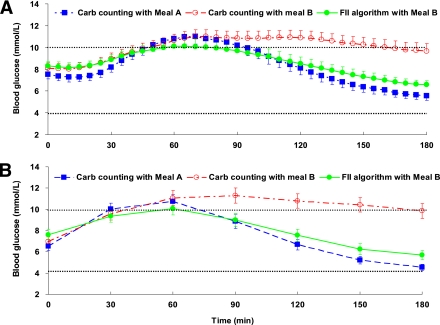
A total of 28 patients using insulin pump therapy consumed two different breakfast meals of equal energy, glycemic index, fiber, and calculated insulin demand (both FII = 60) but approximately twofold difference in carbohydrate content, in random order on three consecutive mornings. On one occasion, a carbohydrate-counting algorithm was applied to meal A (75 g carbohydrate) for determining bolus insulin dose. On the other two occasions, carbohydrate counting (about half the insulin dose as meal A) and the FII algorithm (same dose as meal A) were applied to meal B (41 g carbohydrate). A real-time continuous glucose monitor was used to assess 3-h postprandial glycemia.
Compared with carbohydrate counting, the FII algorithm significantly decreased glucose incremental area under the curve over 3 h (-52%, P = 0.013) and peak glucose excursion (-41%, P = 0.01) and improved the percentage of time within the normal blood glucose range (4-10 mmol/L) (31%, P = 0.001). There was no significant difference in the occurrence of hypoglycemia.
An insulin algorithm based on physiological insulin demand evoked by foods in healthy subjects may be a useful tool for estimating mealtime insulin dose in patients with type 1 diabetes.
尽管碳水化合物计数是 1 型糖尿病的常规实践,但高血糖发作很常见。已经开发并验证了一种食物胰岛素指数(FII),用于预测健康成年人混合餐所产生的正常胰岛素需求。我们试图比较一种基于 FII 的新算法,用于估计 1 型糖尿病成人的进餐胰岛素剂量与碳水化合物计数。
共有 28 名使用胰岛素泵治疗的患者连续三个早晨随机顺序摄入两种不同的早餐,能量、血糖指数、纤维和计算的胰岛素需求(均为 FII = 60)相同,但碳水化合物含量相差约两倍。在一种情况下,应用碳水化合物计数算法确定餐 A(75 克碳水化合物)的推注胰岛素剂量。在另外两种情况下,应用碳水化合物计数(约为餐 A 的一半胰岛素剂量)和 FII 算法(与餐 A 相同剂量)处理餐 B(41 克碳水化合物)。实时连续血糖监测仪用于评估餐后 3 小时的血糖。
与碳水化合物计数相比,FII 算法显著降低了 3 小时内血糖增量曲线下面积(-52%,P = 0.013)和峰值血糖(-41%,P = 0.01),并改善了正常血糖范围内的时间百分比(4-10mmol/L)(31%,P = 0.001)。低血糖的发生率没有显著差异。
基于健康受试者食物引起的生理胰岛素需求的胰岛素算法可能是估计 1 型糖尿病患者进餐胰岛素剂量的有用工具。