Hunt C Anthony, Ropella Glen E P, Lam Tai ning, Gewitz Andrew D
Department of Bioengineering and Therapeutic Sciences, University of California, San Francisco, CA 94143, USA.
Theor Biol Med Model. 2011 Sep 27;8:35. doi: 10.1186/1742-4682-8-35.
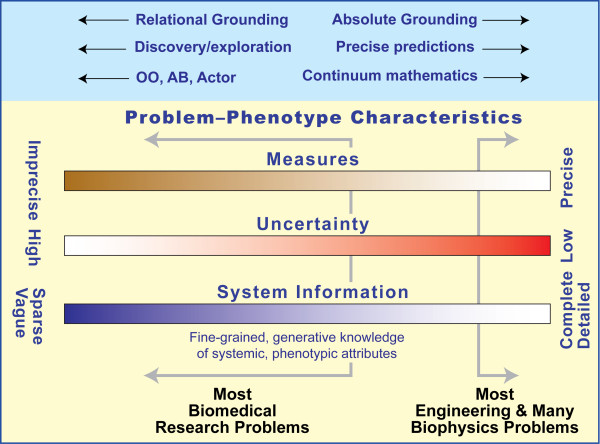
We review grounding issues that influence the scientific usefulness of any biomedical multiscale model (MSM). Groundings are the collection of units, dimensions, and/or objects to which a variable or model constituent refers. To date, models that primarily use continuous mathematics rely heavily on absolute grounding, whereas those that primarily use discrete software paradigms (e.g., object-oriented, agent-based, actor) typically employ relational grounding. We review grounding issues and identify strategies to address them. We maintain that grounding issues should be addressed at the start of any MSM project and should be reevaluated throughout the model development process. We make the following points. Grounding decisions influence model flexibility, adaptability, and thus reusability. Grounding choices should be influenced by measures, uncertainty, system information, and the nature of available validation data. Absolute grounding complicates the process of combining models to form larger models unless all are grounded absolutely. Relational grounding facilitates referent knowledge embodiment within computational mechanisms but requires separate model-to-referent mappings. Absolute grounding can simplify integration by forcing common units and, hence, a common integration target, but context change may require model reengineering. Relational grounding enables synthesis of large, composite (multi-module) models that can be robust to context changes. Because biological components have varying degrees of autonomy, corresponding components in MSMs need to do the same. Relational grounding facilitates achieving such autonomy. Biomimetic analogues designed to facilitate translational research and development must have long lifecycles. Exploring mechanisms of normal-to-disease transition requires model components that are grounded relationally. Multi-paradigm modeling requires both hyperspatial and relational grounding.
我们回顾了影响任何生物医学多尺度模型(MSM)科学实用性的基础问题。基础是变量或模型组成部分所指的单位、维度和/或对象的集合。迄今为止,主要使用连续数学的模型严重依赖绝对基础,而主要使用离散软件范式(如面向对象、基于智能体、基于参与者)的模型通常采用关系基础。我们回顾基础问题并确定解决这些问题的策略。我们认为,基础问题应在任何MSM项目开始时得到解决,并应在整个模型开发过程中重新评估。我们提出以下观点。基础决策会影响模型的灵活性、适应性,进而影响其可重用性。基础选择应受测量、不确定性、系统信息以及可用验证数据性质的影响。绝对基础会使模型组合形成更大模型的过程变得复杂,除非所有模型都有绝对基础。关系基础有助于在计算机制中体现参照知识,但需要单独的模型到参照的映射。绝对基础可以通过强制使用共同单位,从而形成共同的整合目标来简化整合,但上下文变化可能需要对模型进行重新设计。关系基础能够合成对上下文变化具有鲁棒性的大型复合(多模块)模型。由于生物组件具有不同程度的自主性,MSM中的相应组件也需要如此。关系基础有助于实现这种自主性。为促进转化研究与开发而设计的仿生类似物必须具有较长的生命周期。探索正常到疾病转变的机制需要具有关系基础的模型组件。多范式建模需要超空间基础和关系基础。