Sobell Department of Motor Neuroscience and Movement Disorders, UCL Institute of Neurology, London, United Kingdom.
Mov Disord. 2011 Dec;26(14):2509-15. doi: 10.1002/mds.23922. Epub 2011 Sep 28.
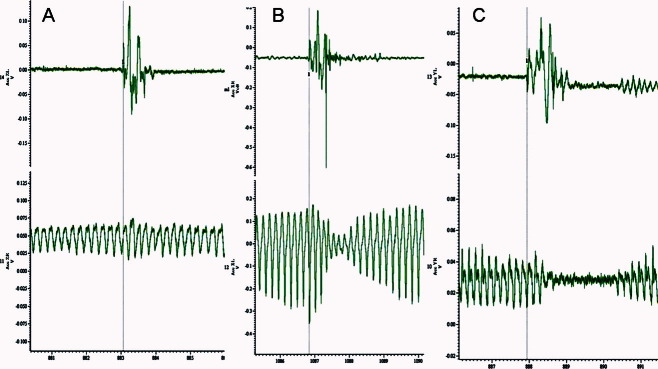
A confident clinical diagnosis of psychogenic tremor is often possible, but, in some cases, a "laboratory-supported" level of certainty would aid in early positive diagnosis. Various electrophysiological tests have been suggested to identify patients with psychogenic tremor, but their diagnostic reliability has never been assessed "head to head" nor compared to forms of organic tremor other than essential tremor or PD. We compared baseline tremor characteristics (e.g., frequency and amplitude) as well as electrophysiological tests previously reported to distinguish psychogenic and organic tremor in a cohort of 13 patients with psychogenic tremor and 25 patients with organic tremor, the latter including PD, essential-, dystonic-, and neuropathic tremors. We assessed between-group differences and calculated sensitivity and specificity for each test. A number of tests, including entrainment or frequency changes with tapping, pause of tremor during contralateral ballistic movements, increase in tremor amplitude with loading, presence of coherence, and tonic coactivation at tremor onset, revealed significant differences on a group level, but there was no single test with adequate sensitivity and specificity for separating the groups (33%-77% and 84%-100%, respectively). However, a combination of electrophysiological tests was able to distinguish psychogenic and organic tremor with excellent sensitivity and specificity. A laboratory-supported level of diagnostic certainty in psychogenic tremor is likely to require a battery of electrophysiological tests to provide sufficient specificity and sensitivity. Our data suggest such a battery that, if supported in a prospective study, may form the basis of laboratory-supported criteria for the diagnosis of psychogenic tremor.
对心因性震颤进行自信的临床诊断通常是可能的,但在某些情况下,“实验室支持”的确定性水平将有助于早期的阳性诊断。已经提出了各种电生理测试来识别心因性震颤患者,但它们的诊断可靠性从未被“面对面”评估过,也从未与除特发性震颤或 PD 以外的其他形式的器质性震颤进行比较。我们比较了基线震颤特征(例如频率和幅度)以及以前报道过的用于区分心因性和器质性震颤的电生理测试,在 13 例心因性震颤患者和 25 例器质性震颤患者(后者包括 PD、特发性、肌张力障碍性和神经病变性震颤)中进行了比较。我们评估了组间差异,并计算了每种测试的敏感性和特异性。包括节律或频率变化的敲击、对侧弹道运动中震颤的停顿、负荷增加时震颤幅度增加、存在相干性以及震颤起始时的紧张性共同激活等多项测试在组水平上显示出显著差异,但没有一种测试具有足够的敏感性和特异性来区分这两组(分别为 33%-77%和 84%-100%)。然而,电生理测试的组合能够以优异的敏感性和特异性来区分心因性和器质性震颤。心因性震颤的实验室支持水平的诊断确定性可能需要一系列电生理测试以提供足够的特异性和敏感性。我们的数据表明,如果在前瞻性研究中得到支持,这种电池可能成为实验室支持心因性震颤诊断标准的基础。