Department of Cardiovascular Medicine, Kyoto University Graduate School of Medicine, 54 Kawahara-cho, Shougoin, Sakyo-ku, Kyoto, 606-8507, Japan.
Clin Res Cardiol. 2012 Feb;101(2):89-99. doi: 10.1007/s00392-011-0368-2. Epub 2011 Sep 30.
The predictive value of T-wave alternans (TWA) for lethal ventricular tachyarrhythmia in patients with left ventricular (LV) dysfunction is controversial. Also, long-term arrhythmia risk of patients ineligible for the TWA test is unknown.
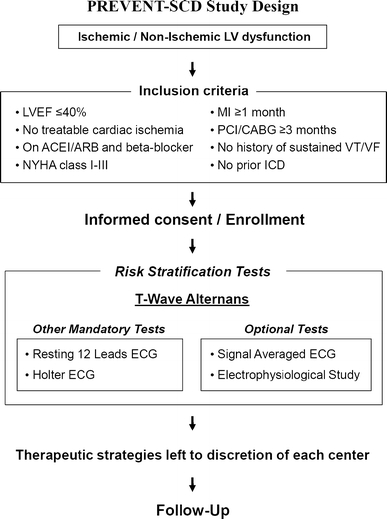
This was a multicenter, prospective observational study of patients with LV ejection fraction ≤40% due to ischemic or non-ischemic cardiomyopathies, designed to evaluate the prognostic value of TWA for lethal ventricular tachyarrhythmia. The primary end point was a composite of sudden cardiac death, sustained rapid ventricular tachycardia (VT) or ventricular fibrillation (VF), and appropriate defibrillator therapy for rapid VT or VF.
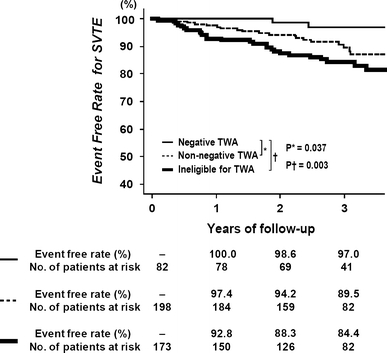
Among 453 patients enrolled in the study, 280 (62%) were eligible for the TWA test. TWA was negative in 82 patients (29%), who accounted for 18% of the total population. The median of follow-up was 36 months. The 3-year event-free rate for the primary end point was significantly higher in TWA-negative patients (97.0%) than in TWA non-negative patients (89.5%, P = 0.037) and those ineligible for the TWA test (84.4%, P = 0.003). Multivariable analysis identified both non-negative TWA [hazard ratio (HR) 4.43; 95% confidence interval (CI) 1.02-19.2; P = 0.047) and ineligibility for the TWA test (HR 6.89; 95% CI 1.59-29.9; P = 0.010) to be independent predictors of the primary end point.
TWA showed high negative predictive ability for lethal ventricular tachyarrhythmia in patients with LV dysfunction, although the TWA-negative patients accounted for only 18% of the entire population. Those ineligible for the TWA test had the highest risk for lethal ventricular tachyarrhythmia.
T 波电交替(TWA)对左心室(LV)功能障碍患者致命性室性心律失常的预测价值存在争议。此外,不适合 TWA 测试的患者的长期心律失常风险尚不清楚。
这是一项多中心、前瞻性观察研究,纳入了因缺血性或非缺血性心肌病导致 LV 射血分数≤40%的患者,旨在评估 TWA 对致命性室性心律失常的预后价值。主要终点是心脏性猝死、持续性快速室性心动过速(VT)或心室颤动(VF)以及快速 VT 或 VF 适当的除颤治疗的复合终点。
在纳入的 453 例患者中,280 例(62%)适合进行 TWA 测试。82 例(29%)TWA 阴性患者占总人群的 18%。中位随访时间为 36 个月。主要终点的 3 年无事件生存率在 TWA 阴性患者(97.0%)显著高于 TWA 非阴性患者(89.5%,P=0.037)和不适合 TWA 测试的患者(84.4%,P=0.003)。多变量分析确定了非阴性 TWA[风险比(HR)4.43;95%置信区间(CI)1.02-19.2;P=0.047]和不适合 TWA 测试(HR 6.89;95% CI 1.59-29.9;P=0.010)是主要终点的独立预测因素。
TWA 对 LV 功能障碍患者致命性室性心律失常具有较高的阴性预测能力,尽管 TWA 阴性患者仅占总人群的 18%。不适合 TWA 测试的患者发生致命性室性心律失常的风险最高。