Center of Integrative Medicine, Professorship Quality of Life, Spirituality and Coping, University of Witten/Herdecke, Gerhard-Kienle-Weg 4, 58313 Herdecke, Germany.
Health Qual Life Outcomes. 2011 Sep 30;9:85. doi: 10.1186/1477-7525-9-85.
Cancer Related Fatigue (CRF) and circadian rhythm have a great impact on the quality of life (HRQL) of patients with breast (BC) and colon cancer (CRC). Other patient related outcomes in oncology are measured by new instruments focusing on adaptive characteristics such as sense of coherence or self-regulation, which could be more appropriate as a prognostic tool than classical HRQL. The aim of this study was to assess the association of autonomic regulation (aR) and self-regulation (SR) with survival.
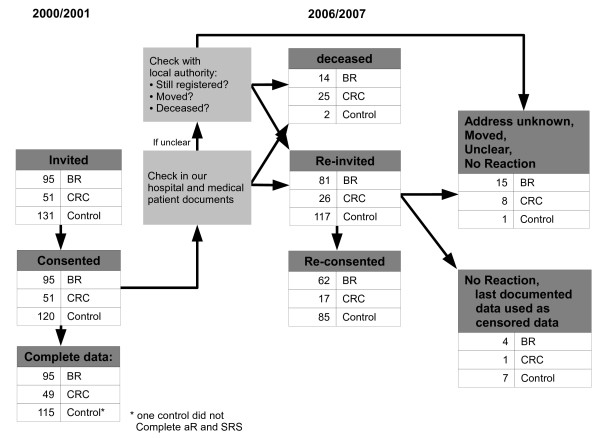
146 cancer patients and 120 healthy controls took part in an initial evaluation in 2000/2001. At a median follow up of 5.9 years later, 62 of 95 BC, 17 of 51 CRC patients, and 85 of 117 healthy controls took part in the follow-up study. 41 participants had died. For the follow-up evaluation, participants were requested to complete the standardized aR and SR questionnaires.
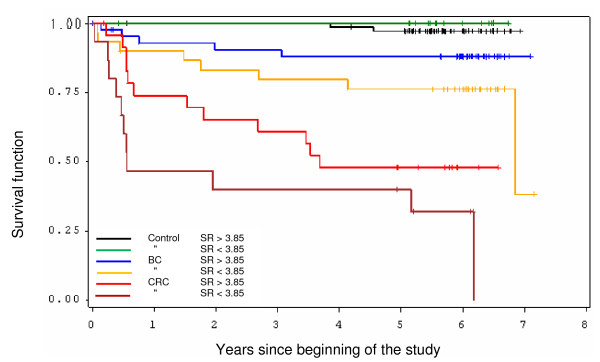
On average, cancer patients had survived for 10.1 years with the disease. Using a Cox proportional hazard regression with stepwise variables such as age, diagnosis group, Charlson co-morbidity index, body mass index (BMI)) aR and SR. SR were identified as independent parameters with potential prognostic relevance on survival While aR did not significantly influence survival, SR showed a positive and independent impact on survival (OR = 0.589; 95%-CI: 0.354 - 0.979). This positive effect persisted significantly in the sensitivity analysis of the subgroup of tumour patients and in the subscale 'Achieve satisfaction and well-being' and by tendency in the UICC stages nested for the different diagnoses groups.
Self-regulation might be an independent prognostic factor for the survival of breast and colon carcinoma patients and merits further prospective studies.
癌症相关疲劳(CRF)和昼夜节律对乳腺癌(BC)和结肠癌(CRC)患者的生活质量(HRQL)有很大影响。肿瘤学中的其他患者相关结果由新的侧重于适应性特征的仪器来衡量,如连贯性或自我调节感,这些特征可能比传统的 HRQL 更适合作为预后工具。本研究的目的是评估自主调节(aR)和自我调节(SR)与生存的相关性。
146 名癌症患者和 120 名健康对照者于 2000/2001 年参加了初步评估。在中位随访 5.9 年后,95 名 BC 中的 62 名、51 名 CRC 中的 17 名和 117 名健康对照者中的 85 名参加了随访研究。41 名参与者死亡。在随访评估中,要求参与者完成标准化的 aR 和 SR 问卷。
平均而言,癌症患者的疾病存活期为 10.1 年。使用 Cox 比例风险回归,逐步变量包括年龄、诊断组、Charlson 合并症指数、体重指数(BMI),aR 和 SR。SR 被确定为具有潜在预后相关性的独立参数。虽然 aR 对生存没有显著影响,但 SR 对生存有积极的独立影响(OR = 0.589;95%CI:0.354 - 0.979)。在肿瘤患者亚组的敏感性分析中,以及在亚量表“实现满足和幸福感”中,这种积极影响仍然显著,并且在不同诊断组嵌套的 UICC 分期中也存在趋势。
自我调节可能是乳腺癌和结肠癌患者生存的独立预后因素,值得进一步进行前瞻性研究。