Center for Microbial Genetics and Genomics, Northern Arizona University, Flagstaff, AZ 86011, USA.
BMC Genomics. 2011 Sep 30;12:477. doi: 10.1186/1471-2164-12-477.
An isolate originally labeled Bacillus megaterium CDC 684 was found to contain both pXO1 and pXO2, was non-hemolytic, sensitive to gamma-phage, and produced both the protective antigen and the poly-D-glutamic acid capsule. These phenotypes prompted Ezzell et al., (J. Clin. Microbiol. 28:223) to reclassify this isolate to Bacillus anthracis in 1990.
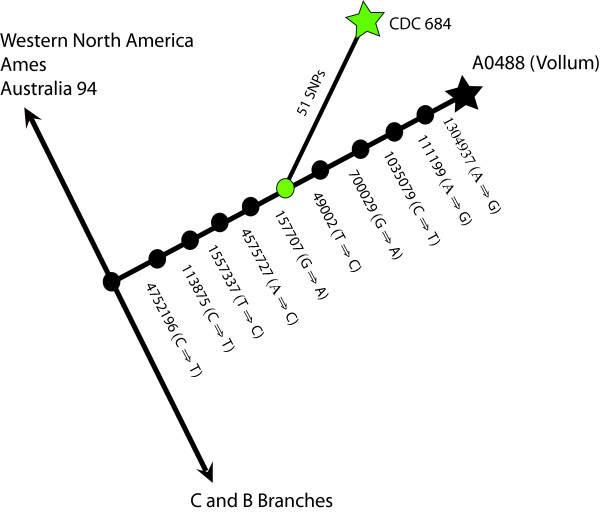
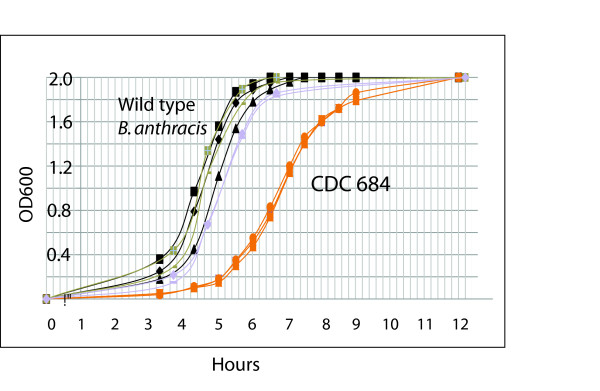
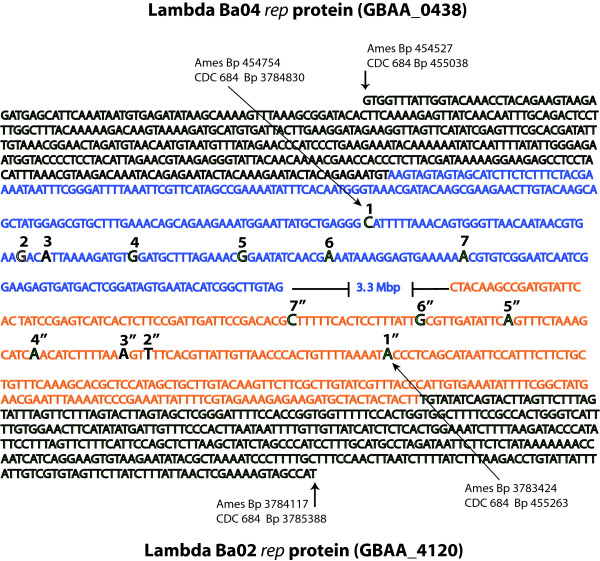
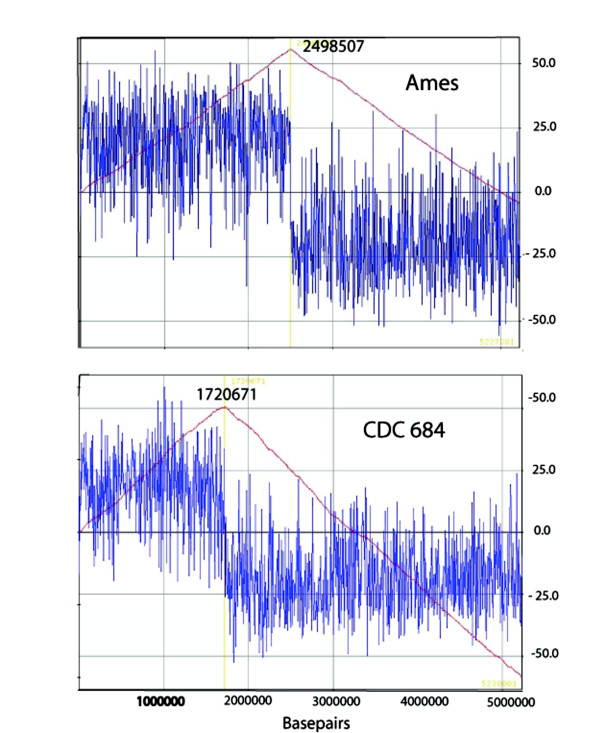
We demonstrate that despite these B. anthracis features, the isolate is severely attenuated in a guinea pig model. This prompted whole genome sequencing and closure. The comparative analysis of CDC 684 to other sequenced B. anthracis isolates and further analysis reveals: a) CDC 684 is a close relative of a virulent strain, Vollum A0488; b) CDC 684 defines a new B. anthracis lineage (at least 51 SNPs) that includes 15 other isolates; c) the genome of CDC 684 contains a large chromosomal inversion that spans 3.3 Mbp; d) this inversion has caused a displacement of the usual spatial orientation of the origin of replication (ori) to the termination of replication (ter) from 180° in wild-type B. anthracis to 120° in CDC 684 and e) this isolate also has altered growth kinetics in liquid media.
We propose two alternative hypotheses explaining the attenuated phenotype of this isolate. Hypothesis 1 suggests that the skewed ori/ter relationship in CDC 684 has altered its DNA replication and/or transcriptome processes resulting in altered growth kinetics and virulence capacity. Hypothesis 2 suggests that one or more of the single nucleotide polymorphisms in CDC 684 has altered the expression of a regulatory element or other genes necessary for virulence.
最初被标记为巨大芽孢杆菌 CDC684 的分离株被发现同时含有 pXO1 和 pXO2,不具有溶血活性,对 γ-噬菌体敏感,并产生保护性抗原和多聚-D-谷氨酸胶囊。这些表型促使 Ezzell 等人(J. Clin. Microbiol. 28:223)于 1990 年将该分离株重新分类为炭疽芽孢杆菌。
我们证明,尽管具有这些炭疽芽孢杆菌特征,但该分离株在豚鼠模型中严重减毒。这促使进行全基因组测序和关闭。对 CDC684 与其他已测序炭疽芽孢杆菌分离株的比较分析以及进一步分析表明:a)CDC684 是一种剧毒菌株 Vollum A0488 的近亲;b)CDC684 定义了一个新的炭疽芽孢杆菌谱系(至少 51 个 SNP),其中包括 15 个其他分离株;c)CDC684 的基因组包含一个大的染色体倒位,跨越 3.3 Mbp;d)该倒位导致复制起点(ori)与复制终点(ter)的通常空间取向从野生型炭疽芽孢杆菌的 180°位移到 CDC684 的 120°;e)该分离株在液体培养基中的生长动力学也发生了改变。
我们提出了两种解释该分离株减毒表型的替代假设。假设 1 表明,CDC684 中偏斜的 ori/ter 关系改变了其 DNA 复制和/或转录过程,导致生长动力学和毒力能力改变。假设 2 表明,CDC684 中的一个或多个单核苷酸多态性改变了调节元件或其他毒力必需基因的表达。