• 文献检索
  • 文档翻译
  • 深度研究
  • 学术资讯
  • Suppr Zotero 插件Zotero 插件
  • 邀请有礼
  • 套餐&价格
  • 历史记录
应用&插件
Suppr Zotero 插件Zotero 插件浏览器插件Mac 客户端Windows 客户端微信小程序
定价
高级版会员购买积分包购买API积分包
服务
文献检索文档翻译深度研究API 文档MCP 服务
关于我们
关于 Suppr公司介绍联系我们用户协议隐私条款
关注我们

Suppr 超能文献

核心技术专利:CN118964589B侵权必究
粤ICP备2023148730 号-1Suppr @ 2026

文献检索

告别复杂PubMed语法,用中文像聊天一样搜索,搜遍4000万医学文献。AI智能推荐,让科研检索更轻松。

立即免费搜索

文件翻译

保留排版,准确专业,支持PDF/Word/PPT等文件格式,支持 12+语言互译。

免费翻译文档

深度研究

AI帮你快速写综述,25分钟生成高质量综述,智能提取关键信息,辅助科研写作。

立即免费体验

早产儿家庭氧疗的临床预测因素和机构差异。

Clinical predictors and institutional variation in home oxygen use in preterm infants.

机构信息

Medical College of Wisconsin, Milwaukee, WI 53204, USA.

出版信息

J Pediatr. 2012 Feb;160(2):232-8. doi: 10.1016/j.jpeds.2011.08.033. Epub 2011 Sep 29.

DOI:10.1016/j.jpeds.2011.08.033
PMID:21962601
原文链接:https://pmc.ncbi.nlm.nih.gov/articles/PMC4432910/
Abstract

OBJECTIVE

To assess home oxygen use in preterm infants, identify risk factors predicting home oxygen use, and quantify the extent of institutional variation in home oxygen use across neonatal intensive care units.

STUDY DESIGN

We conducted a retrospective cohort analysis of surviving infants of 23- to 31-week gestational age discharged home in 2009, with de-identified electronic medical record information from the Pediatrix Clinical Data Warehouse. Mixed-effects logistic regression quantified clinical risk factors and institutional variation affecting home oxygen use.

RESULTS

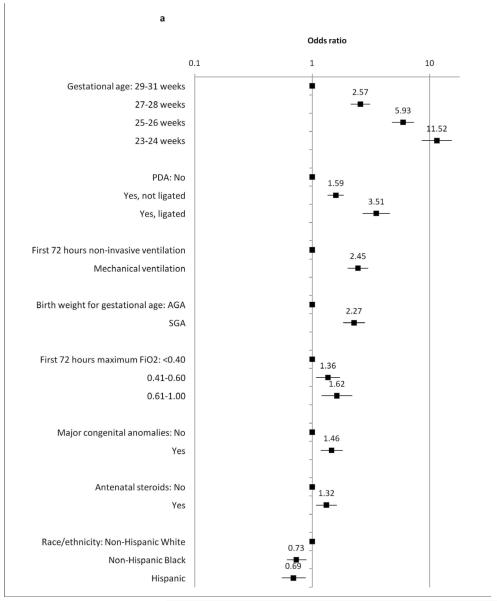
A total of 8167 infants were identified. Home oxygen use varied by gestational age, from 59% of infants 23 to 24 weeks gestational age to 7% of infants 29 to 31 weeks gestational age. Other risk factors included small for gestational age, congenital anomalies, mechanical ventilation in the first 72 hours, fraction of inhaled oxygen >0.4 in the first 72 hours, and patent ductus arteriosus. After adjusting for clinical risk factors, there was still a 4- to 5-fold difference in institutions' odds of home oxygen use.

CONCLUSIONS

Home oxygen use was common in infants of earlier gestational ages and infants with more severe respiratory illness. Institutional variation accounted for 4- to 5-fold variation in home oxygen use. Families should be counseled about the likelihood of home oxygen use, and prospective research must identify optimal treatment strategies for high-risk infants.

摘要

目的

评估早产儿家庭吸氧情况,确定预测家庭吸氧的风险因素,并量化各新生儿重症监护病房(NICU)家庭吸氧的机构间差异程度。

研究设计

我们对 2009 年出院回家的 23 至 31 周龄存活婴儿进行了回顾性队列分析,Pediatrix 临床数据仓库提供了去标识化的电子病历信息。混合效应逻辑回归量化了影响家庭吸氧的临床风险因素和机构间差异。

结果

共确定了 8167 名婴儿。家庭吸氧情况因胎龄而异,23 至 24 周胎龄的婴儿中 59%需要吸氧,29 至 31 周胎龄的婴儿中仅 7%需要吸氧。其他风险因素包括小于胎龄儿、先天畸形、出生后前 72 小时内使用机械通气、前 72 小时内吸入氧分数>0.4 以及动脉导管未闭。在调整了临床风险因素后,各机构家庭吸氧的几率仍存在 4 至 5 倍的差异。

结论

胎龄较早和患有更严重呼吸系统疾病的婴儿更常需要家庭吸氧。机构间差异导致家庭吸氧的几率存在 4 至 5 倍的差异。应向家庭提供关于家庭吸氧可能性的咨询,前瞻性研究必须确定高危婴儿的最佳治疗策略。
https://cdn.ncbi.nlm.nih.gov/pmc/blobs/ea59/4432910/e0ab70116df0/nihms-684915-f0003.jpg
https://cdn.ncbi.nlm.nih.gov/pmc/blobs/ea59/4432910/2fc8f734b9fd/nihms-684915-f0001.jpg
https://cdn.ncbi.nlm.nih.gov/pmc/blobs/ea59/4432910/e0ab70116df0/nihms-684915-f0003.jpg
https://cdn.ncbi.nlm.nih.gov/pmc/blobs/ea59/4432910/2fc8f734b9fd/nihms-684915-f0001.jpg
https://cdn.ncbi.nlm.nih.gov/pmc/blobs/ea59/4432910/e0ab70116df0/nihms-684915-f0003.jpg

相似文献

1
Clinical predictors and institutional variation in home oxygen use in preterm infants.早产儿家庭氧疗的临床预测因素和机构差异。
J Pediatr. 2012 Feb;160(2):232-8. doi: 10.1016/j.jpeds.2011.08.033. Epub 2011 Sep 29.
2
Home Oxygen Use and 1-Year Readmission among Infants Born Preterm with Bronchopulmonary Dysplasia Discharged from Children's Hospital Neonatal Intensive Care Units.早产儿支气管肺发育不良患儿出院后家庭氧疗使用与 1 年再入院的关系
J Pediatr. 2020 May;220:40-48.e5. doi: 10.1016/j.jpeds.2020.01.018. Epub 2020 Feb 21.
3
Retinopathy of prematurity: a study of prevalence and risk factors.早产儿视网膜病变:患病率及危险因素研究
Middle East Afr J Ophthalmol. 2012 Jul-Sep;19(3):289-94. doi: 10.4103/0974-9233.97927.
4
Home oxygen therapy after preterm birth in Western Australia.西澳大利亚州早产之后的家庭氧疗
J Paediatr Child Health. 2004 Sep-Oct;40(9-10):519-23. doi: 10.1111/j.1440-1754.2004.00455.x.
5
Aerosol therapy in relation to retinopathy of prematurity in mechanically ventilated preterm infants.机械通气早产儿中与早产儿视网膜病变相关的雾化治疗。
BMC Pulm Med. 2019 Aug 13;19(1):145. doi: 10.1186/s12890-019-0912-9.
6
Predicting the Need for Home Oxygen Therapy in Preterm Infants Born Before 28 Weeks' Gestation.预测孕周小于28周的早产儿家庭氧疗需求
Am J Perinatol. 2016 Jan;33(1):34-9. doi: 10.1055/s-0035-1555122. Epub 2015 Jun 17.
7
Neonatal assisted ventilation: predictors, frequency, and duration in a mature managed care organization.新生儿辅助通气:成熟管理式医疗组织中的预测因素、频率及持续时间
Pediatrics. 2000 Apr;105(4 Pt 1):822-30. doi: 10.1542/peds.105.4.822.
8
[Failure of non-invasive continuous positive airway pressure as the initial respiratory support in very preterm infants: a multicenter prospective cohort study].[无创持续气道正压通气作为极早产儿初始呼吸支持的失败:一项多中心前瞻性队列研究]
Zhonghua Er Ke Za Zhi. 2021 Apr 2;59(4):273-279. doi: 10.3760/cma.j.cn112140-20201117-01034.
9
Rehospitalization for respiratory syncytial virus among premature infants.早产儿呼吸道合胞病毒再入院情况
Pediatrics. 1999 Oct;104(4 Pt 1):894-9. doi: 10.1542/peds.104.4.894.
10
Multicenter controlled clinical trial of high-frequency jet ventilation in preterm infants with uncomplicated respiratory distress syndrome.高频喷射通气治疗单纯性呼吸窘迫综合征早产儿的多中心对照临床试验
Pediatrics. 1997 Oct;100(4):593-9. doi: 10.1542/peds.100.4.593.

引用本文的文献

1
Factors of late respiratory support or oxygen weaning in infants with bronchopulmonary dysplasia.支气管肺发育不良婴儿晚期呼吸支持或氧疗撤机的相关因素。
Pediatr Pulmonol. 2025 Jan;60(1):e27367. doi: 10.1002/ppul.27367. Epub 2024 Oct 25.
2
Trends in the Incidence of Bronchopulmonary Dysplasia after the Introduction of Neurally Adjusted Ventilatory Assist (NAVA).神经调节通气辅助(NAVA)应用后支气管肺发育不良的发病率趋势
Children (Basel). 2024 Jan 17;11(1):113. doi: 10.3390/children11010113.
3
Outpatient respiratory outcomes in children with BPD on supplemental oxygen.

本文引用的文献

1
Prediction of bronchopulmonary dysplasia by postnatal age in extremely premature infants.预测极早产儿支气管肺发育不良的出生后年龄。
Am J Respir Crit Care Med. 2011 Jun 15;183(12):1715-22. doi: 10.1164/rccm.201101-0055OC. Epub 2011 Mar 4.
2
Intercenter differences in bronchopulmonary dysplasia or death among very low birth weight infants.极低出生体重儿支气管肺发育不良或死亡的中心间差异。
Pediatrics. 2011 Jan;127(1):e106-16. doi: 10.1542/peds.2010-0648. Epub 2010 Dec 13.
3
Neonatal outcomes of extremely preterm infants from the NICHD Neonatal Research Network.
儿童支气管肺发育不良患者在补充吸氧下的门诊呼吸系统转归。
Pediatr Pulmonol. 2023 May;58(5):1535-1541. doi: 10.1002/ppul.26356. Epub 2023 Feb 24.
4
Characteristics of home oxygen therapy for preterm infants with bronchopulmonary dysplasia in China: results of a multicenter cohort study.中国支气管肺发育不良早产儿家庭氧疗的特点:多中心队列研究的结果。
World J Pediatr. 2023 Jun;19(6):557-567. doi: 10.1007/s12519-022-00591-9. Epub 2022 Aug 11.
5
The association between pulmonary vascular disease and respiratory improvement in infants with type I severe bronchopulmonary dysplasia.I型重度支气管肺发育不良婴儿的肺血管疾病与呼吸改善之间的关联。
J Perinatol. 2022 Jun;42(6):788-795. doi: 10.1038/s41372-022-01386-6. Epub 2022 Apr 9.
6
Impact of the definition of bronchopulmonary dysplasia on neurodevelopmental outcomes.支气管肺发育不良的定义对神经发育结局的影响。
Sci Rep. 2021 Nov 19;11(1):22589. doi: 10.1038/s41598-021-01219-0.
7
Health Care and Societal Costs of Bronchopulmonary Dysplasia.支气管肺发育不良的医疗保健及社会成本
Neoreviews. 2018 Apr;19(4):e211-e223. doi: 10.1542/neo.19-4-e211.
8
Using a home oxygen weaning protocol and pCO to evaluate outcomes for infants with bronchopulmonary dysplasia discharged on home oxygen.使用家庭氧疗脱机方案和 pCO 评估支气管肺发育不良患儿出院后家庭氧疗的结局。
Pediatr Pulmonol. 2020 Dec;55(12):3293-3303. doi: 10.1002/ppul.25057. Epub 2020 Sep 15.
9
Home Oxygen Use and 1-Year Readmission among Infants Born Preterm with Bronchopulmonary Dysplasia Discharged from Children's Hospital Neonatal Intensive Care Units.早产儿支气管肺发育不良患儿出院后家庭氧疗使用与 1 年再入院的关系
J Pediatr. 2020 May;220:40-48.e5. doi: 10.1016/j.jpeds.2020.01.018. Epub 2020 Feb 21.
10
Bronchopulmonary Dysplasia: When the Very Preterm Baby Comes Home.支气管肺发育不良:极早产儿回家时的情况
Mo Med. 2019 Mar-Apr;116(2):117-122.
美国国立卫生研究院新生儿研究网络中极早产儿的新生儿结局。
Pediatrics. 2010 Sep;126(3):443-56. doi: 10.1542/peds.2009-2959. Epub 2010 Aug 23.
4
Target ranges of oxygen saturation in extremely preterm infants.极低出生体重儿氧饱和度目标范围。
N Engl J Med. 2010 May 27;362(21):1959-69. doi: 10.1056/NEJMoa0911781. Epub 2010 May 16.
5
Special health care needs of infants born at the limits of viability.极早产儿的特殊医疗需求。
Pediatrics. 2010 Jun;125(6):1152-8. doi: 10.1542/peds.2009-1922. Epub 2010 May 3.
6
The Pediatrix BabySteps Data Warehouse and the Pediatrix QualitySteps improvement project system--tools for "meaningful use" in continuous quality improvement.Pediatrix BabySteps 数据仓库和 Pediatrix QualitySteps 改善项目系统——持续质量改进中“有意义使用”的工具。
Clin Perinatol. 2010 Mar;37(1):49-70. doi: 10.1016/j.clp.2010.01.016.
7
Predicting time to hospital discharge for extremely preterm infants.预测极早产儿的住院时间。
Pediatrics. 2010 Jan;125(1):e146-54. doi: 10.1542/peds.2009-0810. Epub 2009 Dec 14.
8
Are outcomes and care processes for preterm neonates influenced by health insurance status?早产新生儿的治疗结果和护理过程会受到健康保险状况的影响吗?
Pediatrics. 2009 Jul;124(1):122-7. doi: 10.1542/peds.2008-1318.
9
Hospital discharge of the high-risk neonate.高危新生儿的出院
Pediatrics. 2008 Nov;122(5):1119-26. doi: 10.1542/peds.2008-2174.
10
Pediatric care for preterm infants after NICU discharge: high number of office visits and prescription medications.新生儿重症监护病房(NICU)出院后早产儿的儿科护理:门诊就诊次数和处方药数量较多。
J Perinatol. 2008 Oct;28(10):696-701. doi: 10.1038/jp.2008.74. Epub 2008 Jul 3.