USDA, ARS, Western Human Nutrition Research Center, Davis, CA 95616, USA.
Nutr Metab (Lond). 2011 Oct 5;8:67. doi: 10.1186/1743-7075-8-67.
Insufficient calcium intake has been proposed to cause unbalanced energy partitioning leading to obesity. However, weight loss interventions including dietary calcium or dairy product consumption have not reported changes in lipid metabolism measured by the plasma lipidome.
The objective of this study was to determine the relationships between dairy product or supplemental calcium intake with changes in the plasma lipidome and body composition during energy restriction. A secondary objective of this study was to explore the relationships among calculated macronutrient composition of the energy restricted diet to changes in the plasma lipidome, and body composition during energy restriction. Overweight adults (n = 61) were randomized into one of three intervention groups including a deficit of 500kcal/d: 1) placebo; 2) 900 mg/d calcium supplement; and 3) 3-4 servings of dairy products/d plus a placebo supplement. Plasma fatty acid methyl esters of cholesterol ester, diacylglycerol, free fatty acids, lysophosphatidylcholine, phosphatidylcholine, phosphatidylethanolamine and triacylglycerol were quantified by capillary gas chromatography.
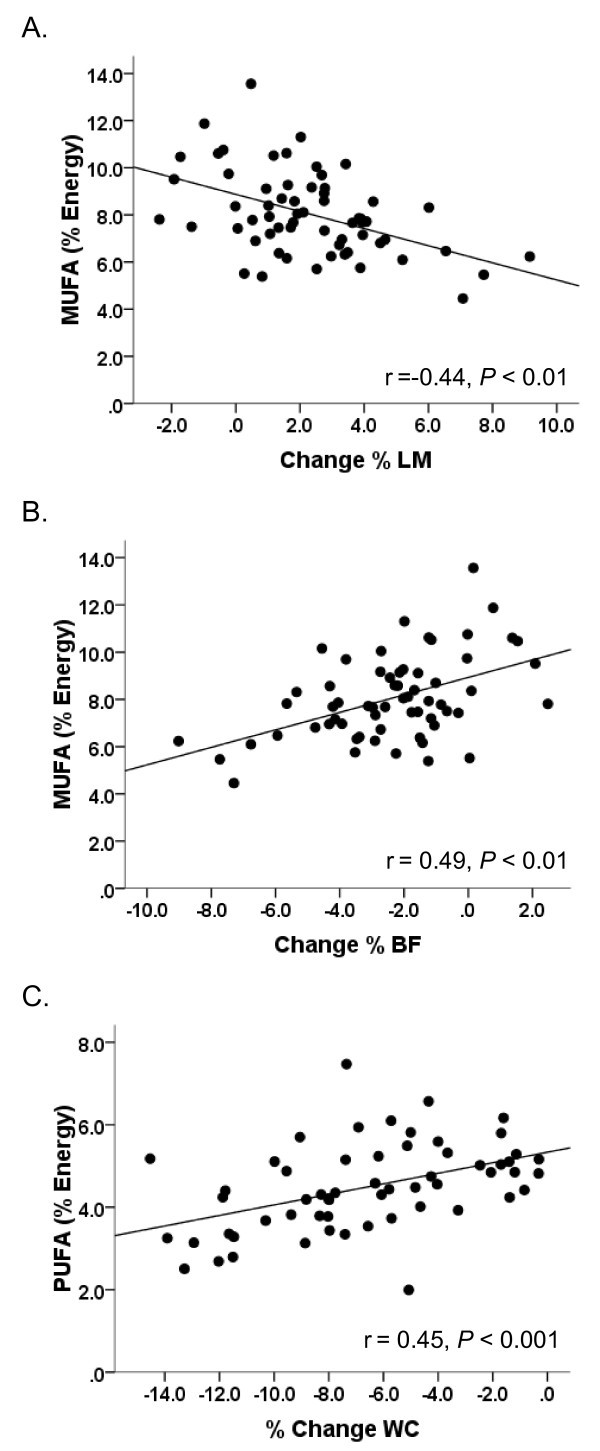
After adjustments for energy and protein (g/d) intake, there was no significant effect of treatment on changes in weight, waist circumference or body composition. Plasma lipidome did not differ among dietary treatment groups. Stepwise regression identified correlations between reported intake of monounsaturated fat (% of energy) and changes in % lean mass (r = -0.44, P < 0.01) and % body fat (r = 0.48, P < 0.001). Polyunsaturated fat intake was associated with the % change in waist circumference (r = 0.44, P < 0.01). Dietary saturated fat was not associated with any changes in anthropometrics or the plasma lipidome.
Dairy product consumption or calcium supplementation during energy restriction over the course of 12 weeks did not affect plasma lipids. Independent of calcium and dairy product consumption, short-term energy restriction altered body composition. Reported dietary fat composition of energy restricted diets was associated with the degree of change in body composition in these overweight and obese individuals.
本研究旨在确定在能量限制期间,乳制品或补充钙的摄入量与血浆脂质组和身体成分变化之间的关系。本研究的次要目的是探索能量限制饮食中计算出的宏量营养素组成与血浆脂质组和身体成分变化之间的关系。
超重成年人(n=61)随机分为三组干预组之一,每天热量摄入减少 500kcal:1)安慰剂;2)900mg/d 钙补充剂;3)3-4 份乳制品/d 加安慰剂补充剂。通过毛细管气相色谱法定量测定胆固醇酯、二酰甘油、游离脂肪酸、溶血磷脂酰胆碱、磷脂酰胆碱、磷脂酰乙醇胺和三酰甘油的血浆脂肪酸甲酯。
调整能量和蛋白质(g/d)摄入量后,治疗对体重、腰围或身体成分的变化没有显著影响。血浆脂质组在不同饮食治疗组之间没有差异。逐步回归分析确定了报告的单不饱和脂肪摄入量(占能量的百分比)与瘦体重百分比变化之间的相关性(r=-0.44,P<0.01)和体脂肪百分比变化(r=0.48,P<0.001)。多不饱和脂肪摄入量与腰围变化百分比(r=0.44,P<0.01)相关。饮食饱和脂肪与人体测量学或血浆脂质组的任何变化均无关。
在能量限制期间,摄入乳制品或钙补充剂并不会影响血浆脂质。独立于钙和乳制品的摄入,短期能量限制会改变身体成分。能量限制饮食中报告的脂肪组成与这些超重和肥胖个体的身体成分变化程度相关。