Faculty of Veterinary Medicine, Utrecht University, Utrecht, The Netherlands.
PLoS One. 2011;6(9):e24006. doi: 10.1371/journal.pone.0024006. Epub 2011 Sep 30.
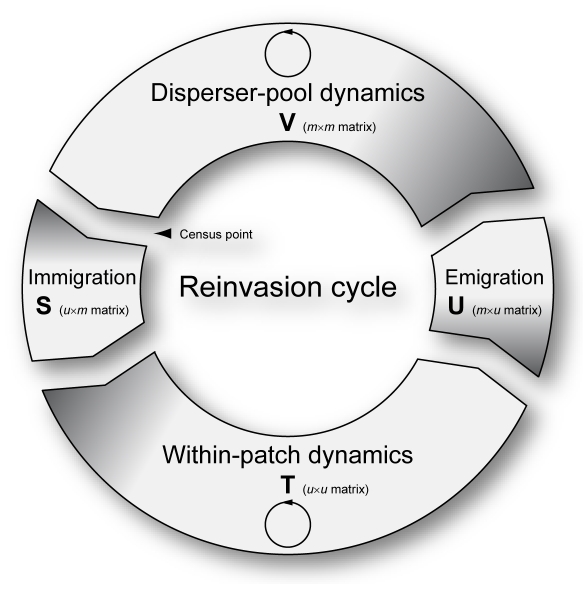
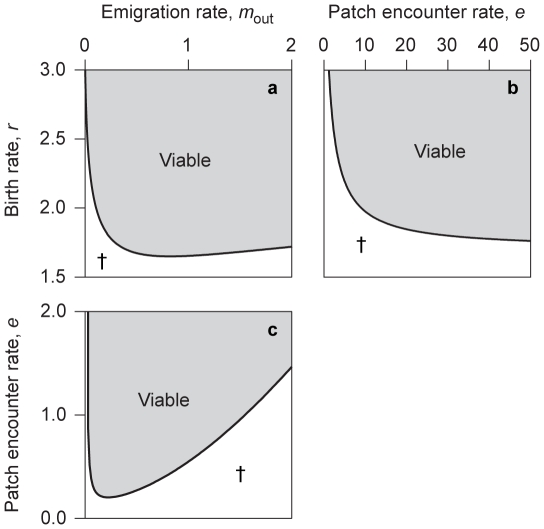
One of the important questions in understanding infectious diseases and their prevention and control is how infectious agents can invade and become endemic in a host population. A ubiquitous feature of natural populations is that they are spatially fragmented, resulting in relatively homogeneous local populations inhabiting patches connected by the migration of hosts. Such fragmented population structures are studied extensively with metapopulation models. Being able to define and calculate an indicator for the success of invasion and persistence of an infectious agent is essential for obtaining general qualitative insights into infection dynamics, for the comparison of prevention and control scenarios, and for quantitative insights into specific systems. For homogeneous populations, the basic reproduction ratio R(0) plays this role. For metapopulations, defining such an 'invasion indicator' is not straightforward. Some indicators have been defined for specific situations, e.g., the household reproduction number R*. However, these existing indicators often fail to account for host demography and especially host migration. Here we show how to calculate a more broadly applicable indicator R(m) for the invasion and persistence of infectious agents in a host metapopulation of equally connected patches, for a wide range of possible epidemiological models. A strong feature of our method is that it explicitly accounts for host demography and host migration. Using a simple compartmental system as an example, we illustrate how R(m) can be calculated and expressed in terms of the key determinants of epidemiological dynamics.
在理解传染病及其预防和控制的过程中,一个重要的问题是感染因子如何侵入并在宿主群体中流行。自然种群的一个普遍特征是它们在空间上是碎片化的,导致相对同质的局部种群栖息在由宿主迁移连接的斑块中。这种碎片化的种群结构通过集合种群模型进行了广泛的研究。能够定义和计算感染因子入侵和持续存在的指标,对于获得对感染动力学的一般定性见解、比较预防和控制方案以及对特定系统进行定量分析都是至关重要的。对于同质种群,基本繁殖比 R(0) 起作用。对于集合种群,定义这样的“入侵指标”并不简单。已经为特定情况定义了一些指标,例如家庭繁殖数 R*。然而,这些现有的指标往往没有考虑到宿主的人口统计学特征,特别是宿主的迁移。在这里,我们展示了如何计算一个更广泛适用的指标 R(m),用于在同样连接的斑块的宿主集合种群中感染因子的入侵和持续存在,适用于广泛的可能的流行病学模型。我们方法的一个显著特点是它明确考虑了宿主的人口统计学和宿主的迁移。我们使用一个简单的隔间系统作为示例,说明了如何计算 R(m)并根据流行病学动力学的关键决定因素来表示。