Department of Health Statistics, Second Military Medical University, Shanghai, China.
PLoS One. 2011;6(9):e25142. doi: 10.1371/journal.pone.0025142. Epub 2011 Sep 28.
Folic acid is widely used to lower homocysteine concentrations and prevent adverse cardiovascular outcomes. However, the effect of folic acid on cardiovascular events is not clear at the present time. We carried out a comprehensive systematic review and meta-analysis to assess the effects of folic acid supplementation on cardiovascular outcomes.
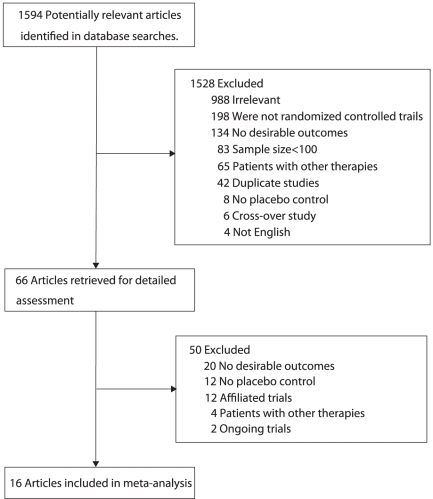
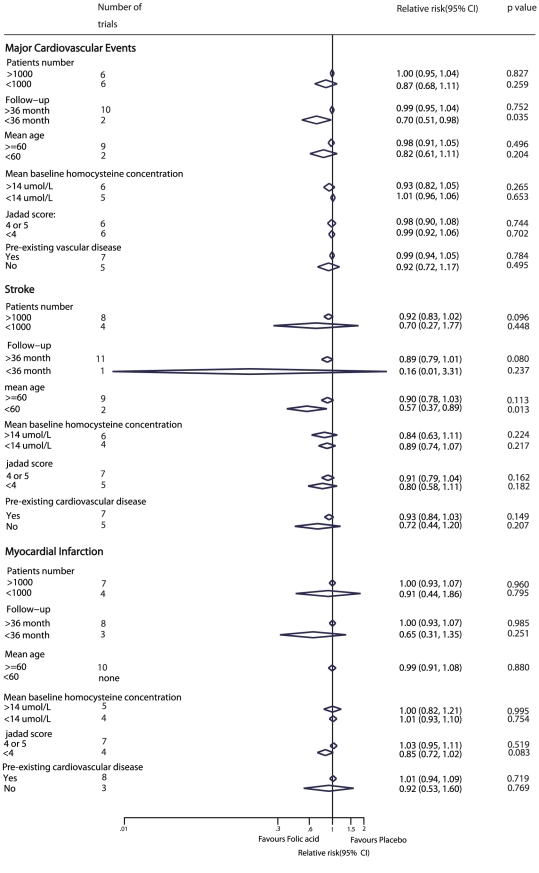
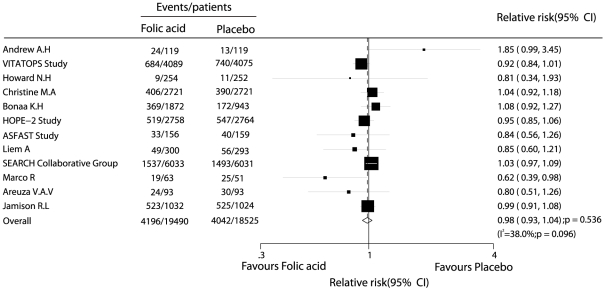
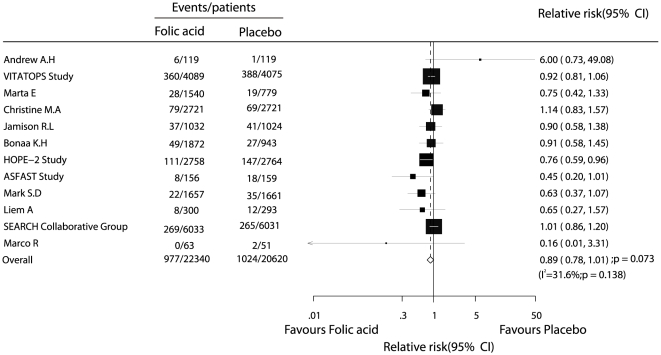
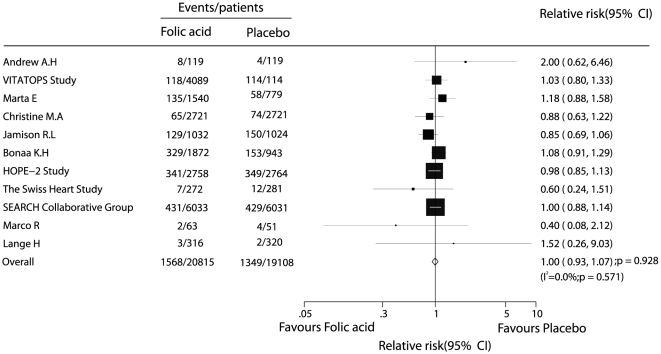
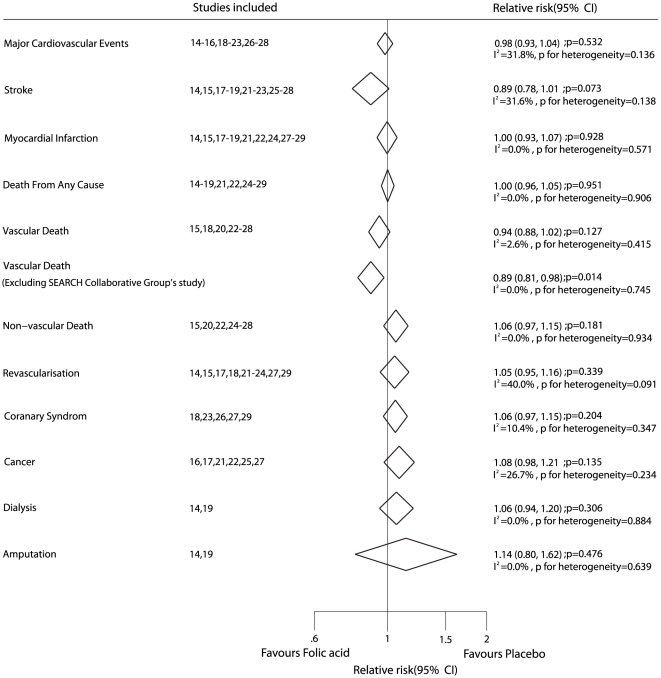
We systematically searched Medline, EmBase, the Cochrane Central Register of Controlled Trials, reference lists of articles, and proceedings of major meetings for relevant literature. We included randomized placebo-controlled trials that reported on the effects of folic acid on cardiovascular events compared to placebo. Of 1594 identified studies, we included 16 trials reporting data on 44841 patients. These studies reported 8238 major cardiovascular events, 2001 strokes, 2917 myocardial infarctions, and 6314 deaths. Folic acid supplementation as compared to placebo had no effect on major cardiovascular events (RR, 0.98; 95% CI, 0.93-1.04), stroke (RR, 0.89; 95% CI,0.78-1.01), myocardial infarction (RR, 1.00; 95% CI, 0.93-1.07), or deaths from any cause (RR, 1.00;95% CI, 0.96-1.05). Moreover, folic acid as compared to placebo also had no effect on the following secondary outcomes: risk of revascularization (RR, 1.05; 95%CI, 0.95-1.16), acute coronary syndrome (RR, 1.06; 95%CI, 0.97-1.15), cancer (RR, 1.08; 95%CI, 0.98-1.21), vascular death (RR, 0.94; 95%CI,0.88-1.02), or non-vascular death (RR, 1.06; 95%CI, 0.97-1.15).
CONCLUSION/SIGNIFICANCE: Folic acid supplementation does not effect on the incidence of major cardiovascular events, stroke, myocardial infarction or all cause mortality.
叶酸被广泛用于降低同型半胱氨酸浓度,预防不良心血管结局。然而,目前尚不清楚叶酸对心血管事件的影响。我们进行了一项全面的系统评价和荟萃分析,以评估叶酸补充剂对心血管结局的影响。
我们系统地检索了 Medline、Embase、Cochrane 对照试验中心注册库、文章参考文献和主要会议记录,以获取相关文献。我们纳入了随机安慰剂对照试验,这些试验报告了与安慰剂相比,叶酸对心血管事件的影响。在 1594 项确定的研究中,我们纳入了 16 项试验,这些试验报告了 44841 名患者的数据。这些研究报告了 8238 例主要心血管事件、2001 例卒中和 2917 例心肌梗死以及 6314 例死亡。与安慰剂相比,叶酸补充剂对主要心血管事件(RR,0.98;95%CI,0.93-1.04)、卒(RR,0.89;95%CI,0.78-1.01)、心肌梗死(RR,1.00;95%CI,0.93-1.07)或任何原因导致的死亡(RR,1.00;95%CI,0.96-1.05)均无影响。此外,与安慰剂相比,叶酸补充剂对以下次要结局也无影响:血运重建风险(RR,1.05;95%CI,0.95-1.16)、急性冠状动脉综合征(RR,1.06;95%CI,0.97-1.15)、癌症(RR,1.08;95%CI,0.98-1.21)、血管死亡(RR,0.94;95%CI,0.88-1.02)或非血管死亡(RR,1.06;95%CI,0.97-1.15)。
结论/意义:叶酸补充剂对主要心血管事件、卒、心肌梗死或全因死亡率的发生率没有影响。