
二甲基硫脲和 N-乙酰半胱氨酸对纳米颗粒诱导的人肺癌细胞 A549 细胞遗传毒性的改善作用。
Ameliorative effects of dimetylthiourea and N-acetylcysteine on nanoparticles induced cyto-genotoxicity in human lung cancer cells-A549.
机构信息
Indian Institute of Toxicology Research, Lucknow, India.
出版信息
PLoS One. 2011;6(9):e25767. doi: 10.1371/journal.pone.0025767. Epub 2011 Sep 29.
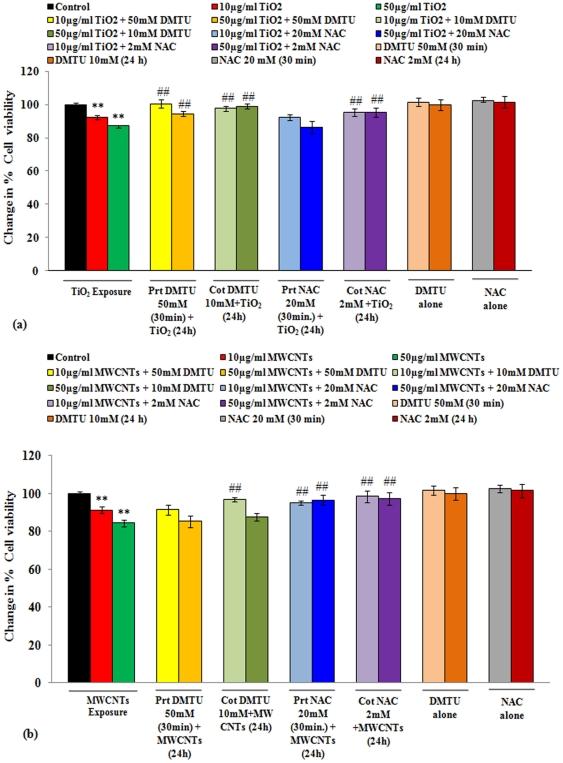
We study the ameliorative potential of dimetylthiourea (DMTU), an OH• radical trapper and N-acetylcysteine (NAC), a glutathione precursor/H₂O₂ scavenger against titanium dioxide nanoparticles (TiO₂-NPs) and multi-walled carbon nanotubes (MWCNTs) induced cyto-genotoxicity in cultured human lung cancer cells-A549. Cytogenotoxicity was induced by exposing the cells to selected concentrations (10 and 50 µg/ml) of either of TiO₂-NPs or MWCNTs for 24 h. Anti-cytogenotoxicity effects of DMTU and NAC were studied in two groups, i.e., treatment of 30 minutes prior to toxic insult (short term exposure), while the other group received DMTU and NAC treatment during nanoparticles exposure, i.e., 24 h (long term exposure). Investigations were carried out for cell viability, generation of reactive oxygen species (ROS), micronuclei (MN), and expression of markers of oxidative stress (HSP27, CYP2E1), genotoxicity (P⁵³) and CYP2E1 dependent n- nitrosodimethylamine-demethylase (NDMA-d) activity. In general, the treatment of both DMTU and NAC was found to be effective significantly against TiO₂-NPs and MWCNTs induced cytogenotoxicity in A549 cells. Long-term treatment of DMTU and NAC during toxic insults has shown better prevention than short-term pretreatment. Although, cells responded significantly to both DMTU and NAC, but responses were chemical specific. In part, TiO₂-NPs induced toxic responses were mediated through OH• radicals generation and reduction in the antioxidant defense system. While in the case of MWCNTs, adverse effects were primarily due to altering/hampering the enzymatic antioxidant system. Data indicate the applicability of human lung cancer cells-A549 as a pre-screening tool to identify the target specific prophylactic and therapeutic potential of drugs candidate molecules against nanoparticles induced cellular damages.
我们研究了二甲基硫脲(DMTU)和 N-乙酰半胱氨酸(NAC)的改善潜力,它们分别是羟自由基捕获剂和谷胱甘肽前体/ H₂O₂清除剂,用于对抗二氧化钛纳米颗粒(TiO₂-NPs)和多壁碳纳米管(MWCNTs)对培养的人肺癌细胞-A549 的细胞遗传毒性。通过将细胞暴露于选定浓度(10 和 50 μg/ml)的 TiO₂-NPs 或 MWCNTs 24 小时来诱导细胞遗传毒性。在两个实验组中研究了 DMTU 和 NAC 的抗细胞遗传毒性作用,即,在毒性攻击前 30 分钟(短期暴露)进行治疗,而另一组在纳米颗粒暴露期间(即 24 小时)接受 DMTU 和 NAC 治疗。研究了细胞活力、活性氧(ROS)的产生、微核(MN)和氧化应激标志物(HSP27、CYP2E1)、遗传毒性(P⁵³)和 CYP2E1 依赖性 N-亚硝二甲胺脱甲基酶(NDMA-d)活性的表达。一般来说,DMTU 和 NAC 的治疗都被发现对 A549 细胞中 TiO₂-NPs 和 MWCNTs 诱导的细胞遗传毒性有显著的抑制作用。在毒性攻击期间进行长期 DMTU 和 NAC 治疗比短期预处理显示出更好的预防效果。尽管细胞对 DMTU 和 NAC 都有明显的反应,但反应是化学特异性的。在一定程度上,TiO₂-NPs 诱导的毒性反应是通过生成 OH•自由基和降低抗氧化防御系统来介导的。而在 MWCNTs 的情况下,不利影响主要是由于改变/干扰了酶抗氧化系统。数据表明,人肺癌细胞-A549 可用作预筛选工具,以鉴定针对纳米颗粒诱导的细胞损伤的药物候选分子的靶向特定预防和治疗潜力。



 Zotero 插件