Department of Population Health Research, Alberta Health Services-Cancer Care, 1331-29 Street NW, Calgary, Alberta, Canada.
Int J Behav Nutr Phys Act. 2011 Oct 10;8:110. doi: 10.1186/1479-5868-8-110.
Knowledge of adult activity patterns across domains of physical activity is essential for the planning of population-based strategies that will increase overall energy expenditure and reduce the risk of obesity and related chronic diseases. We describe domain-specific hours of activity and energy expended among participants in a prospective cohort in Alberta, Canada.
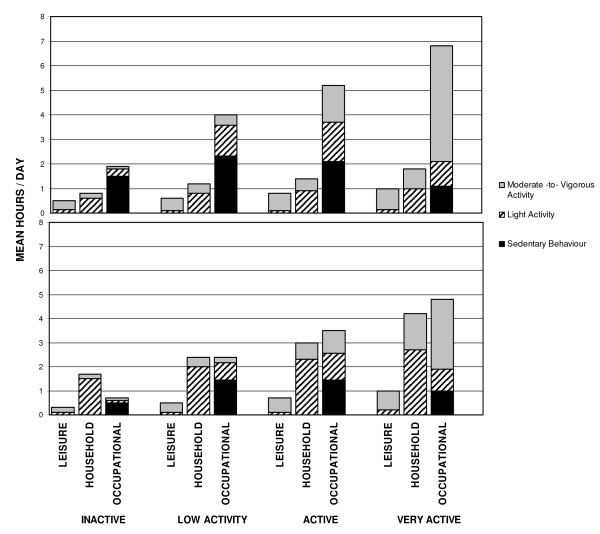
The Past Year Total Physical Activity Questionnaire was completed by 15,591 Tomorrow Project® participants, between 2001 and 2005 detailing physical activity type, duration, frequency and intensity. Domain-specific hours of activity and activity-related energy expenditure, expressed as a percent of total energy expenditure (TEE) (Mean (SD); Median (IQR)) are reported across inactive (<1.4), low active (1.4 to 1.59), active (1.6 to 1.89) and very active (≥ 1.9) Physical Activity Level (PAL = TEE:REE) categories.
In very active women and amongst all men except those classified as inactive, activity-related energy expenditure comprised primarily occupational activity. Amongst inactive men and women in active, low active and inactive groups, activity-related energy expenditure from household activity was comparable to, or exceeded that for occupational activity. Leisure-time activity-related energy expenditure decreased with decreasing PAL categories; however, even amongst the most active men and women it accounted for less than 10 percent of TEE. When stratified by employment status, leisure-time activity-related energy expenditure was greatest for retired men [mean (SD): 10.8 (8.5) percent of TEE], compared with those who were fully employed, employed part-time or not employed. Transportation-related activity was negligible across all categories of PAL and employment status.
For the inactive portion of this population, active non-leisure activities, specifically in the transportation and occupational domains, need to be considered for inclusion in daily routines as a means of increasing population-wide activity levels. Environmental and policy changes to promote active transport and workplace initiatives could increase overall daily energy expenditure through reducing prolonged sitting time.
了解成年人在各体力活动领域的活动模式对于制定基于人群的策略至关重要,这些策略将增加总体能量消耗,降低肥胖和相关慢性疾病的风险。我们描述了加拿大艾伯塔省一个前瞻性队列研究中参与者在特定领域的活动时间和消耗的能量。
在 2001 年至 2005 年间,Tomorrow Project®的 15591 名参与者完成了过去一年的总体力活动问卷,详细记录了体力活动类型、持续时间、频率和强度。报告了各领域的活动时间和与活动相关的能量消耗,以总能量消耗(TEE)的百分比表示(平均值(标准差);中位数(四分位距)),按不活跃(<1.4)、低活跃(1.4 至 1.59)、活跃(1.6 至 1.89)和非常活跃(≥1.9)体力活动水平(PAL = TEE:REE)分类。
在非常活跃的女性和除不活跃组外的所有男性中,与活动相关的能量消耗主要来自职业活动。在不活跃的男性和女性、活跃、低活跃和不活跃组中,来自家务活动的与活动相关的能量消耗与职业活动相当,或者超过职业活动。休闲时间与活动相关的能量消耗随 PAL 分类的降低而降低;然而,即使在最活跃的男性和女性中,它也只占 TEE 的不到 10%。按就业状况分层时,退休男性的休闲时间与活动相关的能量消耗最高[平均(标准差):TEE 的 10.8(8.5)%],与全职、兼职或非就业人员相比。在所有 PAL 和就业状况类别中,交通相关活动都微不足道。
对于该人群的不活跃部分,需要考虑在日常生活中增加积极的非休闲活动,特别是在交通和职业领域,以提高人群的活动水平。为促进积极的交通和工作场所举措而进行的环境和政策改变,可以通过减少长时间久坐来增加日常总能量消耗。