Department of Thoracic Surgery, Peking Union Medical College Hospital, Chinese Academy of Medical Sciences and Peking Union Medical College, Beijing, P. R. China.
Department of Gastric Surgery, Sun Yat-sen University Cancer Center, Guangzhou, Guangdong, P. R. China.
Cancer Commun (Lond). 2023 Nov;43(11):1229-1243. doi: 10.1002/cac2.12488. Epub 2023 Sep 24.
Adopting a healthy lifestyle, including regular physical activity, is widely believed to decrease cancer risk. This study aimed to quantitatively establish the dose-response relationships between total physical activity and the risk of breast, colon, lung, gastric, and liver cancers.
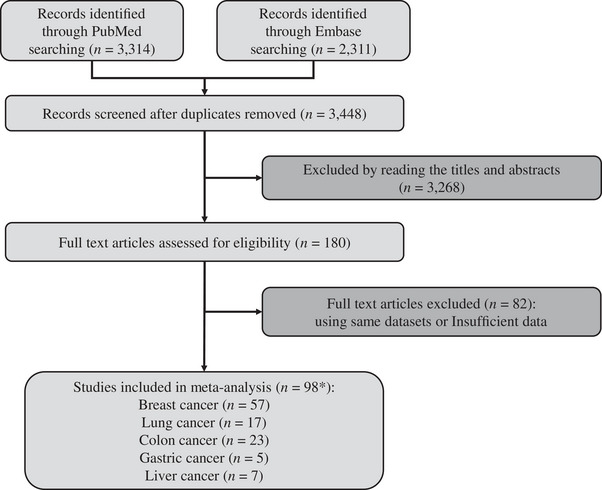
A systematic review and dose-response analysis were conducted using PubMed and Embase from January 1, 1980 to March 20, 2023. Prospective cohort studies that examined the association between physical activity and the risks of any of the 5 outcomes were included. The search was confined to publications in the English language with a specific focus on human studies. Physical activity is standardized by using the data from US National Health and Nutrition Examination Surveys (NHANES) and the Global Burden of Disease 2019 database.
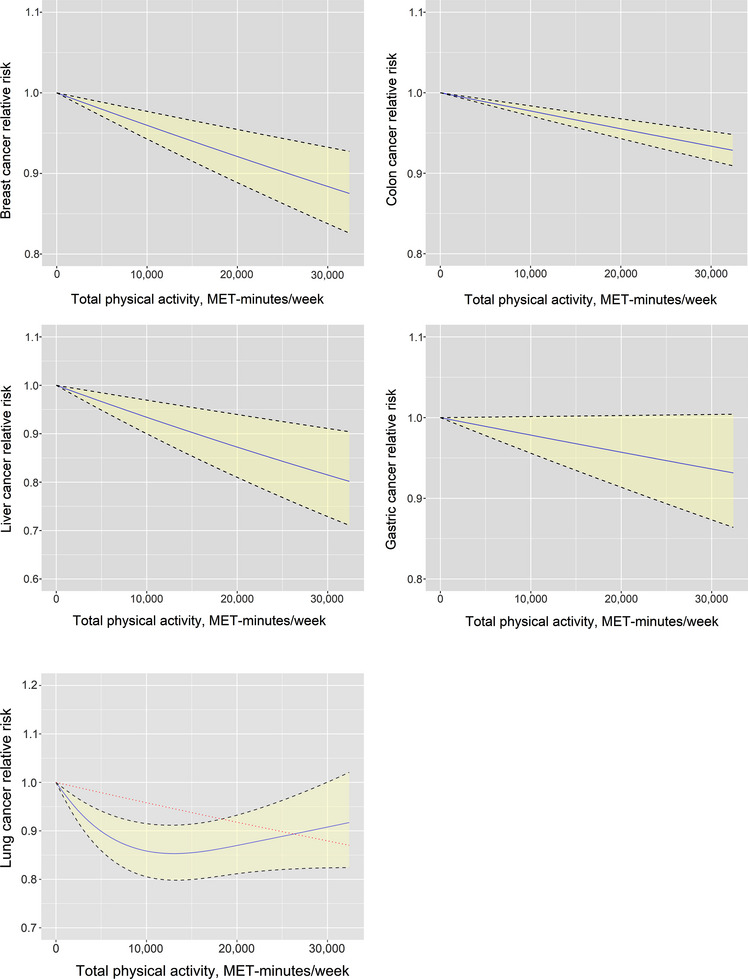
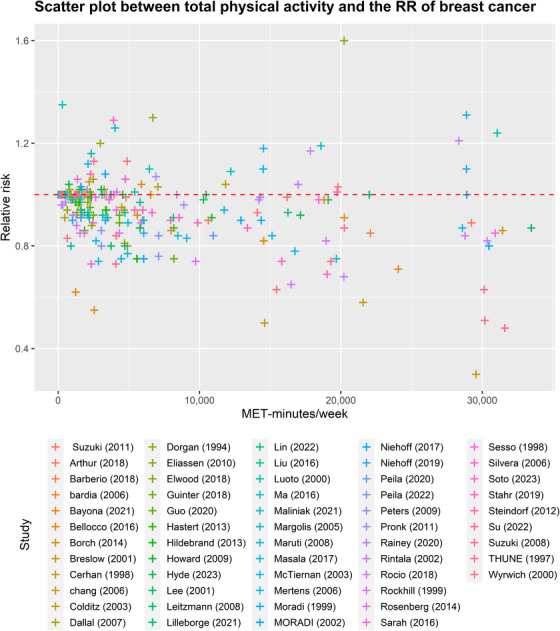
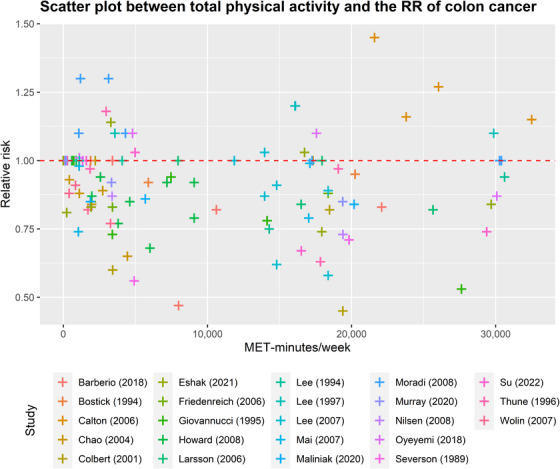
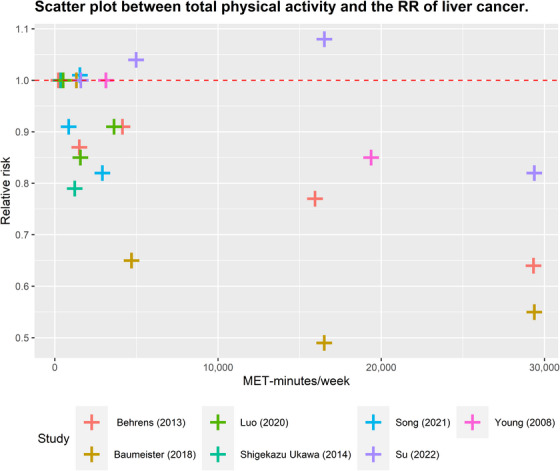
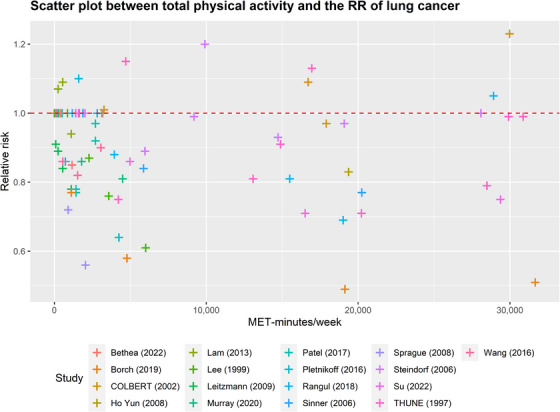
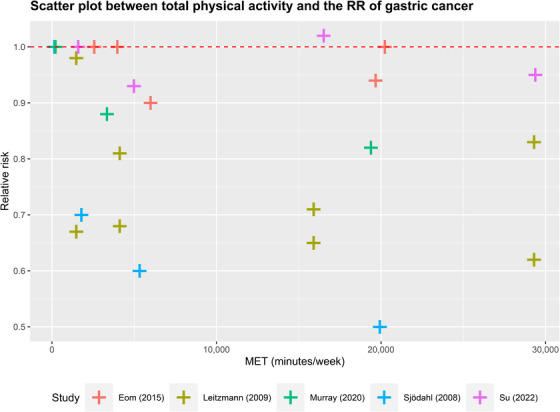
A total of 98 studies, involving a combined population of 16,418,361 individuals, were included in the analysis. Among the included studies, 57 focused on breast cancer, 17 on lung cancer, 23 on colon cancer, 5 on gastric cancer, and 7 on liver cancer. Overall, elevated levels of physical activity exhibited an inverse correlation with the risk of cancer. The dose-response curve for lung cancer exhibited a non-linear pattern, with the greatest benefit risk reduction observed at 13,200 MET-minutes/week of physical activity, resulting in a 14.7% reduction in risk (relative risk 0.853, uncertainty interval 0.798 to 0.912) compared to the inactive population. In contrast, the dose-response curves for colon, gastric, breast, and liver cancers showed linear associations, indicating that heightened levels of total physical activity were consistently associated with reduced cancer risks. However, the increase in physical activity yielded a smaller risk reduction for colon and gastric cancers compared to breast and liver cancers. Compared to individuals with insufficient activity (total activity level < 600 MET-minutes/week), individuals with high levels of activity (≥ 8,000 MET-minutes/week) experienced a 10.3% (0.897, 0.860 to 0.934) risk reduction for breast cancer; 5.9% (0.941, 0.884 to 1.001) for lung cancer; 7.1% (0.929, 0.909 to 0.949) for colon cancer; 5.1% (0.949, 0.908 to 0.992) for gastric cancer; 17.1% (0.829, 0.760 to 0.903) for liver cancer.
This study demonstrated a significant inverse relationship between total physical activity and the risk of breast, gastric, liver, colon, and lung cancers.
采用健康的生活方式,包括有规律的体育活动,被广泛认为可以降低癌症风险。本研究旨在定量建立总体育活动与乳腺癌、结肠癌、肺癌、胃癌和肝癌风险之间的剂量-反应关系。
系统检索了 1980 年 1 月 1 日至 2023 年 3 月 20 日的 PubMed 和 Embase 数据库,以评估身体活动与 5 种结果(任何一种癌症)风险之间的相关性。纳入了研究身体活动与任何一种上述 5 种结果风险之间相关性的前瞻性队列研究。检索仅限于英文出版物,并且特别关注人类研究。使用来自美国国家健康和营养调查(NHANES)和 2019 年全球疾病负担数据库的数据,对身体活动进行标准化。
共纳入 98 项研究,涉及 16418361 人。其中 57 项研究聚焦于乳腺癌,17 项研究聚焦于肺癌,23 项研究聚焦于结肠癌,5 项研究聚焦于胃癌,7 项研究聚焦于肝癌。总的来说,较高水平的身体活动与癌症风险呈负相关。肺癌的剂量-反应曲线呈非线性模式,与不活动人群相比,身体活动 13200MET-分钟/周时,风险降低最大,风险降低 14.7%(相对风险 0.853,不确定性区间 0.798 至 0.912)。相比之下,结肠癌、胃癌、乳腺癌和肝癌的剂量-反应曲线呈线性关联,表明总身体活动水平的升高与癌症风险的降低呈一致的关联。然而,与乳腺癌和肝癌相比,结肠癌和胃癌的身体活动增加导致的风险降低幅度较小。与活动不足的人群(总活动水平<600MET-分钟/周)相比,活动水平高的人群(≥8000MET-分钟/周)患乳腺癌的风险降低 10.3%(0.897,0.860 至 0.934);患肺癌的风险降低 5.9%(0.941,0.884 至 1.001);患结肠癌的风险降低 7.1%(0.929,0.909 至 0.949);患胃癌的风险降低 5.1%(0.949,0.908 至 0.992);患肝癌的风险降低 17.1%(0.829,0.760 至 0.903)。
本研究表明,总身体活动与乳腺癌、胃癌、肝癌、结肠癌和肺癌的风险呈显著负相关。