Department of Medical Genetics, Mayo Clinic, Rochester, Minnesota 55905, USA.
Hum Mutat. 2012 Jan;33(1):8-21. doi: 10.1002/humu.21627. Epub 2011 Nov 3.
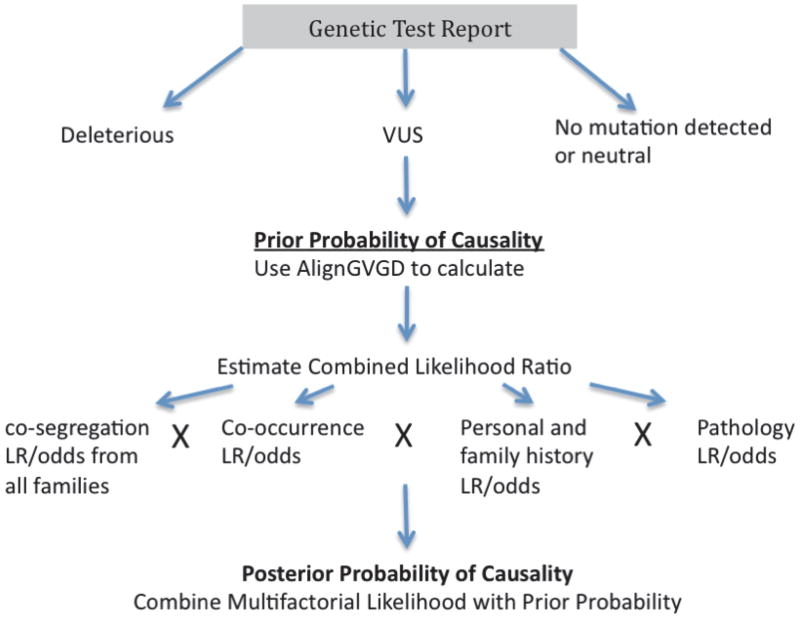
Clinical mutation screening of the BRCA1 and BRCA2 genes for the presence of germline inactivating mutations is used to identify individuals at elevated risk of breast and ovarian cancer. Variants identified during screening are usually classified as pathogenic (increased risk of cancer) or not pathogenic (no increased risk of cancer). However, a significant proportion of genetic tests yields variants of uncertain significance (VUS) that have undefined risk of cancer. Individuals carrying these VUS cannot benefit from individualized cancer risk assessment. Recently, a quantitative "posterior probability model" for assessing the clinical relevance of VUS in BRCA1 or BRCA2, which integrates multiple forms of genetic evidence has been developed. Here, we provide a detailed review of this model. We describe the components of the model and explain how these can be combined to calculate a posterior probability of pathogenicity for each VUS. We explain how the model can be applied to public data and provide tables that list the VUS that have been classified as not pathogenic or pathogenic using this method. While we use BRCA1 and BRCA2 VUS as examples, the method can be used as a framework for classification of the pathogenicity of VUS in other cancer genes.
临床突变筛查 BRCA1 和 BRCA2 基因中的胚系失活突变,用于识别乳腺癌和卵巢癌风险增加的个体。筛选过程中发现的变异通常分为致病性(增加癌症风险)或非致病性(无增加癌症风险)。然而,很大一部分基因检测会产生意义不明的变异(VUS),这些变异的癌症风险尚未确定。携带这些 VUS 的个体无法从个体化癌症风险评估中受益。最近,一种用于评估 BRCA1 或 BRCA2 中 VUS 的临床相关性的定量“后验概率模型”已经开发出来,该模型整合了多种形式的遗传证据。在这里,我们对该模型进行了详细的回顾。我们描述了模型的组成部分,并解释了如何将这些部分组合起来计算每个 VUS 的致病性后验概率。我们解释了如何将该模型应用于公共数据,并提供了使用该方法分类为非致病性或致病性的 VUS 列表。虽然我们使用 BRCA1 和 BRCA2 的 VUS 作为示例,但该方法可作为其他癌症基因中 VUS 致病性分类的框架。