Department of Urology, Glickman Urological and Kidney Institute, Cleveland Clinic, Cleveland, Ohio 44195, USA.
JAMA. 2011 Oct 12;306(14):1549-56. doi: 10.1001/jama.2011.1437.
The initial report of the Selenium and Vitamin E Cancer Prevention Trial (SELECT) found no reduction in risk of prostate cancer with either selenium or vitamin E supplements but a statistically nonsignificant increase in prostate cancer risk with vitamin E. Longer follow-up and more prostate cancer events provide further insight into the relationship of vitamin E and prostate cancer.
To determine the long-term effect of vitamin E and selenium on risk of prostate cancer in relatively healthy men.
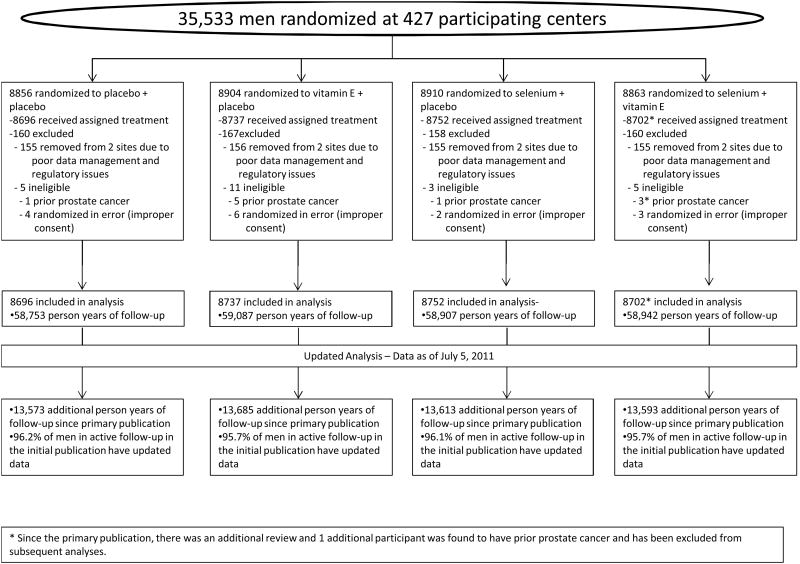
DESIGN, SETTING, AND PARTICIPANTS: A total of 35,533 men from 427 study sites in the United States, Canada, and Puerto Rico were randomized between August 22, 2001, and June 24, 2004. Eligibility criteria included a prostate-specific antigen (PSA) of 4.0 ng/mL or less, a digital rectal examination not suspicious for prostate cancer, and age 50 years or older for black men and 55 years or older for all others. The primary analysis included 34,887 men who were randomly assigned to 1 of 4 treatment groups: 8752 to receive selenium; 8737, vitamin E; 8702, both agents, and 8696, placebo. Analysis reflect the final data collected by the study sites on their participants through July 5, 2011.
Oral selenium (200 μg/d from L-selenomethionine) with matched vitamin E placebo, vitamin E (400 IU/d of all rac-α-tocopheryl acetate) with matched selenium placebo, both agents, or both matched placebos for a planned follow-up of a minimum of 7 and maximum of 12 years.
Prostate cancer incidence.
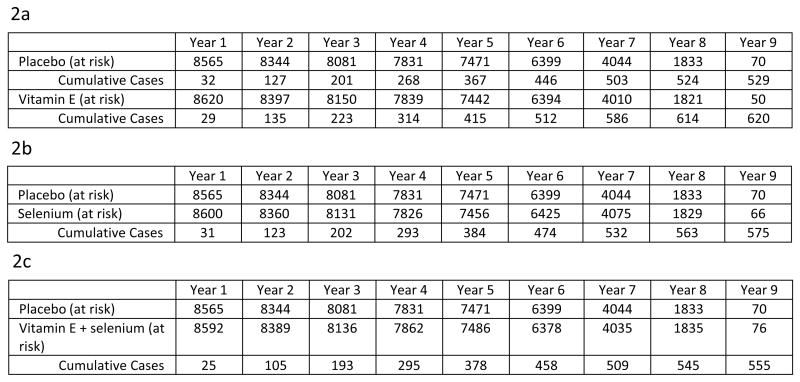
This report includes 54,464 additional person-years of follow-up and 521 additional cases of prostate cancer since the primary report. Compared with the placebo (referent group) in which 529 men developed prostate cancer, 620 men in the vitamin E group developed prostate cancer (hazard ratio [HR], 1.17; 99% CI, 1.004-1.36, P = .008); as did 575 in the selenium group (HR, 1.09; 99% CI, 0.93-1.27; P = .18), and 555 in the selenium plus vitamin E group (HR, 1.05; 99% CI, 0.89-1.22, P = .46). Compared with placebo, the absolute increase in risk of prostate cancer per 1000 person-years was 1.6 for vitamin E, 0.8 for selenium, and 0.4 for the combination.
Dietary supplementation with vitamin E significantly increased the risk of prostate cancer among healthy men.
Clinicaltrials.gov Identifier: NCT00006392.
硒和维生素 E 防癌试验(SELECT)的初步报告显示,硒或维生素 E 补充剂均不能降低前列腺癌的风险,但维生素 E 会使前列腺癌风险出现统计学上无显著增加。更长时间的随访和更多的前列腺癌事件为维生素 E 与前列腺癌之间的关系提供了进一步的见解。
确定维生素 E 和硒对相对健康男性前列腺癌风险的长期影响。
设计、地点和参与者:共有来自美国、加拿大和波多黎各 427 个研究点的 35533 名男性于 2001 年 8 月 22 日至 2004 年 6 月 24 日被随机分配。入选标准包括前列腺特异性抗原(PSA)水平为 4.0ng/ml 或更低,直肠指检未发现前列腺癌可疑,年龄 50 岁或以上的黑人男性,55 岁或以上的其他男性。主要分析包括 34887 名随机分配至 4 个治疗组之一的男性:8752 名接受硒治疗;8737 名接受维生素 E 治疗;8702 名同时接受两种药物治疗;8696 名接受安慰剂治疗。分析结果反映了研究点通过 2011 年 7 月 5 日对其参与者收集的最终数据。
口服硒(来自 L-硒代蛋氨酸的 200μg/d)和匹配的维生素 E 安慰剂、维生素 E(400IU/d 的全 rac-α-生育酚醋酸酯)和匹配的硒安慰剂、两种药物或两种匹配的安慰剂,计划随访时间至少为 7 年,最长为 12 年。
前列腺癌发病率。
本报告包括 54464 人年的随访时间和自主要报告以来的 521 例前列腺癌病例。与安慰剂(参照组)相比,529 名男性发生前列腺癌,维生素 E 组有 620 名男性发生前列腺癌(风险比[HR],1.17;99%CI,1.004-1.36,P=0.008);硒组有 575 名(HR,1.09;99%CI,0.93-1.27;P=0.18)和硒加维生素 E 组有 555 名(HR,1.05;99%CI,0.89-1.22,P=0.46)。与安慰剂相比,每 1000 人年的前列腺癌风险绝对增加分别为维生素 E 组 1.6、硒组 0.8 和联合组 0.4。
健康男性补充维生素 E 可显著增加前列腺癌的风险。
Clinicaltrials.gov 标识符:NCT00006392。