Department of Epidemiology, Rollins School of Public Health, Emory University, Atlanta, Georgia, USA.
PLoS Negl Trop Dis. 2011 Oct;5(10):e1311. doi: 10.1371/journal.pntd.0001311. Epub 2011 Oct 4.
Dengue viruses (DENVs) and Japanese encephalitis virus (JEV) have significant cross-reactivity in serological assays; the clinical implications of this remain undefined. An improved understanding of whether and how JEV immunity modulates the clinical outcome of DENV infection is important as large-scale DENV vaccine trials will commence in areas where JEV is co-endemic and/or JEV immunization is routine.
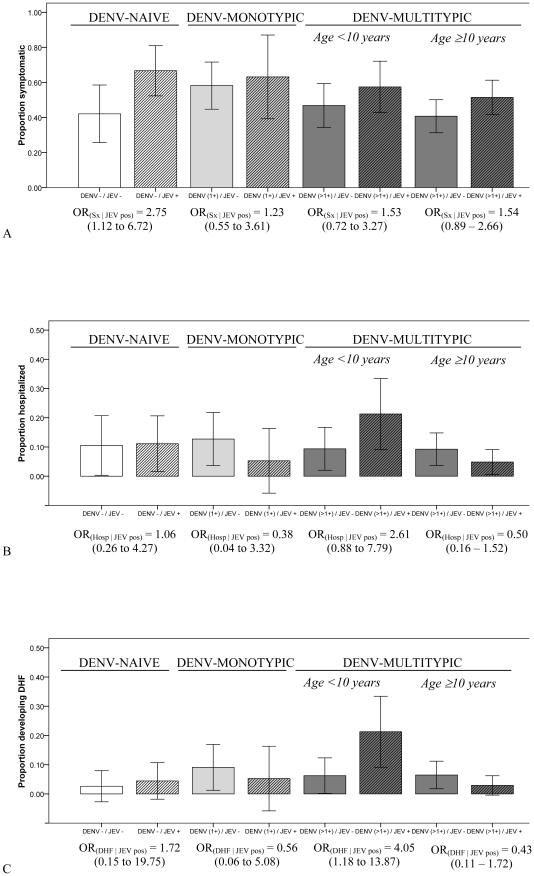
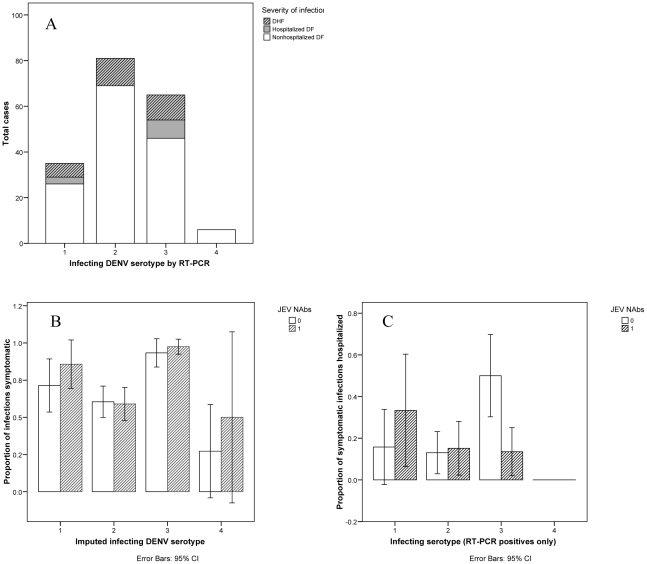
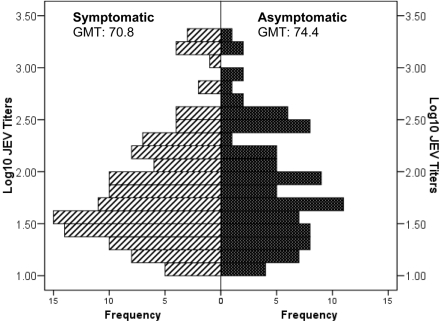
The association between preexisting JEV neutralizing antibodies (NAbs) and the clinical severity of DENV infection was evaluated in a prospective school-based cohort in Thailand that captured asymptomatic, non-hospitalized, and hospitalized DENV infections. Covariates considered included age, baseline DENV antibody status, school of attendance, epidemic year, and infecting DENV serotype. 942 children experienced at least one DENV infection between 1998 and 2002, out of 3,687 children who were enrolled for at least one full year. In crude analysis, the presence of JEV NAbs was associated with an increased occurrence of symptomatic versus asymptomatic infection (odds ratio [OR]= 1.55, 95% CI: 1.08-2.23) but not hospitalized illness or dengue hemorrhagic fever (DHF). The association was strongest in children with negative DENV serology (DENV-naive) (OR=2.75, 95% CI: 1.12-6.72), for whom the presence of JEV NAbs was also associated with a symptomatic illness of longer duration (5.4 days for JEV NAb+ versus 2.6 days for JEV NAb-, p=0.048). JEV NAbs were associated with increased DHF in younger children with multitypic DENV NAb profiles (OR=4.05, 95% CI: 1.18 to 13.87). Among those with JEV NAbs, the association with symptomatic illness did not vary by antibody titer.
The prior existence of JEV NAbs was associated with an increased probability of symptomatic as compared to asymptomatic DENV illness. These findings are in contrast to previous studies suggesting an attenuating effect of heterologous flavivirus immunity on DENV disease severity.
登革热病毒(DENV)和日本脑炎病毒(JEV)在血清学检测中具有显著的交叉反应性;但这种交叉反应的临床意义尚不清楚。了解 JEV 免疫是否以及如何调节 DENV 感染的临床结局非常重要,因为大规模的 DENV 疫苗试验将在 JEV 地方性流行和/或 JEV 免疫常规进行的地区开展。
本研究在泰国开展了一项前瞻性学校队列研究,评估了预先存在的 JEV 中和抗体(NAb)与 DENV 感染临床严重程度之间的关系,该研究纳入了无症状、非住院和住院的 DENV 感染病例。考虑的协变量包括年龄、基线 DENV 抗体状态、就读学校、流行年份和感染的 DENV 血清型。在 1998 年至 2002 年期间,共有 942 名儿童至少经历了一次 DENV 感染,而在至少入组一整年的 3687 名儿童中,有 942 名儿童至少经历了一次 DENV 感染。在未经校正的分析中,JEV NAb 的存在与症状性感染(比值比[OR]=1.55,95%可信区间[CI]:1.08-2.23)而非住院疾病或登革出血热(DHF)的发生呈正相关。在 DENV 血清学阴性(DENV 初免)的儿童中,这种相关性最强(OR=2.75,95% CI:1.12-6.72),而且 JEV NAb 的存在还与较长时间的症状性疾病(JEV NAb+为 5.4 天,JEV NAb-为 2.6 天,p=0.048)相关。在具有多种 DENV NAb 特征的年幼儿童中,JEV NAb 与 DHF 的发生呈正相关(OR=4.05,95% CI:1.18 至 13.87)。在有 JEV NAb 的儿童中,与症状性疾病相关的关联与抗体滴度无关。
先前存在的 JEV NAb 与 DENV 疾病的症状性发作的可能性增加相关,而非无症状感染。这些发现与之前的研究结果相反,之前的研究表明异源黄病毒免疫对 DENV 疾病严重程度有减弱作用。