Department of Population, Family, and Reproductive Health, Johns Hopkins Bloomberg School of Public Health, Baltimore, MD, USA.
Sex Transm Dis. 2011 Nov;38(11):1040-5. doi: 10.1097/OLQ.0b013e3182275499.
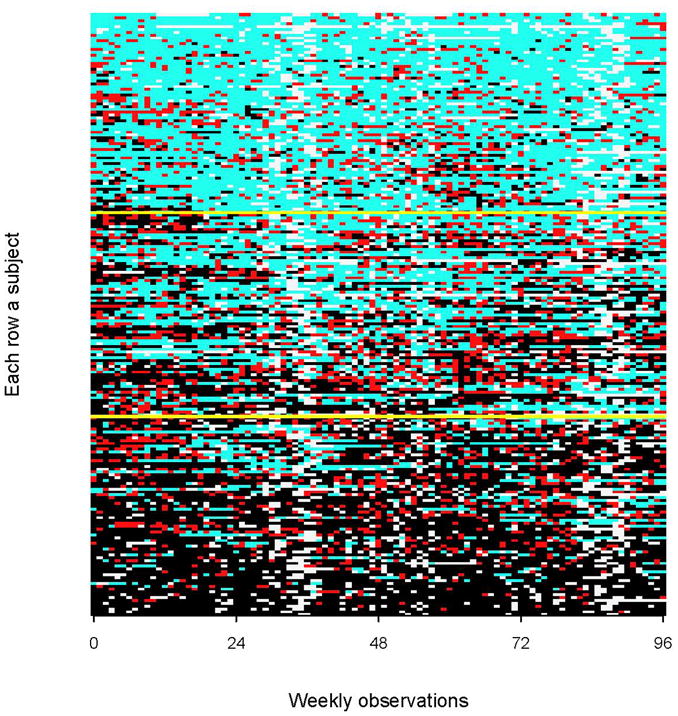
Large datasets for investigating vaginal flora change at frequent, repeated intervals are limited and graphical methods for exploring such data are inadequate. We report 2-year weekly vaginal flora changes based on Gram stain using lasagna plots.
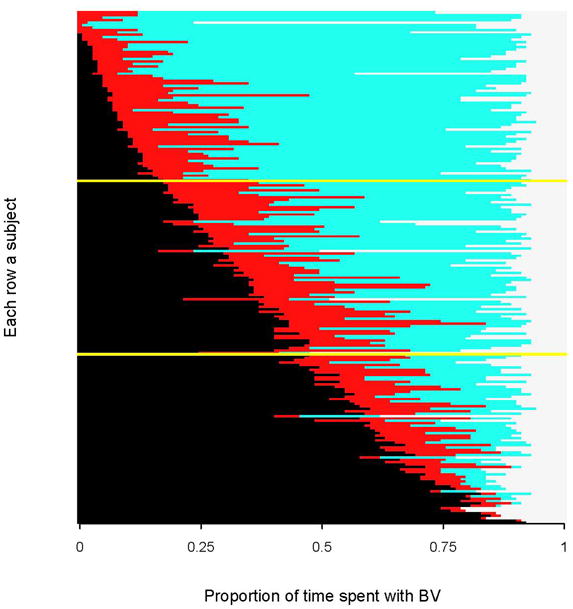
Weekly vaginal flora patterns were evaluated among 211 sexually experienced women with ≥18 months of follow-up in Rakai, Uganda. Vaginal flora swabs were self-collected weekly and categorized by Nugent Gram stain criteria (0-3, normal; 4-6, intermediate; 7-10, bacterial vaginosis [BV]). Vaginal flora patterns were analyzed as the percentage of weekly observations with BV (longitudinal prevalence) and illustrated by lasagna plots. Characteristics of women were compared across tertiles of longitudinal prevalence of BV.
Ninety-five percent of women had at least 1 episode of BV over 2 years, with one-third of women spending more than half (52%-100%) of their time with BV. Vaginal pH >4.5 increased with increasing tertiles of longitudinal prevalence of BV (P < 0.001). Weekly fluctuation in vaginal flora states, as measured by a change in flora states from the before current visit, was highest in the middle (41.9%) compared with the lower (30.1%) and upper tertiles (27.8%, P < 0.001). HIV status and reported vaginal symptoms did not differ significantly across BV tertiles.
Women exhibited different patterns of vaginal flora changes over time, which could not be described by baseline behaviors. Lasagna plots aided in describing the natural history of BV within and across women and may be applied to future BV natural history studies.
用于频繁、重复间隔调查阴道菌群变化的大型数据集有限,探索此类数据的图形方法也不充分。我们使用千层面图报告基于革兰氏染色的 2 年每周阴道菌群变化。
在乌干达拉凯,对 211 名有≥18 个月随访的有性经验的女性进行每周阴道菌群模式评估。每周自我收集阴道菌群拭子,并根据 Nugent 革兰氏染色标准(0-3,正常;4-6,中间;7-10,细菌性阴道病[BV])进行分类。阴道菌群模式通过 BV 的每周观察百分比(纵向患病率)进行分析,并通过千层面图说明。将女性的特征与 BV 纵向患病率的三分位数进行比较。
95%的女性在 2 年内至少有一次 BV 发作,三分之一的女性有超过一半(52%-100%)的时间患有 BV。阴道 pH 值>4.5 随着纵向 BV 患病率三分位数的增加而增加(P < 0.001)。从当前就诊前的菌群状态变化衡量的阴道菌群状态每周波动,在中间(41.9%)最高,与较低(30.1%)和较高(27.8%)三分位数相比(P < 0.001)。HIV 状况和报告的阴道症状在 BV 三分位数之间没有显著差异。
女性随时间表现出不同的阴道菌群变化模式,这不能用基线行为来描述。千层面图有助于描述女性内部和之间的 BV 自然史,并且可能应用于未来的 BV 自然史研究。