Kippner Linda E, Finn Nnenna A, Shukla Shreya, Kemp Melissa L
The Wallace H. Coulter Department of Biomedical Engineering, Georgia Institute of Technology and Emory University, Atlanta, GA, USA.
BMC Syst Biol. 2011 Oct 13;5:164. doi: 10.1186/1752-0509-5-164.
Cellular clearance of reactive oxygen species is dependent on a network of tightly coupled redox enzymes; this network rapidly adapts to oxidative conditions such as aging, viral entry, or inflammation. Current widespread use of shRNA as a means to perturb specific redox couples may be misinterpreted if the targeted effects are not monitored in the context of potential global remodeling of the redox enzyme network.
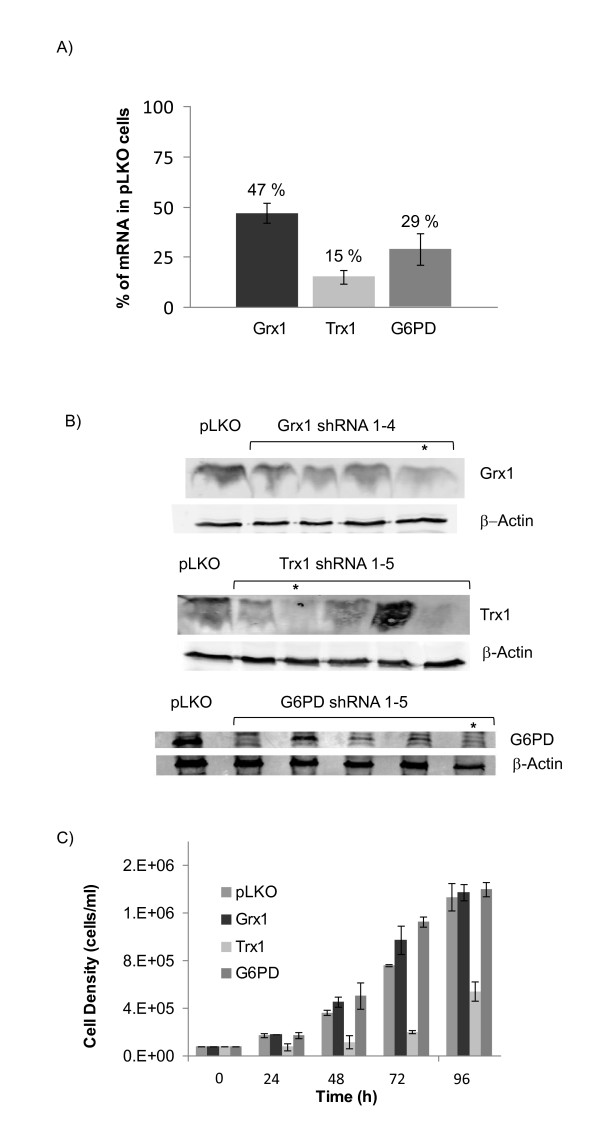
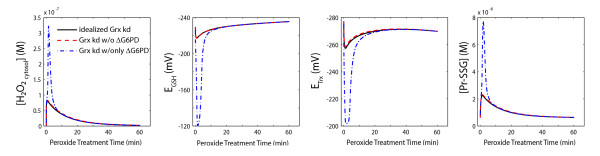
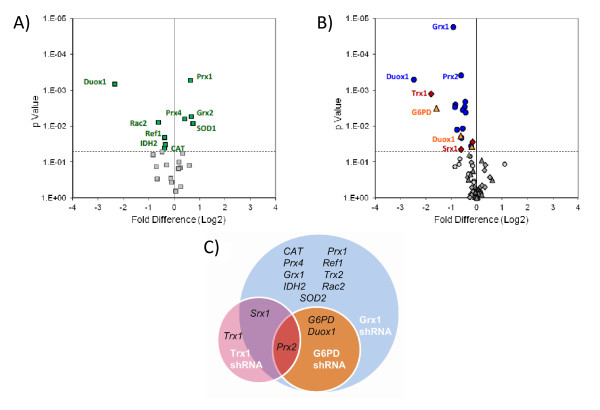
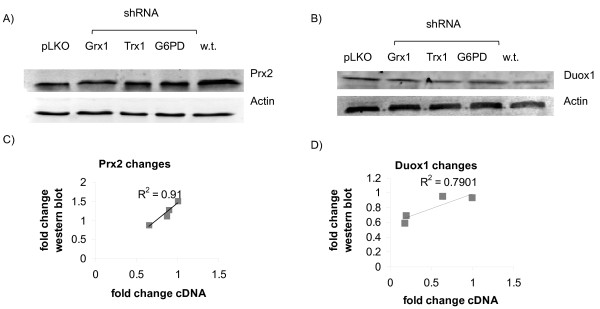
Stable cell lines containing shRNA targets for glutaredoxin 1, thioredoxin 1, or glucose-6-phosphate dehydrogenase were generated in order to examine the changes in expression associated with altering cytosolic redox couples. A qRT PCR array revealed systemic off-target effects of altered antioxidant capacity and reactive oxygen species formation. Empty lentiviral particles generated numerous enzyme expression changes in comparison to uninfected cells, indicating an alteration in antioxidant capacity irrespective of a shRNA target. Of the three redox couples perturbed, glutaredoxin 1, attenuation produced the most numerous off-target effects with 10/28 genes assayed showing statistically significant changes. A multivariate analysis extracted strong co-variance between glutaredoxin 1 and peroxiredoxin 2 which was subsequently experimentally verified. Computational modeling of the peroxide clearance dynamics associated with the remodeling of the redox network indicated that the compromised antioxidant capacity compared across the knockdown cell lines was unequally affected by the changes in expression of off-target proteins.
Our results suggest that targeted reduction of redox enzyme expression leads to widespread changes in off-target protein expression, changes that are well-insulated between sub-cellular compartments, but compensatory in both the production of and protection against intracellular reactive oxygen species. Our observations suggest that the use of lentivirus can in itself have off-target effects on dynamic responses to oxidative stress due to the changes in species concentrations.
活性氧的细胞清除依赖于紧密耦合的氧化还原酶网络;该网络能迅速适应诸如衰老、病毒入侵或炎症等氧化条件。如果在氧化还原酶网络潜在的全局重塑背景下未监测到靶向效应,那么目前广泛使用的短发夹RNA(shRNA)作为干扰特定氧化还原对的手段可能会被误解。
为了研究与改变胞质氧化还原对相关的表达变化,构建了针对谷氧还蛋白1、硫氧还蛋白1或葡萄糖-6-磷酸脱氢酶的shRNA靶点的稳定细胞系。定量逆转录聚合酶链反应(qRT PCR)阵列显示了抗氧化能力改变和活性氧形成的系统性脱靶效应。与未感染细胞相比,空的慢病毒颗粒产生了许多酶表达变化,表明无论有无shRNA靶点,抗氧化能力均发生了改变。在被干扰的三个氧化还原对中,谷氧还蛋白1的减弱产生了最多的脱靶效应,在检测的28个基因中有10个显示出统计学上的显著变化。多变量分析提取了谷氧还蛋白1和过氧化物还原酶2之间的强协方差,随后通过实验进行了验证。与氧化还原网络重塑相关的过氧化物清除动力学的计算模型表明,在敲低细胞系中比较受损的抗氧化能力受到脱靶蛋白表达变化的影响不均等。
我们的结果表明,靶向降低氧化还原酶表达会导致脱靶蛋白表达的广泛变化,这些变化在亚细胞区室之间具有良好的隔离性,但在细胞内活性氧的产生和保护方面具有补偿性。我们的观察结果表明,由于物种浓度的变化,慢病毒的使用本身可能对氧化应激的动态反应产生脱靶效应。