Department of Medicine, University of Chicago, Chicago, Illinois, USA.
Obesity (Silver Spring). 2012 Feb;20(2):278-84. doi: 10.1038/oby.2011.306. Epub 2011 Oct 13.
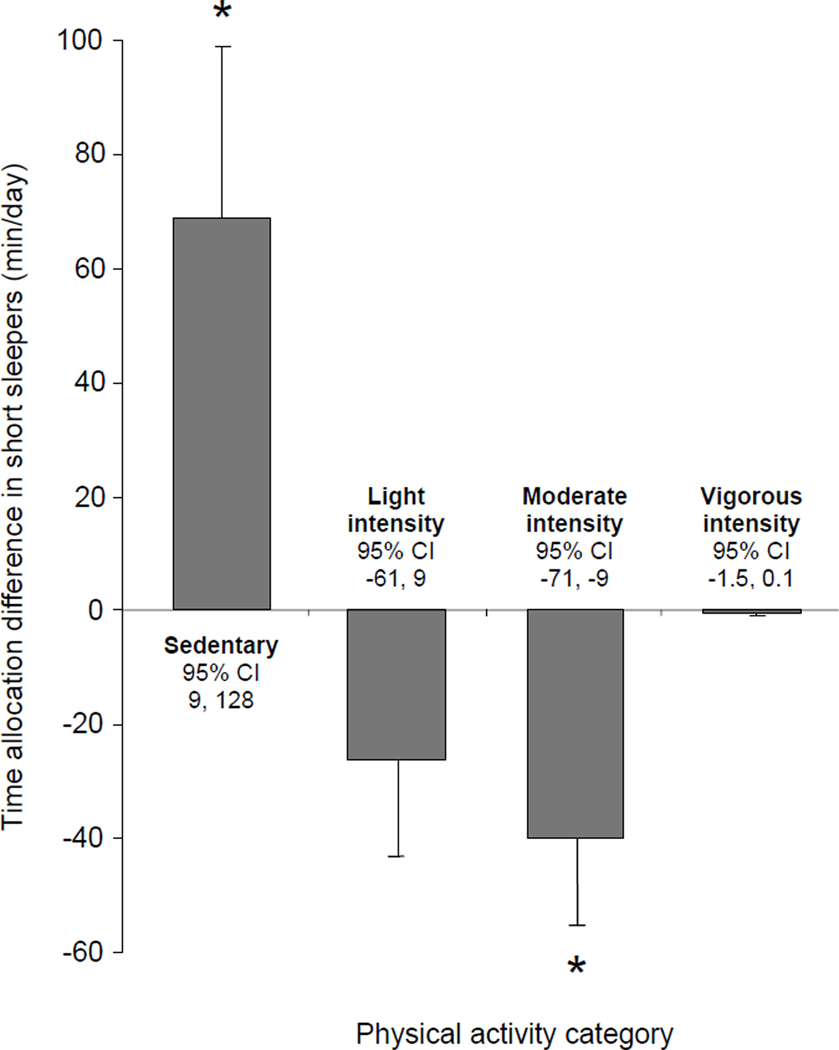
Adults with parental history of type 2 diabetes have high metabolic morbidity, which is exacerbated by physical inactivity. Self-reported sleep <6 h/day is associated with increased incidence of obesity and diabetes, which may be mediated in part by sleep-loss-related reduction in physical activity. We examined the relationship between habitual sleep curtailment and physical activity in adults with parental history of type 2 diabetes. Forty-eight young urban adults with parental history of type 2 diabetes (27 F/21 M; mean (s.d.) age 26 (4) years; BMI 23.8 (2.5) kg/m(2)) each completed 13 (2) days of sleep and physical activity monitoring by wrist actigraphy and waist accelerometry while following their usual lifestyle at home. Laboratory polysomnography was used to screen for sleep disorders. The primary outcome of the study was the comparison of total daily activity counts between participants with habitual sleep <6 vs. ≥6 h/night. Secondary measures included daily time spent sedentary and in light, moderate, and vigorous physical activity. Short sleepers had no sleep abnormalities and showed signs of increased sleep pressure consistent with a behavioral pattern of habitual sleep curtailment. Compared to participants who slept ≥6 h/night, short sleepers had 27% fewer daily activity counts (P = 0.042), spent less time in moderate-plus-vigorous physical activity (-43 min/day; P = 0.010), and remained more sedentary (+69 min/day; P = 0.026). Our results indicate that young urban adults with parental history of type 2 diabetes who habitually curtail their sleep have less daily physical activity and more sedentary living, which may enhance their metabolic risk.
有 2 型糖尿病家族史的成年人代谢疾病发病率较高,而缺乏运动则会使这种情况恶化。自我报告的每日睡眠时间<6 小时与肥胖和糖尿病的发病率增加有关,这可能部分是由于睡眠不足导致体力活动减少所致。我们研究了有 2 型糖尿病家族史的成年人习惯性睡眠不足与体力活动之间的关系。48 名年轻的城市成年人有 2 型糖尿病家族史(27 名女性/21 名男性;平均(标准差)年龄 26(4)岁;BMI 23.8(2.5)kg/m2),每个人都通过腕部动作记录仪和腰部加速度计完成了 13(2)天的睡眠和体力活动监测,同时按照他们在家中的日常生活习惯进行。实验室多导睡眠图用于筛查睡眠障碍。该研究的主要结果是比较习惯性睡眠<6 小时与≥6 小时/晚的参与者的总日常活动计数。次要测量指标包括每日久坐时间和轻、中、高强度体力活动时间。习惯性睡眠不足的人没有睡眠异常,并表现出睡眠压力增加的迹象,这与习惯性睡眠不足的行为模式一致。与睡眠时间≥6 小时/晚的参与者相比,习惯性睡眠不足的人日常活动计数减少了 27%(P=0.042),中度至剧烈体力活动时间减少了 43 分钟/天(P=0.010),久坐时间增加了 69 分钟/天(P=0.026)。我们的结果表明,有 2 型糖尿病家族史的年轻城市成年人如果习惯性地缩短睡眠时间,他们的日常体力活动会减少,久坐时间会增加,这可能会增加他们的代谢风险。