Department of Psychology, University of Oregon, Eugene, Oregon, USA.
Int J Eat Disord. 2011 Nov;44(7):585-95. doi: 10.1002/eat.20869. Epub 2010 Nov 5.
To test the hypothesis that women with full and subthreshold bulimia nervosa show abnormal neural activation in response to food intake and anticipated food intake relative to healthy control women.
Females with and without full/subthreshold bulimia nervosa recruited from the community (N = 26) underwent functional magnetic resonance imaging (fMRI) during receipt and anticipated receipt of chocolate milkshake and a tasteless control solution.
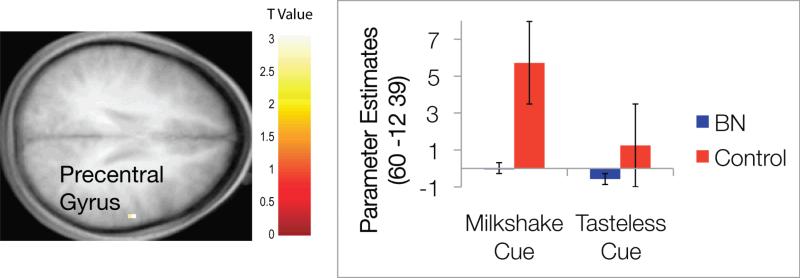
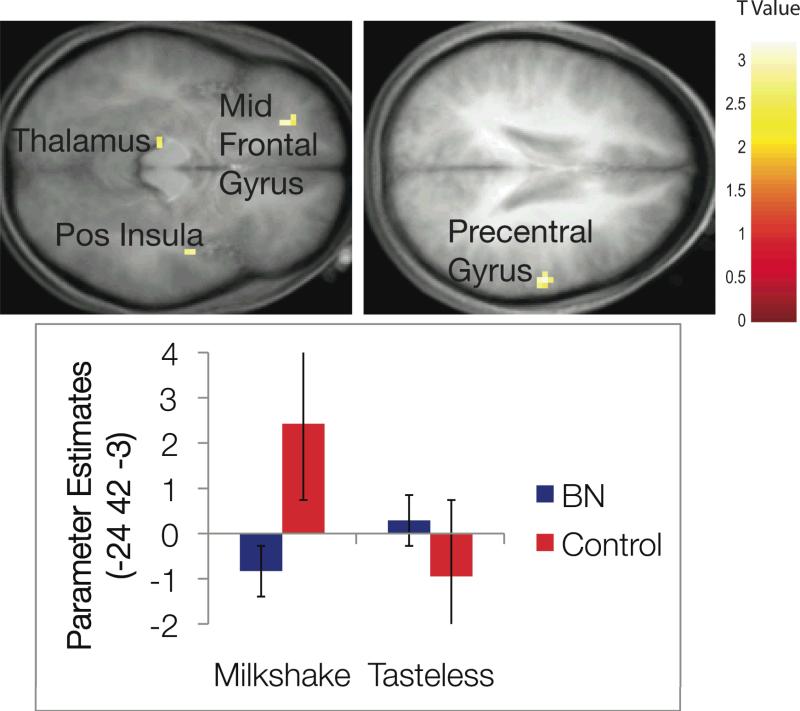
Women with bulimia nervosa showed trends for less activation than healthy controls in the right anterior insula in response to anticipated receipt of chocolate milkshake (vs. tasteless solution) and in the left middle frontal gyrus, right posterior insula, right precentral gyrus, and right mid dorsal insula in response to consumptions of milkshake (vs. tasteless solution).
Bulimia nervosa may be related to potential hypofunctioning of the brain reward system, which may lead these individuals to binge eat to compensate for this reward deficit, though the hypo-responsivity might be a result of a history of binge eating highly palatable foods.
验证女性暴食症患者(完全和阈下型)在摄入食物和预期摄入食物时的神经激活反应异常的假设,与健康对照组女性相比。
从社区招募的有或没有完全/阈下型暴食症的女性(N=26)在接受和预期接受巧克力奶昔和无味对照溶液时接受功能磁共振成像(fMRI)检查。
与健康对照组相比,暴食症患者在预期摄入巧克力奶昔(与无味溶液相比)时右侧前岛叶的激活程度较低,在摄入奶昔(与无味溶液相比)时左侧额中回、右侧后岛叶、右侧额前回和右侧中背侧岛叶的激活程度较低。
暴食症可能与大脑奖励系统的潜在功能障碍有关,这可能导致这些人通过暴食来弥补这种奖励不足,尽管这种低反应性可能是暴食高美味食物的历史结果。