Biocomplexity Institute and Department of Physics, Indiana University Bloomington, Bloomington, Indiana, United States of America.
PLoS Comput Biol. 2011 Oct;7(10):e1002155. doi: 10.1371/journal.pcbi.1002155. Epub 2011 Oct 6.
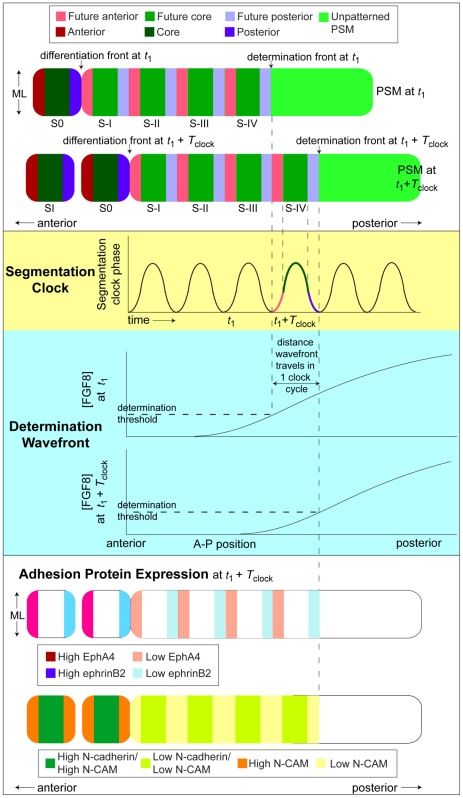
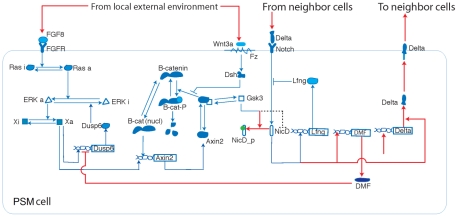
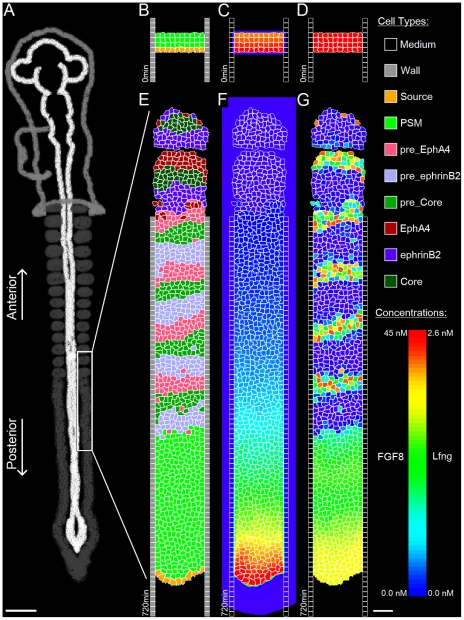
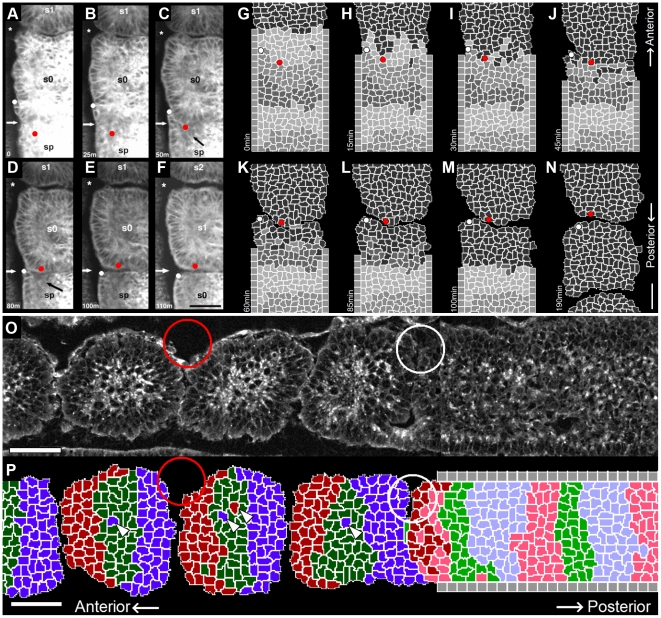
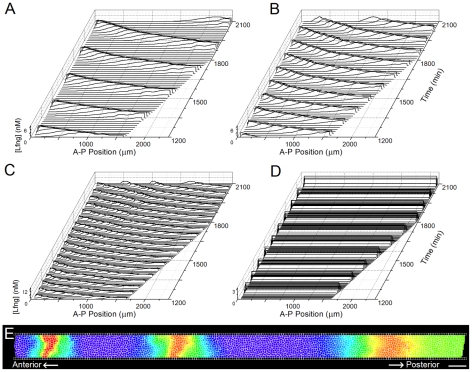
Somitogenesis, the formation of the body's primary segmental structure common to all vertebrate development, requires coordination between biological mechanisms at several scales. Explaining how these mechanisms interact across scales and how events are coordinated in space and time is necessary for a complete understanding of somitogenesis and its evolutionary flexibility. So far, mechanisms of somitogenesis have been studied independently. To test the consistency, integrability and combined explanatory power of current prevailing hypotheses, we built an integrated clock-and-wavefront model including submodels of the intracellular segmentation clock, intercellular segmentation-clock coupling via Delta/Notch signaling, an FGF8 determination front, delayed differentiation, clock-wavefront readout, and differential-cell-cell-adhesion-driven cell sorting. We identify inconsistencies between existing submodels and gaps in the current understanding of somitogenesis mechanisms, and propose novel submodels and extensions of existing submodels where necessary. For reasonable initial conditions, 2D simulations of our model robustly generate spatially and temporally regular somites, realistic dynamic morphologies and spontaneous emergence of anterior-traveling stripes of Lfng. We show that these traveling stripes are pseudo-waves rather than true propagating waves. Our model is flexible enough to generate interspecies-like variation in somite size in response to changes in the PSM growth rate and segmentation-clock period, and in the number and width of Lfng stripes in response to changes in the PSM growth rate, segmentation-clock period and PSM length.
体节发生是所有脊椎动物发育中共同的身体初级节段结构的形成,需要在几个尺度上协调生物机制。解释这些机制如何在尺度上相互作用以及事件如何在空间和时间上协调,对于全面理解体节发生及其进化灵活性是必要的。到目前为止,体节发生的机制已经被独立地研究了。为了测试当前流行假说的一致性、可整合性和综合解释能力,我们构建了一个集成的时钟-波前模型,包括细胞内节段时钟的子模型、Delta/Notch 信号介导的细胞间节段时钟耦合、FGF8 决定前沿、延迟分化、时钟-波前读出以及差异细胞-细胞粘附驱动的细胞分选。我们发现了现有子模型之间的不一致之处,以及体节发生机制理解上的差距,并在必要时提出了新的子模型和现有子模型的扩展。对于合理的初始条件,我们的模型的 2D 模拟能够稳健地生成具有时空规律的体节、真实的动态形态以及 Lfng 的前向行进条纹的自发出现。我们表明这些行进条纹是伪波而不是真正的传播波。我们的模型足够灵活,可以根据 PSM 生长速度和节段时钟周期的变化以及 PSM 生长速度、节段时钟周期和 PSM 长度的变化,产生物种间相似的体节大小变化以及 Lfng 条纹的数量和宽度变化。