Sackler School of Biomedical Sciences, Tufts University School of Medicine, Boston, Massachusetts, United States of America.
PLoS Pathog. 2011 Oct;7(10):e1002272. doi: 10.1371/journal.ppat.1002272. Epub 2011 Oct 6.
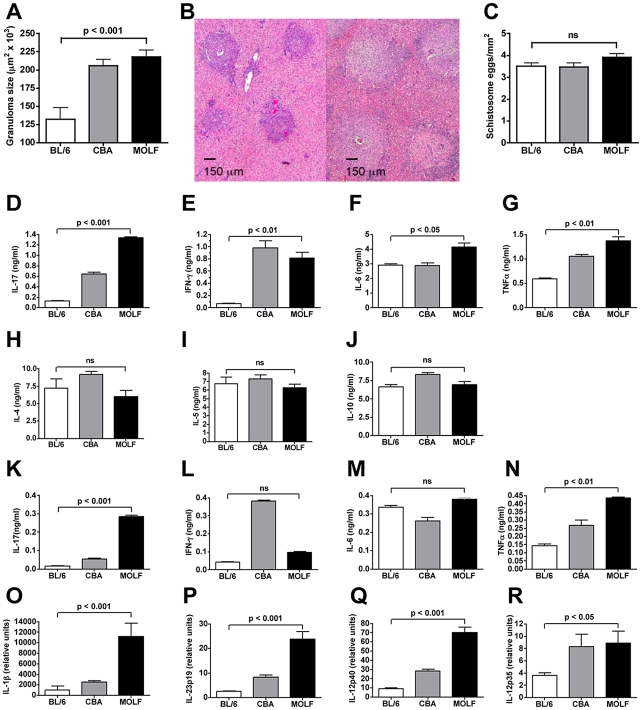
Infection with the trematode parasite Schistosoma mansoni results in distinct heterogeneity of disease severity both in humans and in mice. In the experimental mouse model, severe disease is characterized by pronounced hepatic egg-induced granulomatous inflammation mediated by CD4 Th17 cells, whereas mild disease is associated with reduced hepatic inflammation in a Th2-skewed cytokine environment. Even though the host's genetic background significantly impacts the clinical outcome of schistosomiasis, specific gene(s) that contribute to disease severity remain elusive. We investigated the schistosome infection in wild-derived mice, which possess a more diverse gene pool than classically inbred mouse strains and thus makes them more likely to reveal novel mechanisms of immune regulation. We now show that inbred wild-derived MOLF mice develop severe hepatic inflammation with high levels of IL-17. Congenic mice with a MOLF locus in chromosome 6, designated Why1, revealed high pathology and enabled the identification of Irak2 as the pathogenic gene. Although IRAK-2 is classically associated with TLR signaling, adoptive transfer of CD4 T cells revealed that IRAK-2 mediates pathology in a CD4 T cell specific manner by promoting Th17 cell development through enhancement of IL-1β-induced activation of transcription factors RORγt and BATF. The use of wild-derived mice unravels IRAK-2 as a novel regulator of IL-1-induced pathogenic Th17 cells in schistosomiasis, which likely has wide-ranging implications for other chronic inflammatory and autoimmune diseases.
曼氏血吸虫感染导致人类和小鼠的疾病严重程度存在明显的异质性。在实验性小鼠模型中,严重疾病的特征是明显的肝卵诱导的肉芽肿炎症,由 CD4 Th17 细胞介导,而轻度疾病与 Th2 偏向的细胞因子环境中肝炎症减少有关。尽管宿主的遗传背景显著影响血吸虫病的临床结果,但导致疾病严重程度的特定基因仍不清楚。我们研究了野生型小鼠中的血吸虫感染,它们具有比经典近交系小鼠更多样化的基因库,因此更有可能揭示免疫调节的新机制。我们现在表明,近交野生型 MOLF 小鼠会发展为严重的肝炎症,并伴有高水平的 IL-17。在染色体 6 上具有 MOLF 基因座的同基因小鼠,命名为 Why1,表现出高病理学,并确定 Irak2 是致病基因。尽管 IRAK-2 通常与 TLR 信号有关,但 CD4 T 细胞的过继转移表明,IRAK-2 通过增强 IL-1β 诱导的转录因子 RORγt 和 BATF 的激活,以促进 Th17 细胞的发育,从而以 CD4 T 细胞特异性的方式介导病理学。野生型小鼠的使用揭示了 IRAK-2 是血吸虫病中 IL-1 诱导的致病性 Th17 细胞的新型调节剂,这可能对其他慢性炎症和自身免疫性疾病具有广泛的影响。