Department of Biochemistry, University of Wisconsin-Madison, Madison, Wisconsin, United States of America.
PLoS Genet. 2011 Oct;7(10):e1002323. doi: 10.1371/journal.pgen.1002323. Epub 2011 Oct 6.
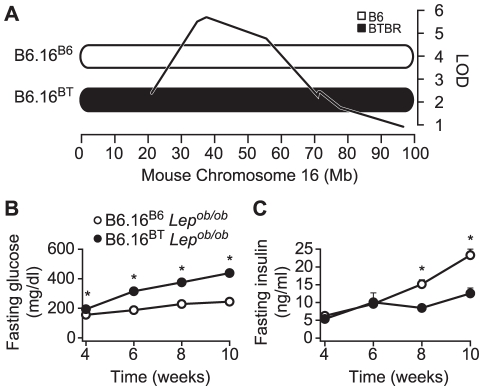
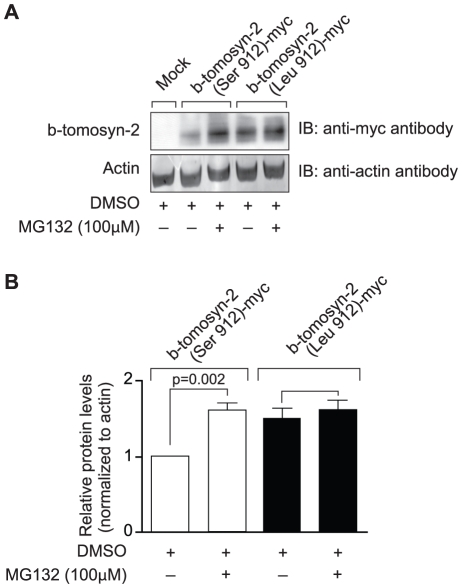
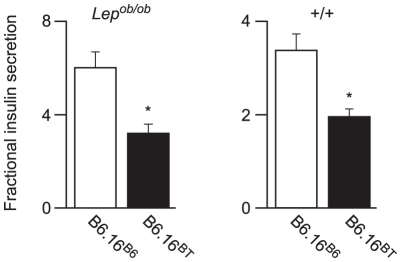
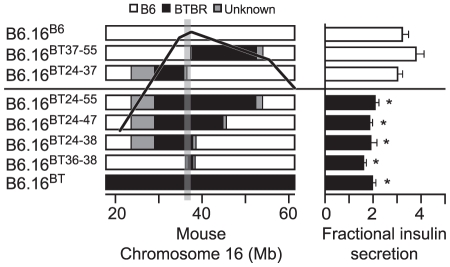
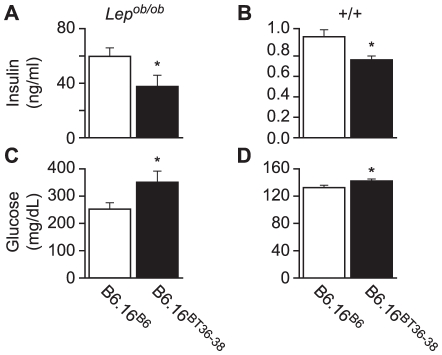
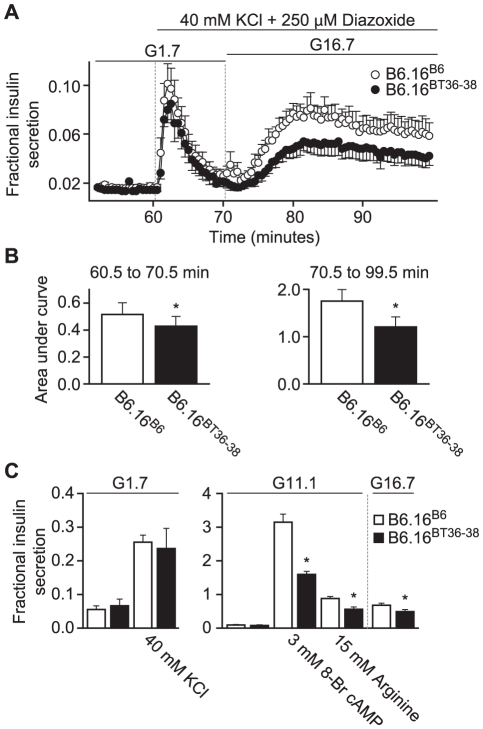
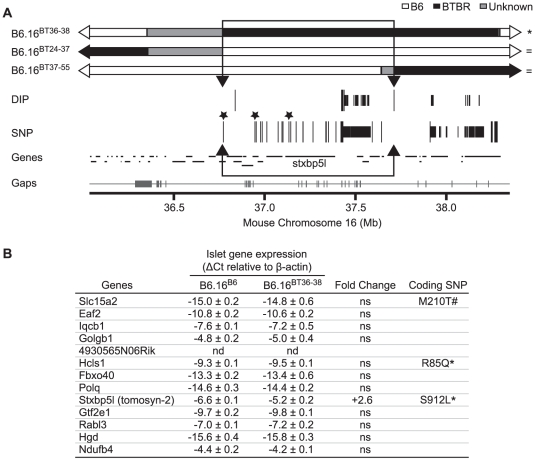
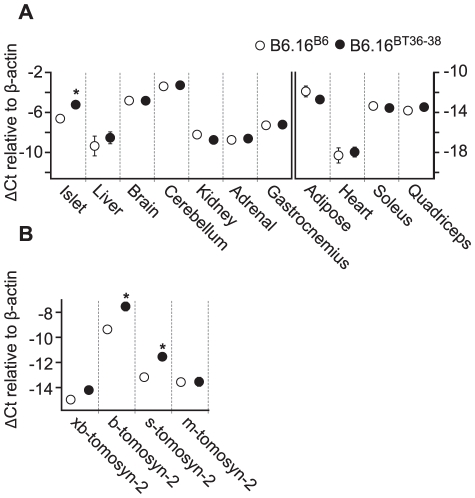
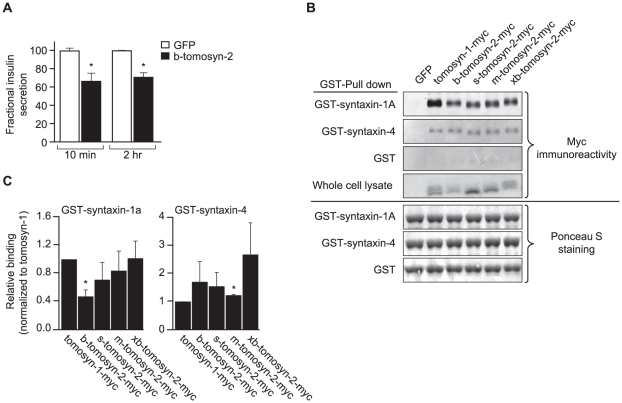
We previously mapped a type 2 diabetes (T2D) locus on chromosome 16 (Chr 16) in an F2 intercross from the BTBR T (+) tf (BTBR) Lep(ob/ob) and C57BL/6 (B6) Lep(ob/ob) mouse strains. Introgression of BTBR Chr 16 into B6 mice resulted in a consomic mouse with reduced fasting plasma insulin and elevated glucose levels. We derived a panel of sub-congenic mice and narrowed the diabetes susceptibility locus to a 1.6 Mb region. Introgression of this 1.6 Mb fragment of the BTBR Chr 16 into lean B6 mice (B6.16(BT36-38)) replicated the phenotypes of the consomic mice. Pancreatic islets from the B6.16(BT36-38) mice were defective in the second phase of the insulin secretion, suggesting that the 1.6 Mb region encodes a regulator of insulin secretion. Within this region, syntaxin-binding protein 5-like (Stxbp5l) or tomosyn-2 was the only gene with an expression difference and a non-synonymous coding single nucleotide polymorphism (SNP) between the B6 and BTBR alleles. Overexpression of the b-tomosyn-2 isoform in the pancreatic β-cell line, INS1 (832/13), resulted in an inhibition of insulin secretion in response to 3 mM 8-bromo cAMP at 7 mM glucose. In vitro binding experiments showed that tomosyn-2 binds recombinant syntaxin-1A and syntaxin-4, key proteins that are involved in insulin secretion via formation of the SNARE complex. The B6 form of tomosyn-2 is more susceptible to proteasomal degradation than the BTBR form, establishing a functional role for the coding SNP in tomosyn-2. We conclude that tomosyn-2 is the major gene responsible for the T2D Chr 16 quantitative trait locus (QTL) we mapped in our mouse cross. Our findings suggest that tomosyn-2 is a key negative regulator of insulin secretion.
我们之前在 BTBR T(+)tf(BTBR)Lep(ob/ob)和 C57BL/6(B6)Lep(ob/ob)小鼠品系的 F2 杂交中,在染色体 16(Chr 16)上定位了一个 2 型糖尿病(T2D)基因座。BTBR Chr 16 导入 B6 小鼠导致空腹血浆胰岛素降低和葡萄糖水平升高的同源染色体小鼠。我们得到了一组亚纯合子小鼠,并将糖尿病易感性基因座缩小到 1.6 Mb 区域。将 BTBR Chr 16 的这 1.6 Mb 片段导入瘦的 B6 小鼠(B6.16(BT36-38))中,复制了同源染色体小鼠的表型。B6.16(BT36-38)小鼠的胰岛在胰岛素分泌的第二阶段存在缺陷,表明 1.6 Mb 区域编码胰岛素分泌的调节剂。在这个区域内, syntaxin-binding protein 5-like(Stxbp5l)或 tomosyn-2 是 B6 和 BTBR 等位基因之间唯一具有表达差异和非同义编码单核苷酸多态性(SNP)的基因。在胰岛β细胞系 INS1(832/13)中过表达 b-tomosyn-2 同工型,导致在 7 mM 葡萄糖下,对 3 mM 8-溴环腺苷酸的胰岛素分泌抑制。体外结合实验表明,tomosyn-2 结合重组 syntaxin-1A 和 syntaxin-4,这两种关键蛋白通过形成 SNARE 复合物参与胰岛素分泌。与 BTBR 形式相比,B6 形式的 tomosyn-2 更容易被蛋白酶体降解,这为 tomosyn-2 中的编码 SNP 建立了功能作用。我们得出结论,tomosyn-2 是我们在小鼠杂交中定位的 T2D Chr 16 数量性状基因座(QTL)的主要基因。我们的研究结果表明,tomosyn-2 是胰岛素分泌的关键负调节剂。