Conservation Science Group, Department of Zoology, University of Cambridge, Downing Street, Cambridge, United Kingdom.
PLoS One. 2011;6(10):e25891. doi: 10.1371/journal.pone.0025891. Epub 2011 Oct 5.
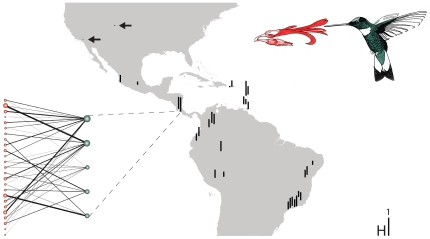
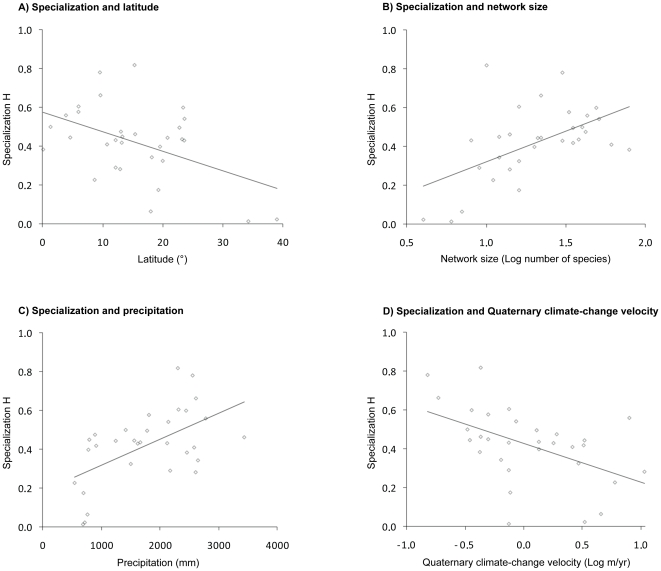
Large-scale geographical patterns of biotic specialization and the underlying drivers are poorly understood, but it is widely believed that climate plays an important role in determining specialization. As climate-driven range dynamics should diminish local adaptations and favor generalization, one hypothesis is that contemporary biotic specialization is determined by the degree of past climatic instability, primarily Quaternary climate-change velocity. Other prominent hypotheses predict that either contemporary climate or species richness affect biotic specialization. To gain insight into geographical patterns of contemporary biotic specialization and its drivers, we use network analysis to determine the degree of specialization in plant-hummingbird mutualistic networks sampled at 31 localities, spanning a wide range of climate regimes across the Americas. We found greater biotic specialization at lower latitudes, with latitude explaining 20-22% of the spatial variation in plant-hummingbird specialization. Potential drivers of specialization--contemporary climate, Quaternary climate-change velocity, and species richness--had superior explanatory power, together explaining 53-64% of the variation in specialization. Notably, our data provides empirical evidence for the hypothesized roles of species richness, contemporary precipitation and Quaternary climate-change velocity as key predictors of biotic specialization, whereas contemporary temperature and seasonality seem unimportant in determining specialization. These results suggest that both ecological and evolutionary processes at Quaternary time scales can be important in driving large-scale geographical patterns of contemporary biotic specialization, at least for co-evolved systems such as plant-hummingbird networks.
生物特化的大规模地理格局及其潜在驱动因素尚未被充分理解,但人们普遍认为气候在决定特化方面起着重要作用。由于气候驱动的范围动态变化应减少局部适应并有利于概括,因此有一个假设是,当代生物特化是由过去气候不稳定性的程度决定的,主要是第四纪气候变化速度。其他突出的假设预测,当代气候或物种丰富度会影响生物特化。为了深入了解当代生物特化的地理格局及其驱动因素,我们使用网络分析来确定在美洲 31 个地点采样的植物-蜂鸟共生网络的特化程度,这些地点涵盖了广泛的气候制度。我们发现,在较低的纬度地区,生物特化程度更高,纬度解释了植物-蜂鸟特化程度空间变化的 20-22%。特化的潜在驱动因素——当代气候、第四纪气候变化速度和物种丰富度——具有更好的解释能力,共同解释了特化程度的 53-64%。值得注意的是,我们的数据为物种丰富度、当代降水和第四纪气候变化速度作为生物特化关键预测因子的假设作用提供了经验证据,而当代温度和季节性似乎在决定特化程度方面不重要。这些结果表明,在第四纪时间尺度上,生态和进化过程都可以在驱动当代生物特化的大规模地理格局中发挥重要作用,至少对于像植物-蜂鸟网络这样的共同进化系统而言是如此。