Department of Biomedical Sciences and Veterinary Public Health, Section of Virology, The Swedish University of Agricultural Sciences, Ulls Väg 2B, SE-751 89 Uppsala, Sweden.
Vet Microbiol. 2012 Mar 23;155(2-4):237-46. doi: 10.1016/j.vetmic.2011.09.022. Epub 2011 Sep 25.
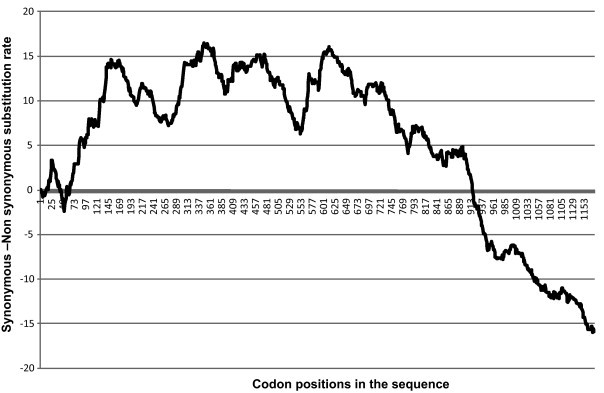
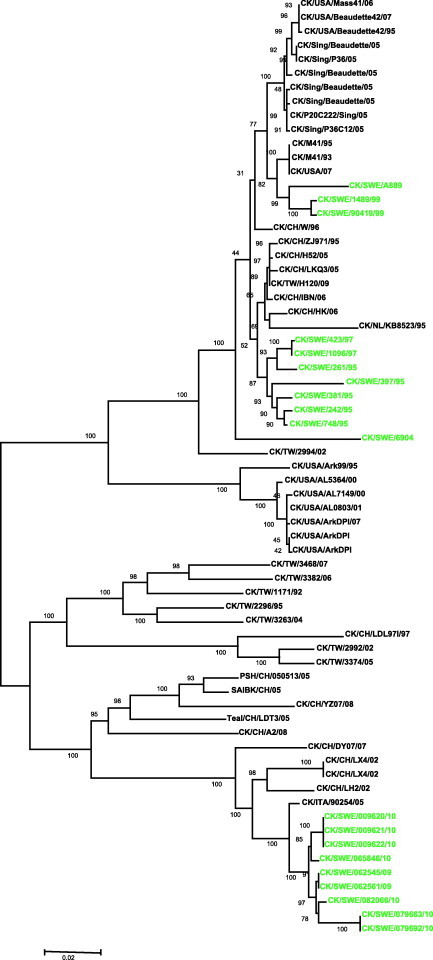
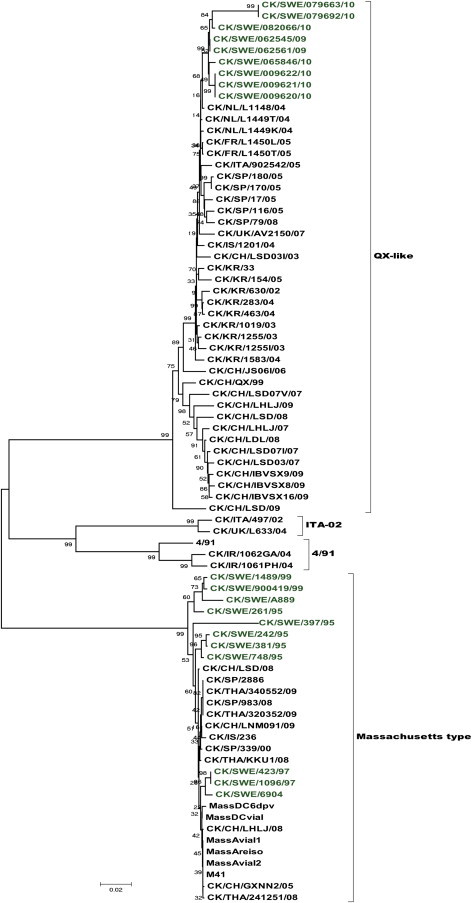
Infectious bronchitis virus (IBV) causes avian infectious bronchitis, an important disease that produces severe economic losses in the poultry industry worldwide. Recent IBV infections in Sweden have been associated with poor growth in broilers, drop in egg production and thin egg shells in layers. The complete spike gene of selected isolates from IBV cases was amplified and sequenced using conventional RT-PCR. Nucleotide and amino acid sequence comparisons have shown that the recent isolates bear 98.97% genetic similarity with strains of the QX-like genotype. The phylogenetic analysis revealed that strains predominant in the nineties, which were of the Massachusetts type, have been replaced by D388/QX-like strains, however the evolutionary link could not be established. The homology between the two genotypes was 79 and 81%. Remarkably, a strong positive selection pressure was determined, mostly involving the S1 subunit of the S gene. This strong selective pressure resulted in recombination events, insertions and deletions in the S gene. Two new isolates generated from recombination were found with nucleotide sequence diverging 1.7-2.4% from the D388/QX-like branch, indicating the emergence of a new lineage. The study demonstrates a constant evolution of IBV that might be in relation to increased poultry farming, trade and vaccine pressure. The findings underscore the importance of continuous monitoring to control spread of infections, as well as to timely adjust diagnostic methods, molecular epidemiological studies, development and use of vaccines that are adapted to the changing disease scenario.
传染性支气管炎病毒(IBV)引起禽类传染性支气管炎,是一种在全球家禽养殖业造成严重经济损失的重要疾病。瑞典最近的 IBV 感染与肉鸡生长不良、产蛋量下降和蛋鸡产薄壳蛋有关。使用常规 RT-PCR 扩增和测序了来自 IBV 病例的选定分离株的完整刺突基因。核苷酸和氨基酸序列比较表明,最近的分离株与 QX 样基因型的菌株具有 98.97%的遗传相似性。系统发育分析表明,90 年代占主导地位的马萨诸塞型菌株已被 D388/QX 样菌株取代,但无法建立进化联系。两种基因型之间的同源性为 79%和 81%。值得注意的是,确定了强烈的正选择压力,主要涉及 S 基因的 S1 亚基。这种强烈的选择压力导致 S 基因发生重组事件、插入和缺失。发现了两个源自重组的新分离株,与 D388/QX 样分支的核苷酸序列差异为 1.7-2.4%,表明出现了一个新谱系。该研究表明 IBV 不断进化,这可能与家禽养殖、贸易和疫苗压力的增加有关。研究结果强调了持续监测以控制感染传播的重要性,以及及时调整诊断方法、分子流行病学研究、开发和使用适应不断变化的疾病情况的疫苗的重要性。