Auditory Neuroscience Laboratory, Northwestern University, Evanston, IL, USA.
Behav Brain Funct. 2011 Oct 17;7:44. doi: 10.1186/1744-9081-7-44.
Neural sensitivity to acoustic regularities supports fundamental human behaviors such as hearing in noise and reading. Although the failure to encode acoustic regularities in ongoing speech has been associated with language and literacy deficits, how auditory expertise, such as the expertise that is associated with musical skill, relates to the brainstem processing of speech regularities is unknown. An association between musical skill and neural sensitivity to acoustic regularities would not be surprising given the importance of repetition and regularity in music. Here, we aimed to define relationships between the subcortical processing of speech regularities, music aptitude, and reading abilities in children with and without reading impairment. We hypothesized that, in combination with auditory cognitive abilities, neural sensitivity to regularities in ongoing speech provides a common biological mechanism underlying the development of music and reading abilities.
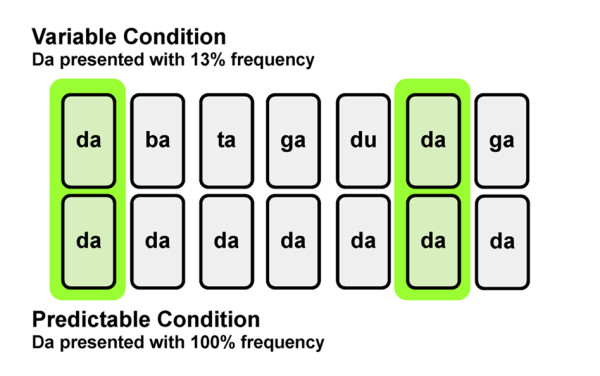
We assessed auditory working memory and attention, music aptitude, reading ability, and neural sensitivity to acoustic regularities in 42 school-aged children with a wide range of reading ability. Neural sensitivity to acoustic regularities was assessed by recording brainstem responses to the same speech sound presented in predictable and variable speech streams.
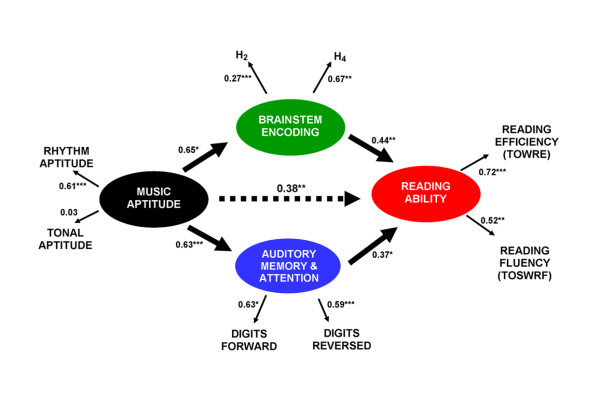
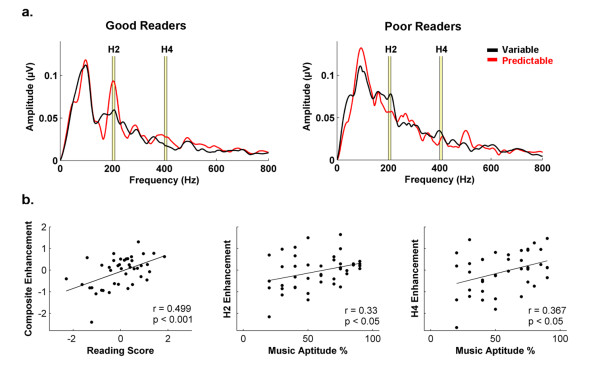
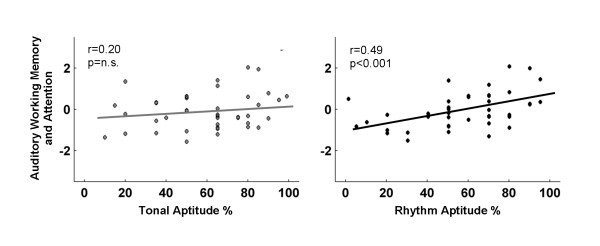
Through correlation analyses and structural equation modeling, we reveal that music aptitude and literacy both relate to the extent of subcortical adaptation to regularities in ongoing speech as well as with auditory working memory and attention. Relationships between music and speech processing are specifically driven by performance on a musical rhythm task, underscoring the importance of rhythmic regularity for both language and music.
These data indicate common brain mechanisms underlying reading and music abilities that relate to how the nervous system responds to regularities in auditory input. Definition of common biological underpinnings for music and reading supports the usefulness of music for promoting child literacy, with the potential to improve reading remediation.
对声音规则的神经敏感性支持着人类的基本行为,例如在噪声中听声音和阅读。尽管在进行中的言语中未能编码声音规则与语言和读写能力缺陷有关,但与听觉专业知识(例如与音乐技能相关的专业知识)相关的脑干对言语规则的处理如何仍是未知的。鉴于重复和规则在音乐中的重要性,音乐技能与对声音规则的神经敏感性之间的关联并不令人惊讶。在这里,我们旨在定义言语规则的皮质下处理、音乐才能和阅读能力之间的关系,这些关系存在于有和没有阅读障碍的儿童中。我们假设,与听觉认知能力相结合,对进行中言语的规则的神经敏感性为音乐和阅读能力的发展提供了一个共同的生物学机制。
我们评估了 42 名学龄儿童的听觉工作记忆和注意力、音乐才能、阅读能力以及对声音规则的神经敏感性,这些儿童的阅读能力范围很广。通过记录对相同语音在可预测和可变语音流中呈现时的脑干反应,评估对声音规则的神经敏感性。
通过相关分析和结构方程建模,我们揭示了音乐才能和读写能力都与皮质下对进行中的言语规则的适应程度以及与听觉工作记忆和注意力有关。音乐和言语处理之间的关系特别受到音乐节奏任务表现的驱动,这突出了节奏规则对语言和音乐的重要性。
这些数据表明,阅读和音乐能力的共同大脑机制与神经系统对听觉输入规则的反应有关。音乐和阅读能力的共同生物学基础的定义支持了音乐对促进儿童读写能力的有用性,具有改善阅读矫正的潜力。