Human Movement Science, NUTRIM, School for Nutrition, Toxicology and Metabolism, Maastricht University Medical Centre, the Netherlands.
BMC Public Health. 2011 Oct 19;11:815. doi: 10.1186/1471-2458-11-815.
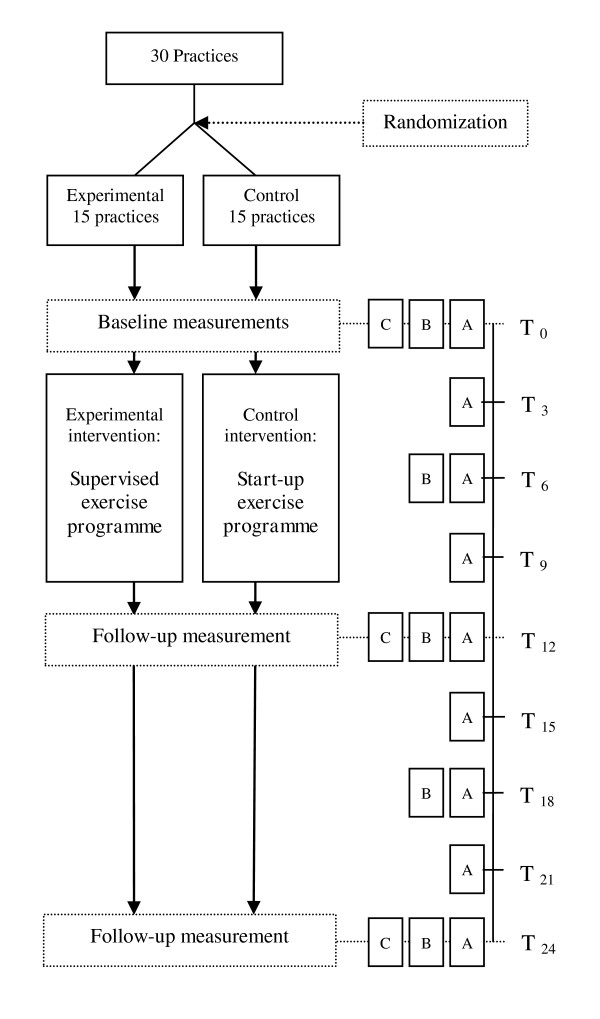
Improving the lifestyle of overweight and obese adults is of increasing interest in view of its role in several chronic diseases. Interventions aiming at overweight or weight-related chronic diseases suffer from high drop-out rates. It has been suggested that Motivational Interviewing and more frequent and more patient-specific coaching could decrease the drop-out rate. 'BeweegKuur' is a multidisciplinary lifestyle intervention which offers three programmes for overweight persons. The effectiveness and the cost-effectiveness of intensively guided programmes, such as the 'supervised exercise programme' of 'BeweegKuur', for patients with high weight-related health risk, remain to be assessed. Our randomized controlled trial compares the expenses and effects of the 'supervised exercise programme' with those of the less intensively supervised 'start-up exercise programme'.
METHODS/DESIGN: The one-year intervention period involves coaching by a lifestyle advisor, a physiotherapist and a dietician, coordinated by general practitioners (GPs). The participating GP practices have been allocated to the interventions, which differ only in terms of the amount of coaching offered by the physiotherapist. Whereas the 'start-up exercise programme' includes several consultations with physiotherapists to identify barriers hampering independent exercising, the 'supervised exercise programme' includes more sessions with a physiotherapist, involving exercise under supervision. The main goal is transfer to local exercise facilities. The main outcome of the study will be the participants' physical activity at the end of the one-year intervention period and after one year of follow-up. Secondary outcomes are dietary habits, health risk, physical fitness and functional capacity. The economic evaluation will consist of a cost-effectiveness analysis and a cost-utility analysis. The primary outcome measures for the economic evaluation will be the physical activity and the number of quality-adjusted life years. Costs will be assessed from a societal perspective with a time horizon of two years. Additionally, a process evaluation will be used to evaluate the performance of the intervention and the participants' evaluation of the intervention.
This study is expected to provide information regarding the additional costs and effects of the 'supervised exercise programme' in adults with very high weight-related health risk.
ISRCTN: ISRCTN46574304.
鉴于生活方式在多种慢性疾病中的作用,改善超重和肥胖成年人的生活方式受到越来越多的关注。旨在治疗超重或与体重相关的慢性疾病的干预措施存在较高的脱落率。有研究表明,动机性访谈和更频繁、更针对患者的辅导可以降低脱落率。“BeweegKuur”是一种多学科的生活方式干预措施,为超重人群提供了三个项目。对于高体重相关健康风险的患者,强化指导项目(如“BeweegKuur”的“监督运动计划”)的有效性和成本效益仍有待评估。我们的随机对照试验比较了“监督运动计划”的费用和效果与监督程度较低的“启动运动计划”的费用和效果。
方法/设计:为期一年的干预期包括由生活方式顾问、物理治疗师和营养师进行辅导,由全科医生(GP)协调。参与的全科医生实践已经被分配到干预措施中,这些干预措施仅在物理治疗师提供的辅导量上有所不同。虽然“启动运动计划”包括与物理治疗师进行几次咨询,以确定阻碍独立运动的障碍,但“监督运动计划”包括更多的物理治疗师会议,包括在监督下进行运动。主要目标是转移到当地的运动设施。研究的主要结果将是参与者在一年干预期结束时和一年随访后的身体活动。次要结果是饮食习惯、健康风险、身体状况和功能能力。经济评估将包括成本效益分析和成本效用分析。经济评估的主要结果测量指标是身体活动和质量调整生命年的数量。将从社会角度评估成本,时间范围为两年。此外,还将进行过程评估,以评估干预措施的效果和参与者对干预措施的评价。
这项研究预计将提供有关非常高体重相关健康风险的成年人中“监督运动计划”的额外成本和效果的信息。
ISRCTN: ISRCTN46574304。