Sadasivam Rajani S, Delaughter Kathryn, Crenshaw Katie, Sobko Heather J, Williams Jessica H, Coley Heather L, Ray Midge N, Ford Daniel E, Allison Jeroan J, Houston Thomas K
Division of Health Informatics and Implementation Science, Quantitative Health Sciences, University of Massachusetts Medical School, Worcester, MA 01545, USA.
J Med Internet Res. 2011 Oct 18;13(4):e87. doi: 10.2196/jmir.1721.
Patient self-management interventions for smoking cessation are effective but underused. Health care providers do not routinely refer smokers to these interventions.
The objective of our study was to uncover barriers and facilitators to the use of an e-referral system that will be evaluated in a community-based randomized trial. The e-referral system will allow providers to refer smokers to an online smoking intervention during routine clinical care.
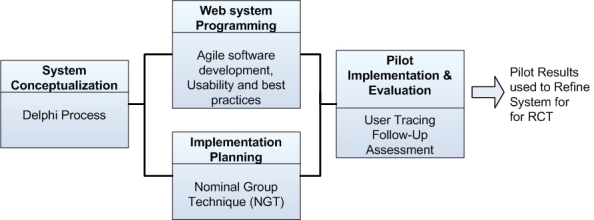
We devised a four-step development and pilot testing process: (1) system conceptualization using Delphi to identify key functionalities that would overcome barriers in provider referrals for smoking cessation, (2) Web system programming using agile software development and best programming practices with usability refinement using think-aloud testing, (3) implementation planning using the nominal group technique for the effective integration of the system into the workflow of practices, and (4) pilot testing to identify practice recruitment and system-use barriers in real-world settings.
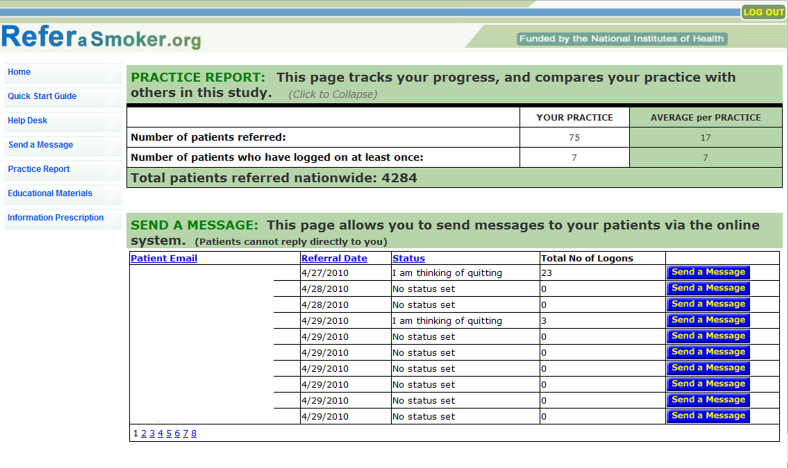
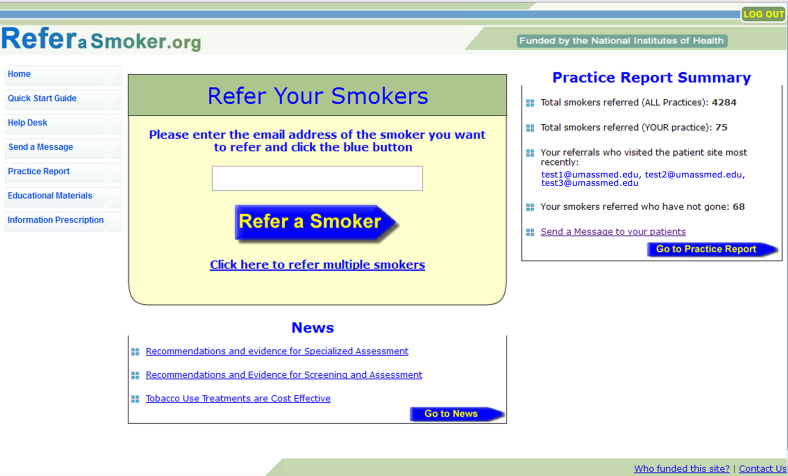
Our Delphi process (step 1) conceptualized three key e-referral functions: (1) Refer Your Smokers, allowing providers to e-refer patients at the point of care by entering their emails directly into the system, (2) practice reports, providing feedback regarding referrals and impact of smoking-cessation counseling, and (3) secure messaging, facilitating provider-patient communication. Usability testing (step 2) suggested the system was easy to use, but implementation planning (step 3) suggested several important approaches to encourage use (eg, proactive email cues to encourage practices to participate). Pilot testing (step 4) in 5 practices had limited success, with only 2 patients referred; we uncovered important recruitment and system-use barriers (eg, lack of study champion, training, and motivation, registration difficulties, and forgetting to refer).
Implementing a system to be used in a clinical setting is complex, as several issues can affect system use. In our ongoing large randomized trial, preliminary analysis with the first 50 practices using the system for 3 months demonstrated that our rigorous preimplementation evaluation helped us successfully identify and overcome these barriers before the main trial.
Clinicaltrials.gov NCT00797628; http://clinicaltrials.gov/ct2/show/NCT00797628 (Archived by WebCite at http://www.webcitation.org/61feCfjCy).
用于戒烟的患者自我管理干预措施有效,但未得到充分利用。医疗保健提供者通常不会将吸烟者转介至这些干预措施。
我们研究的目的是找出在一项基于社区的随机试验中将要评估的电子转介系统使用方面的障碍和促进因素。该电子转介系统将使提供者能够在常规临床护理期间将吸烟者转介至在线戒烟干预措施。
我们设计了一个四步开发和试点测试过程:(1)使用德尔菲法进行系统概念化,以确定能够克服提供者转介戒烟障碍的关键功能;(2)使用敏捷软件开发和最佳编程实践进行网络系统编程,并通过出声思考测试进行可用性优化;(3)使用名义小组技术进行实施规划,以有效地将系统集成到实践工作流程中;(4)进行试点测试,以确定在实际环境中的实践招募和系统使用障碍。
我们的德尔菲法过程(第1步)确定了三个关键的电子转介功能:(1)“转介您的吸烟者”,允许提供者通过直接在系统中输入患者电子邮件在护理点进行电子转介;(2)实践报告,提供有关转介和戒烟咨询影响的反馈;(3)安全消息传递,促进提供者与患者之间的沟通。可用性测试(第2步)表明该系统易于使用,但实施规划(第3步)提出了几种鼓励使用的重要方法(例如,主动发送电子邮件提示以鼓励实践参与)。在5个实践点进行的试点测试(第4步)取得的成功有限,仅转介了2名患者;我们发现了重要的招募和系统使用障碍(例如,缺乏研究支持者、培训和动力、注册困难以及忘记转介)。
在临床环境中实施一个系统很复杂,因为有几个问题会影响系统的使用。在我们正在进行的大型随机试验中,对最初使用该系统3个月的50个实践点进行的初步分析表明,我们严格的实施前评估帮助我们在主要试验之前成功识别并克服了这些障碍。
Clinicaltrials.gov NCT00797628;http://clinicaltrials.gov/ct2/show/NCT00797628(由WebCite存档于http://www.webcitation.org/61feCfjCy)。