Australian and New Zealand Intensive Care - Research Centre, School of Public Health and Preventive Medicine, Monash University, Commercial Road, Melbourne, VIC, Australia.
Crit Care. 2011;15(5):R242. doi: 10.1186/cc10497. Epub 2011 Oct 20.
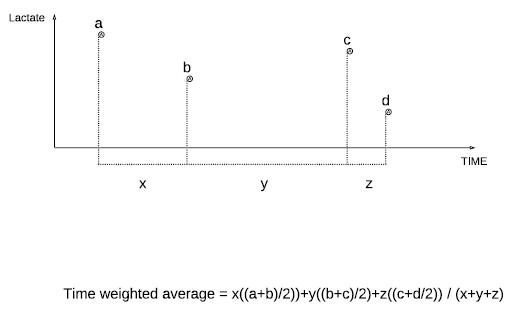
Dynamic changes in lactate concentrations in the critically ill may predict patient outcome more accurately than static indices. We aimed to compare the predictive value of dynamic indices of lactatemia in the first 24 hours of intensive care unit (ICU) admission with the value of more commonly used static indices.
This was a retrospective observational study of a prospectively obtained intensive care database of 5,041 consecutive critically ill patients from four Australian university hospitals. We assessed the relationship between dynamic lactate values collected in the first 24 hours of ICU admission and both ICU and hospital mortality.
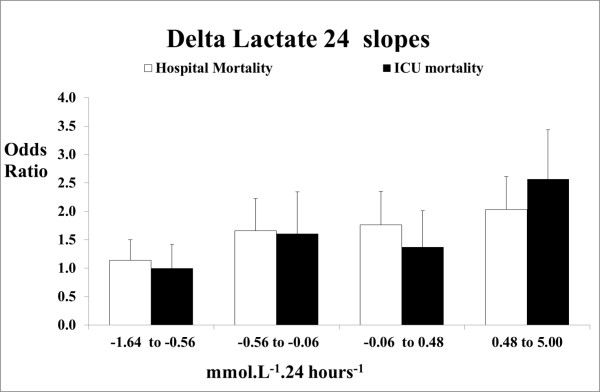
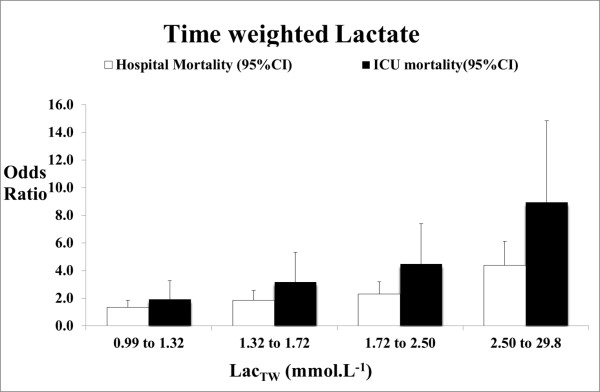
We obtained 36,673 lactate measurements in 5,041 patients in the first 24 hours of ICU admission. Both the time weighted average lactate (LACTW₂₄) and the change in lactate (LACΔ₂₄) over the first 24 hours were independently predictive of hospital mortality with both relationships appearing to be linear in nature. For every one unit increase in LACTW₂₄ and LACΔ₂₄ the risk of hospital death increased by 37% (OR 1.37, 1.29 to 1.45; P < 0.0001) and by 15% (OR 1.15, 1.10 to 1.20; P < 0.0001) respectively. Such dynamic indices, when combined with Acute Physiology and Chronic Health Evaluation II (APACHE II) scores, improved overall outcome prediction (P < 0.0001) achieving almost 90% accuracy. When all lactate measures in the first 24 hours were considered, the combination of LACTW₂₄ and LACΔ₂₄ significantly outperformed (P < 0.0001) static indices of lactate concentration, such as admission lactate, maximum lactate and minimum lactate.
In the first 24 hours following ICU admission, dynamic indices of hyperlactatemia have significant independent predictive value, improve the performance of illness severity score-based outcome predictions and are superior to simple static indices of lactate concentration.
危重病患者乳酸浓度的动态变化可能比静态指标更能准确预测患者的预后。我们旨在比较重症监护病房(ICU)入住后 24 小时内乳酸血症的动态指标与更常用的静态指标的预测价值。
这是一项对来自澳大利亚四所大学医院的 5041 例连续危重病患者前瞻性获得的 ICU 数据库进行的回顾性观察性研究。我们评估了 ICU 入住后 24 小时内收集的动态乳酸值与 ICU 死亡率和医院死亡率之间的关系。
我们在 ICU 入住后 24 小时内获得了 5041 例患者的 36673 次乳酸测量值。时间加权平均乳酸(LACTW₂₄)和 24 小时内乳酸变化(LACΔ₂₄)均独立预测医院死亡率,两者的关系似乎呈线性。LACTW₂₄ 和 LACΔ₂₄ 每增加一个单位,医院死亡的风险分别增加 37%(OR 1.37,1.29 至 1.45;P < 0.0001)和 15%(OR 1.15,1.10 至 1.20;P < 0.0001)。当将这些动态指标与急性生理学和慢性健康评估 II(APACHE II)评分相结合时,改善了整体预后预测(P < 0.0001),准确率接近 90%。当考虑到 24 小时内的所有乳酸测量值时,LACTW₂₄ 和 LACΔ₂₄ 的组合明显优于(P < 0.0001)乳酸浓度的静态指标,如入院时乳酸、最大乳酸和最小乳酸。
在 ICU 入住后的 24 小时内,高乳酸血症的动态指标具有显著的独立预测价值,改善了基于疾病严重程度评分的预后预测的性能,并且优于简单的乳酸浓度静态指标。