Laboratory for Mathematics in Imaging, Harvard Medical School, USA.
Neuroimage. 2012 Feb 15;59(4):4032-43. doi: 10.1016/j.neuroimage.2011.09.074. Epub 2011 Oct 8.
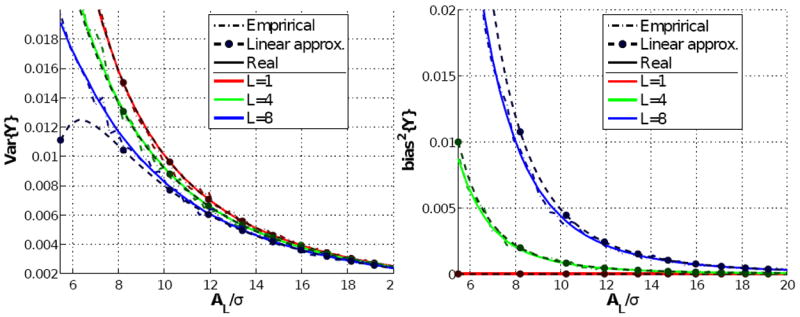
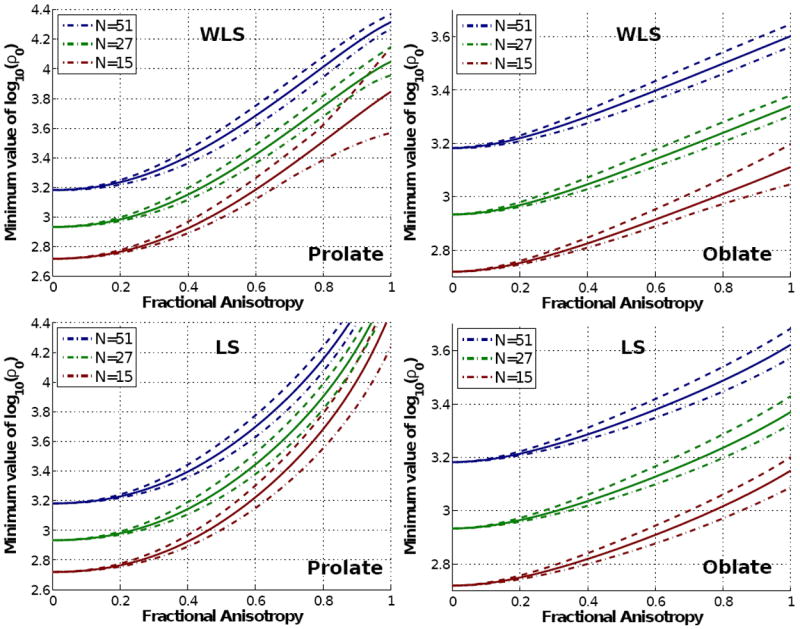
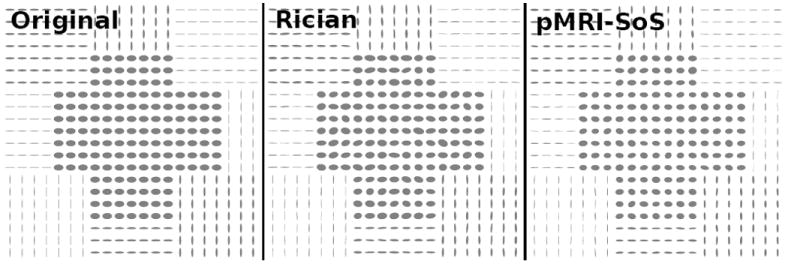
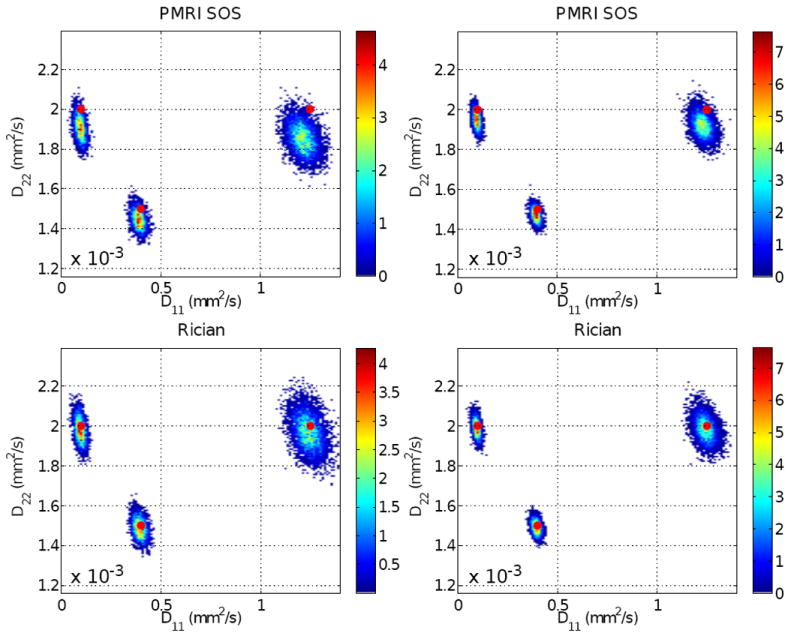
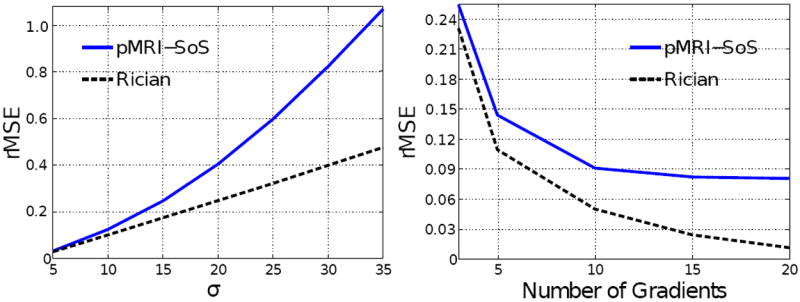
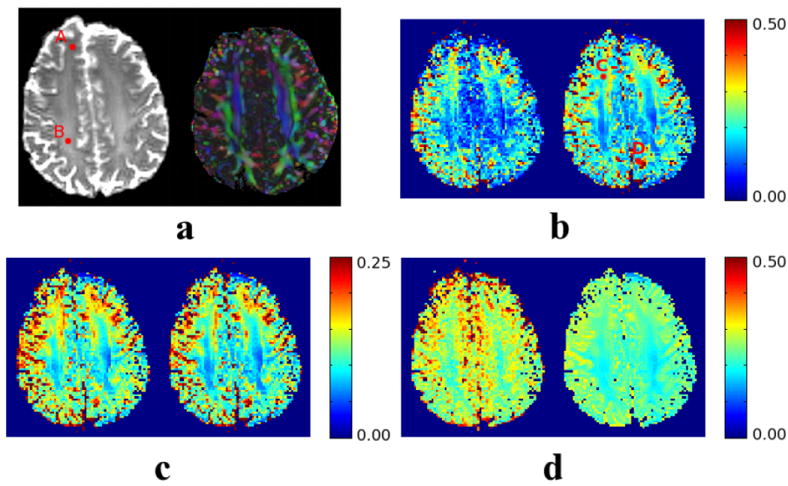
Least Squares (LS) and its minimum variance counterpart, Weighted Least Squares (WLS), have become very popular when estimating the Diffusion Tensor (DT), to the point that they are the standard in most of the existing software for diffusion MRI. They are based on the linearization of the Stejskal-Tanner equation by means of the logarithmic compression of the diffusion signal. Due to the Rician nature of noise in traditional systems, a certain bias in the estimation is known to exist. This artifact has been made patent through some experimental set-ups, but it is not clear how the distortion translates in the reconstructed DT, and how important it is when compared to the other source of error contributing to the Mean Squared Error (MSE) in the estimate, i.e. the variance. In this paper we propose the analytical characterization of log-Rician noise and its propagation to the components of the DT through power series expansions. We conclude that even in highly noisy scenarios the bias for log-Rician signals remains moderate when compared to the corresponding variance. Yet, with the advent of Parallel Imaging (pMRI), the Rician model is not always valid. We make our analysis extensive to a number of modern acquisition techniques through the study of a more general Non Central-Chi (nc-χ) model. Since WLS techniques were initially designed bearing in mind Rician noise, it is not clear whether or not they still apply to pMRI. An important finding in our work is that the common implementation of WLS is nearly optimal when nc-χ noise is considered. Unfortunately, the bias in the estimation becomes far more important in this case, to the point that it may nearly overwhelm the variance in given situations. Furthermore, we evidence that such bias cannot be removed by increasing the number of acquired gradient directions. A number of experiments have been conducted that corroborate our analytical findings, while in vivo data have been used to test the actual relevance of the bias in the estimation.
最小二乘法(LS)及其最小方差对应物,加权最小二乘法(WLS),在估计扩散张量(DT)时变得非常流行,以至于它们是大多数现有的扩散 MRI 软件的标准。它们基于通过对扩散信号进行对数压缩来线性化 Stejskal-Tanner 方程。由于传统系统中噪声的瑞利性质,已知存在一定的估计偏差。通过一些实验设置已经证明了这种伪影的存在,但尚不清楚在重建的 DT 中这种扭曲是如何转化的,以及与导致估计中均方误差(MSE)的其他误差源相比,它有多重要,即方差。在本文中,我们通过幂级数展开提出了对数瑞利噪声的分析特性及其在 DT 分量中的传播。我们得出的结论是,即使在高度嘈杂的情况下,与相应的方差相比,对数瑞利信号的偏差仍然适中。然而,随着并行成像(pMRI)的出现,瑞利模型并不总是有效的。我们通过研究更一般的非中心-χ(nc-χ)模型,将我们的分析扩展到许多现代采集技术。由于 WLS 技术最初是基于瑞利噪声设计的,因此尚不清楚它们是否仍然适用于 pMRI。我们工作中的一个重要发现是,当考虑 nc-χ 噪声时,WLS 的常见实现几乎是最优的。不幸的是,在这种情况下,估计中的偏差变得更加重要,以至于在某些情况下,它可能几乎超过了方差。此外,我们证明,在给定情况下,通过增加采集的梯度方向数量,无法消除这种偏差。已经进行了一些实验来验证我们的分析结果,同时还使用体内数据来测试估计中的偏差的实际相关性。