Department of Anesthesia and Pain Medicine, Pusan National University Hospital, Busan, Korea.
Korean J Anesthesiol. 2011 Sep;61(3):225-32. doi: 10.4097/kjae.2011.61.3.225. Epub 2011 Sep 23.
Both the Trendelenburg position and pneumoperitoneum with carbon dioxide have been reported to increase intracranial pressure (ICP) and to alter cerebral blood flow or cerebral blood volume. Also anesthetic agents have variable effects on cerebral hemodynamics and ICP. The present study was conducted to determine whether regional cerebral oxygen saturation (rSO(2)) values differ between propofol and sevoflurane anesthesia during laparoscopic surgery in the Trendelenburg position.
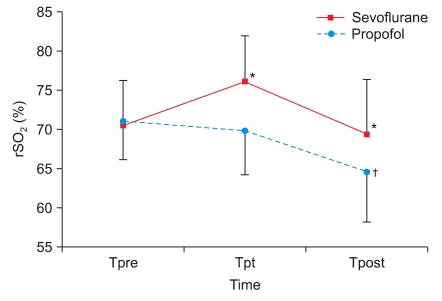
Thirty-two adult women undergoing gynecological laparoscopic surgery were divided into sevoflurane and propofol groups. rSO(2) values were recorded at 10 min after induction in the neutral position (Tpre), 10 min after the pneumoperitoneum in the Trendelenburg position (Tpt) and 10 min after desufflation in the neutral position (Tpost). For analysis of rSO(2), we did ANOVA and univariate two-way ANCOVA with covariates being mean arterial pressure and end tidal carbon dioxide tension.
Between sevoflurane and propofol groups, the change in rSO(2) was significantly different even after ANCOVA. rSO(2) at Tpt (76.3 ± 5.9% in sevoflurane vs 69.4 ± 5.8% in propofol) and Tpost (69.5 ± 7.1% in sevoflurane vs 63.8 ± 6.6% in propofol) were significantly higher in the sevoflurane group compared with the propofol group. In the propofol group, rSO(2) at Tpost was significantly lower than at Tpre (71.1 ± 4.8%) and cerebral oxygen desaturation occurred in two patients (14.3%).
Significantly lower rSO(2) values were observed in the propofol group during gynecological laparoscopic surgery. The possibility of cerebral oxygen desaturation should not be overlooked during propofol anesthesia even after desufflation of the abdomen in the neutral position.
特伦德伦堡体位和二氧化碳气腹均已被报道会增加颅内压(ICP)并改变脑血流或脑血容量。麻醉剂也会对脑血流动力学和 ICP 产生不同的影响。本研究旨在确定在特伦德伦堡体位行腹腔镜手术时,异丙酚和七氟醚麻醉下的局部脑氧饱和度(rSO2)值是否存在差异。
32 例行妇科腹腔镜手术的成年女性患者分为七氟醚组和异丙酚组。在中立位诱导后 10 分钟(Tpre)、特伦德伦堡体位气腹后 10 分钟(Tpt)和中立位放气后 10 分钟(Tpost)记录 rSO2 值。为分析 rSO2,我们进行了方差分析和协方差单因素双向 ANOVA 分析,协变量为平均动脉压和呼气末二氧化碳分压。
即使进行了协方差分析,七氟醚组和异丙酚组之间 rSO2 的变化仍存在显著差异。Tpt 时 rSO2(七氟醚组 76.3 ± 5.9%,异丙酚组 69.4 ± 5.8%)和 Tpost 时 rSO2(七氟醚组 69.5 ± 7.1%,异丙酚组 63.8 ± 6.6%)在七氟醚组中均显著高于异丙酚组。在异丙酚组中,Tpost 时 rSO2 显著低于 Tpre(71.1 ± 4.8%),并且有 2 名患者(14.3%)出现脑氧饱和度降低。
在妇科腹腔镜手术中,异丙酚组的 rSO2 值显著较低。即使在中立位放气后,异丙酚麻醉时也不应忽视脑氧饱和度降低的可能性。