Physiology Department, Georgia Health Sciences University, Augusta, Georgia, GA 30912, USA.
J Alzheimers Dis. 2012;30 Suppl 2(0 2):S5-13. doi: 10.3233/JAD-2011-110899.
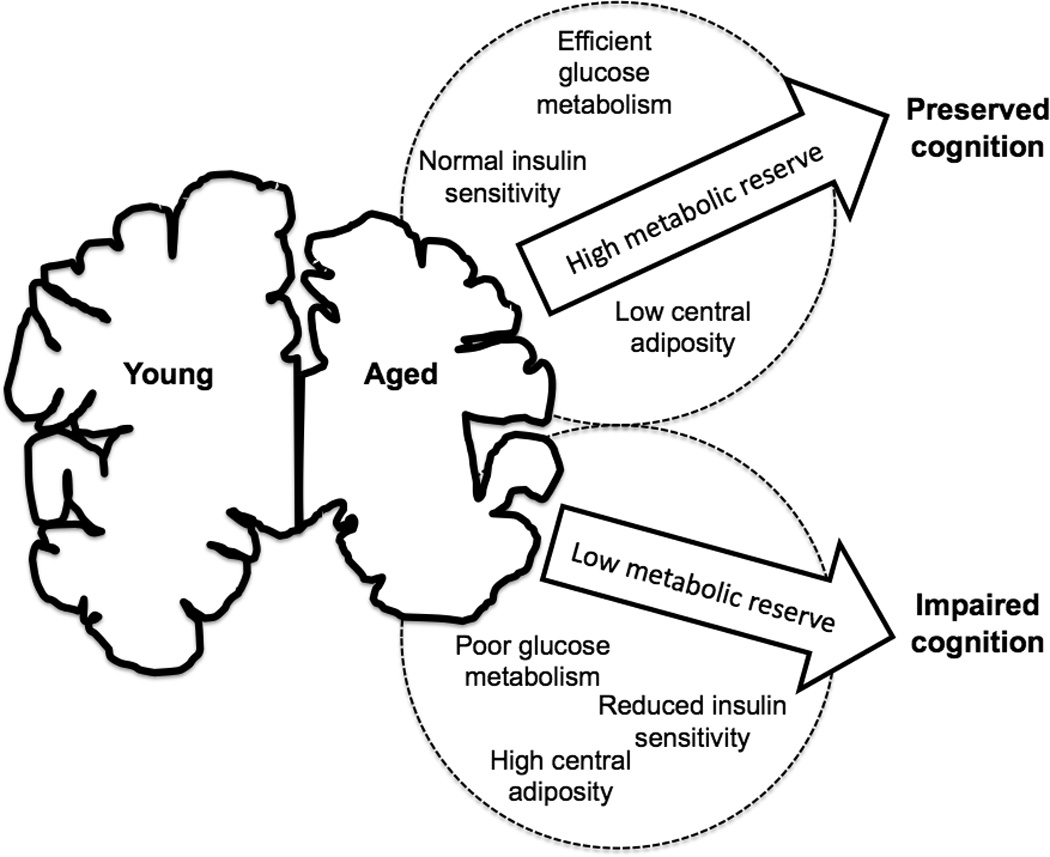
Mild cognitive impairment (MCI) and Alzheimer's disease (AD) represent points on a continuum of cognitive performance in aged populations. Cognition may be impaired or preserved in the context of brain aging. One theory to account for memory maintenance in the context of extensive pathology involves 'cognitive reserve', or the ability to compensate for neuropathology through greater recruitment of remaining neurons. In this review, we propose a complementary hypothesis of 'metabolic reserve', where a brain with high metabolic reserve is characterized by the presence of neuronal circuits that respond adaptively to perturbations in cellular and somatic energy metabolism and thereby protects against declining cognition. Lifestyle determinants of metabolic reserve, such as exercise, reduced caloric intake, and intake of specific dietary components can promote neuroprotection, while pathological states arising from sedentary lifestyles and excessive caloric intake contribute to neuronal endangerment. This bidirectional relationship between metabolism and cognition may be mediated by alterations in central insulin and neurotrophic factor signaling and glucose metabolism, with downstream consequences for accumulation of amyloid-β and hyperphosphorylated tau. The metabolic reserve hypothesis is supported by epidemiological findings and the spectrum of individual cognitive trajectories during aging, with additional data from animal models identifying potential mechanisms for this relationship. Identification of biomarkers for metabolic reserve could assist in generating a predictive model for the likelihood of cognitive decline with aging.
轻度认知障碍(MCI)和阿尔茨海默病(AD)代表了老年人群认知表现的连续体上的两个点。在大脑老化的背景下,认知可能受损或保留。一种解释广泛病理学背景下记忆维持的理论涉及“认知储备”,或者通过更多地招募剩余神经元来补偿神经病理学的能力。在这篇综述中,我们提出了“代谢储备”的互补假设,其中具有高代谢储备的大脑的特征是存在神经元回路,这些回路可以对细胞和体细胞能量代谢的扰动做出适应性反应,从而防止认知能力下降。代谢储备的生活方式决定因素,如运动、减少热量摄入和特定饮食成分的摄入,可以促进神经保护,而久坐不动的生活方式和过量热量摄入引起的病理状态会导致神经元受损。代谢和认知之间的这种双向关系可能是由中枢胰岛素和神经营养因子信号以及葡萄糖代谢的改变介导的,其下游后果是淀粉样β和过度磷酸化 tau 的积累。代谢储备假说得到了流行病学发现和个体认知轨迹在衰老过程中的变化范围的支持,动物模型的额外数据确定了这种关系的潜在机制。鉴定代谢储备的生物标志物可以帮助生成一个预测模型,用于预测随着年龄的增长认知能力下降的可能性。