Université catholique de Louvain, Pole of Pharmacology and Therapeutics, Angiogenesis and Cancer Research Laboratory, Brussels, Belgium.
Dis Model Mech. 2011 Nov;4(6):727-32. doi: 10.1242/dmm.007724.
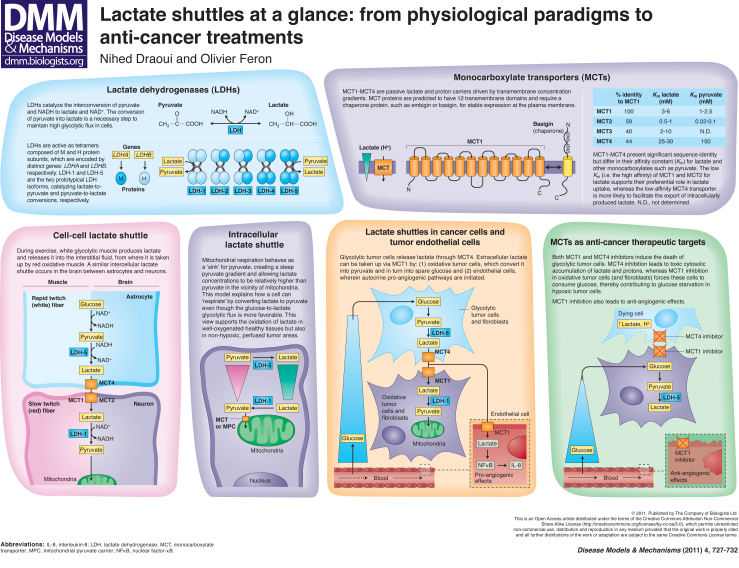
Hypoxia and oncogene expression both stimulate glycolytic metabolism in tumors, thereby leading to lactate production. However, lactate is more than merely a by-product of glycolysis: it can be used as a metabolic fuel by oxidative cancer cells. This phenomenon resembles processes that have been described for skeletal muscle and brain that involve what are known as cell-cell and intracellular lactate shuttles. Two control points regulate lactate shuttles: the lactate dehydrogenase (LDH)-dependent conversion of lactate into pyruvate (and back), and the transport of lactate into and out of cells through specific monocarboxylate transporters (MCTs). In tumors, MCT4 is largely involved in hypoxia-driven lactate release, whereas the uptake of lactate into both tumor cells and tumor endothelial cells occurs via MCT1. Translating knowledge of lactate shuttles to the cancer field offers new perspectives to therapeutically target the hypoxic tumor microenvironment and to tackle tumor angiogenesis.
缺氧和癌基因表达均刺激肿瘤中的糖酵解代谢,从而导致乳酸的产生。然而,乳酸不仅仅是糖酵解的副产物:它可以被氧化癌细胞用作代谢燃料。这种现象类似于已经描述过的骨骼肌和大脑的过程,涉及所谓的细胞间和细胞内乳酸穿梭。两个控制点调节乳酸穿梭:依赖于乳酸脱氢酶(LDH)的将乳酸转化为丙酮酸(反之亦然)的过程,以及通过特定的单羧酸转运蛋白(MCT)将乳酸进出细胞的运输过程。在肿瘤中,MCT4 主要参与缺氧驱动的乳酸释放,而乳酸进入肿瘤细胞和肿瘤内皮细胞则通过 MCT1 进行。将乳酸穿梭的知识转化为癌症领域为治疗性靶向缺氧肿瘤微环境和解决肿瘤血管生成提供了新的视角。