Laboratory for Functional Connectome and Development, Institute of Psychology, Chinese Academy of Sciences, Beijing, China.
PLoS One. 2011;6(10):e26703. doi: 10.1371/journal.pone.0026703. Epub 2011 Oct 31.
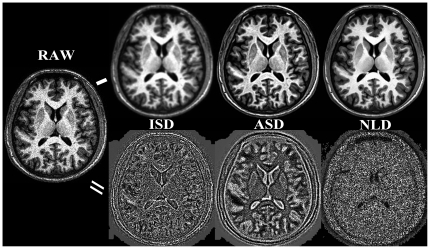
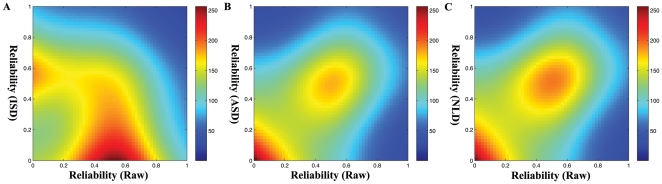
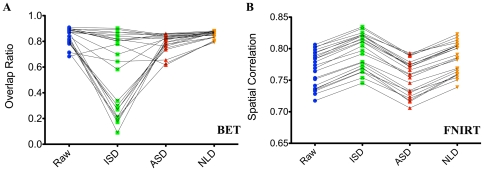
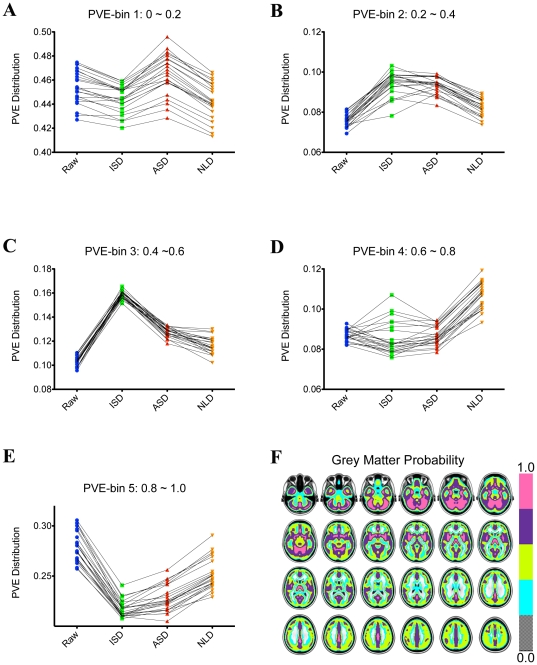
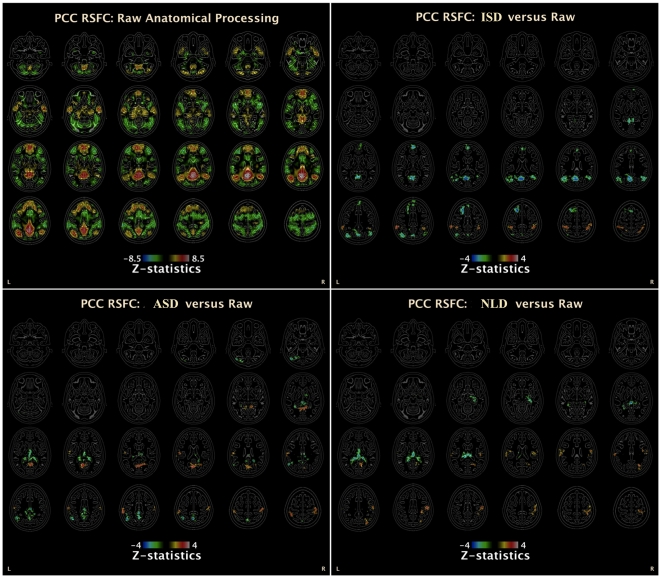
Neuroimaging community usually employs spatial smoothing to denoise magnetic resonance imaging (MRI) data, e.g., Gaussian smoothing kernels. Such an isotropic diffusion (ISD) based smoothing is widely adopted for denoising purpose due to its easy implementation and efficient computation. Beyond these advantages, Gaussian smoothing kernels tend to blur the edges, curvature and texture of images. Researchers have proposed anisotropic diffusion (ASD) and non-local diffusion (NLD) kernels. We recently demonstrated the effect of these new filtering paradigms on preprocessing real degraded MRI images from three individual subjects. Here, to further systematically investigate the effects at a group level, we collected both structural and functional MRI data from 23 participants. We first evaluated the three smoothing strategies' impact on brain extraction, segmentation and registration. Finally, we investigated how they affect subsequent mapping of default network based on resting-state functional MRI (R-fMRI) data. Our findings suggest that NLD-based spatial smoothing maybe more effective and reliable at improving the quality of both MRI data preprocessing and default network mapping. We thus recommend NLD may become a promising method of smoothing structural MRI images of R-fMRI pipeline.
神经影像学领域通常采用空间平滑技术来对磁共振成像(MRI)数据进行降噪,例如高斯平滑核。由于其易于实现和高效计算,这种各向同性扩散(ISD)平滑方法被广泛应用于降噪目的。除了这些优点之外,高斯平滑核往往会使图像的边缘、曲率和纹理变得模糊。研究人员提出了各向异性扩散(ASD)和非局部扩散(NLD)核。我们最近展示了这些新的滤波范例对预处理来自三个个体的真实退化 MRI 图像的效果。在这里,为了在组水平上进一步系统地研究这些效果,我们从 23 名参与者中收集了结构和功能 MRI 数据。我们首先评估了三种平滑策略对脑提取、分割和配准的影响。最后,我们研究了它们如何影响基于静息状态功能磁共振成像(R-fMRI)数据的默认网络的后续映射。我们的研究结果表明,基于 NLD 的空间平滑在提高 MRI 数据预处理和默认网络映射的质量方面可能更有效和可靠。因此,我们建议 NLD 可能成为 R-fMRI 管道结构 MRI 图像平滑的一种有前途的方法。