Laboratory of Biochemistry and Vascular Biology, Division of Hematology, Center for Biologics Evaluation and Research, Food and Drug Administration, Bethesda, Maryland, MD 20892, USA.
Toxins (Basel). 2011 Oct;3(10):1278-93. doi: 10.3390/toxins3101278. Epub 2011 Oct 20.
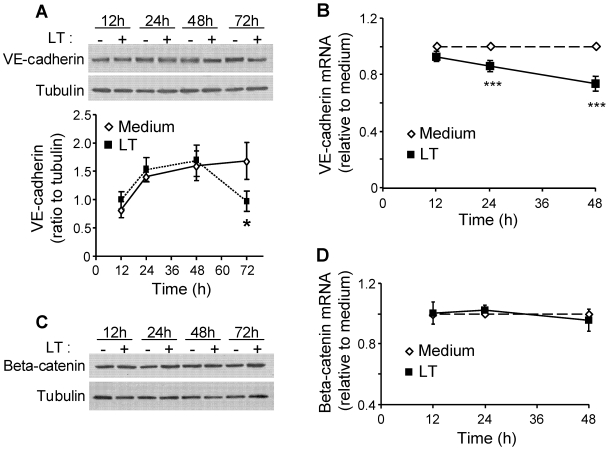
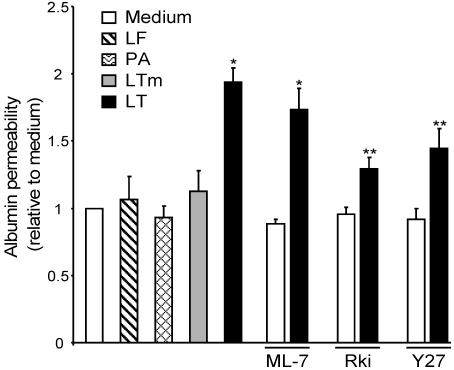
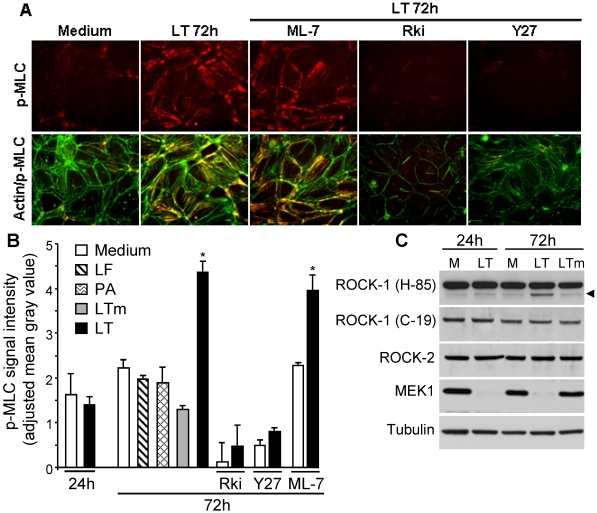
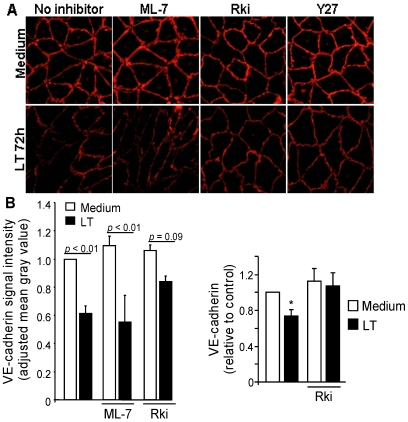
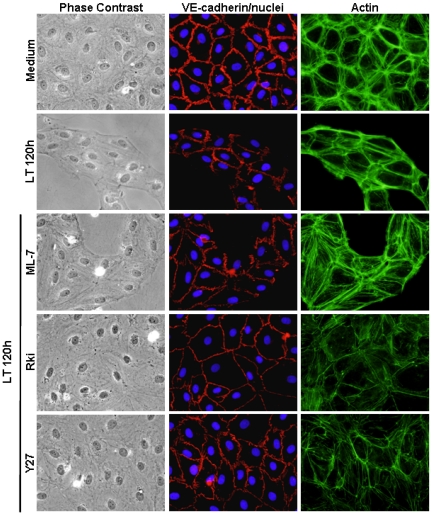
Systemic anthrax disease is characterized by vascular leakage pathologies. We previously reported that anthrax lethal toxin (LT) induces human endothelial barrier dysfunction in a cell death-independent manner with actin stress fiber formation and disruption of adherens junctions (AJs). In the present study, we further characterize the molecular changes in the AJ complex and investigate whether AJ structure and barrier function can be preserved by modulating key cytoskeletal signaling pathways. Here, we show that LT reduces total VE-cadherin protein and gene expression but the expression of the key linker protein beta-catenin remained unchanged. The changes in VE-cadherin expression correlated temporally with the appearance of actin stress fibers and a two-fold increase in phosphorylation of the stress fiber-associated protein myosin light chain (p-MLC) and cleavage of Rho-associated kinase-1 (ROCK-1). Co-treatment with ROCK inhibitors (H-1152 and Y27632), but not an inhibitor of MLC kinase (ML-7), blocked LT-induced p-MLC enhancement and stress fiber formation. This was accompanied by the restoration of VE-cadherin expression and membrane localization, and attenuation of the LT-induced increase in monolayer permeability to albumin. Together, these findings suggest the ROCK pathway may be a relevant target for countering LT-mediated endothelial barrier dysfunction.
系统性炭疽病的特征是血管渗漏性病变。我们之前曾报道过,炭疽致死毒素(LT)以细胞死亡非依赖性的方式诱导人内皮细胞屏障功能障碍,导致肌动蛋白应力纤维形成和黏附连接(AJ)破坏。在本研究中,我们进一步描述了 AJ 复合物的分子变化,并研究了是否可以通过调节关键细胞骨架信号通路来维持 AJ 结构和屏障功能。在这里,我们表明 LT 降低了总 VE-钙粘蛋白蛋白和基因表达,但关键连接蛋白β-连环蛋白的表达保持不变。VE-钙粘蛋白表达的变化与肌动蛋白应力纤维的出现以及应激纤维相关蛋白肌球蛋白轻链(p-MLC)的磷酸化增加两倍和 Rho 相关激酶-1(ROCK-1)的切割呈时间相关性。用 ROCK 抑制剂(H-1152 和 Y27632)共同处理,而不是肌球蛋白轻链激酶(ML-7)抑制剂,可阻断 LT 诱导的 p-MLC 增强和应力纤维形成。这伴随着 VE-钙粘蛋白表达和膜定位的恢复,以及 LT 诱导的白蛋白单层通透性增加的减弱。总之,这些发现表明 ROCK 途径可能是对抗 LT 介导的内皮细胞屏障功能障碍的一个相关靶点。