Institute of Molecular Pathology and Immunology of the University of Porto, Porto, Portugal.
PLoS One. 2011;6(11):e26970. doi: 10.1371/journal.pone.0026970. Epub 2011 Nov 2.
Gastric carcinoma is the second leading cause of cancer-associated death worldwide. The high mortality associated with this disease is in part due to limited knowledge about gastric carcinogenesis and a lack of available therapeutic and prevention strategies. MUC1 is a high molecular weight transmembrane mucin protein expressed at the apical surface of most glandular epithelial cells and a major component of the mucus layer above gastric mucosa. Overexpression of MUC1 is found in approximately 95% of human adenocarcinomas, where it is associated with oncogenic activity. The role of MUC1 in gastric cancer progression remains to be clarified.
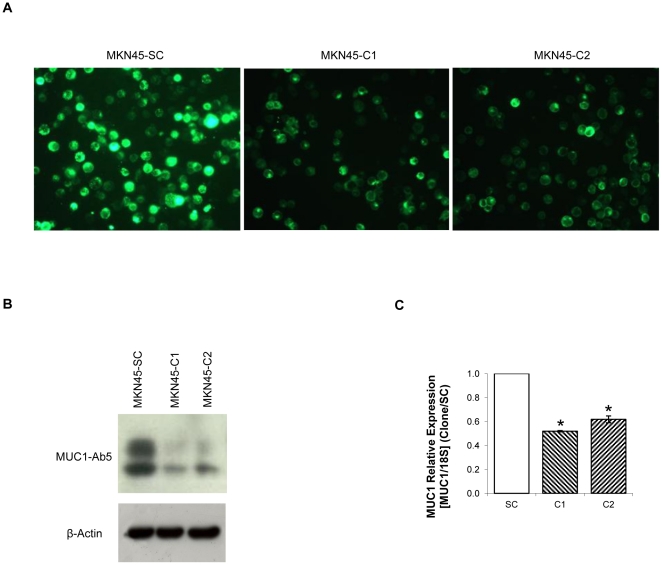
We downregulated MUC1 expression in a gastric carcinoma cell line by RNA interference and studied the effects on cellular proliferation (MTT assay), apoptosis (TUNEL assay), migration (migration assay), invasion (invasion assay) and aggregation (aggregation assay). Global gene expression was evaluated by microarray analysis to identify alterations that are regulated by MUC1 expression. In vivo assays were also performed in mice, in order to study the tumorigenicity of cells with and without MUC1 downregulation in MKN45 gastric carcinoma cell line.
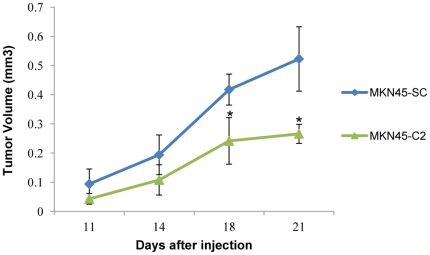
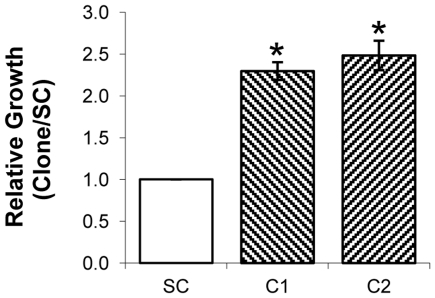
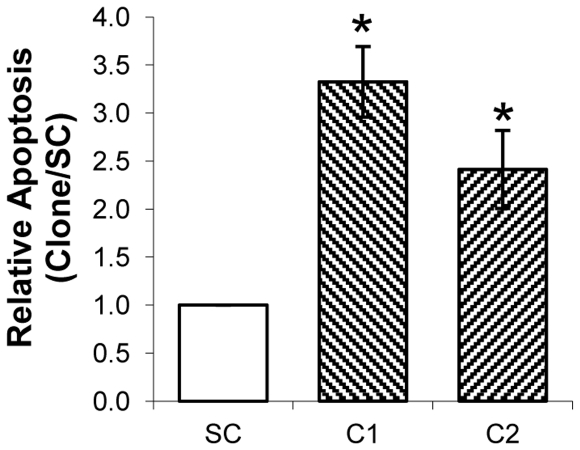
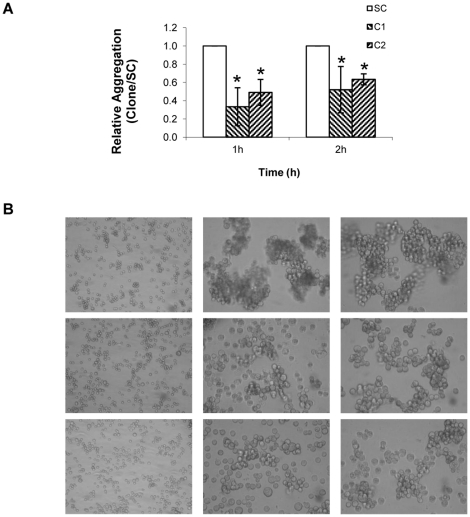
Downregulation of MUC1 expression increased proliferation and apoptosis as compared to controls, whereas cell-cell aggregation was decreased. No significant differences were found in terms of migration and invasion between the downregulated clones and the controls. Expression of TCN1, KLK6, ADAM29, LGAL4, TSPAN8 and SHPS-1 was found to be significantly different between MUC1 downregulated clones and the control cells. In vivo assays have shown that mice injected with MUC1 downregulated cells develop smaller tumours when compared to mice injected with the control cells.
These results indicate that MUC1 downregulation alters the phenotype and tumorigenicity of MKN45 gastric carcinoma cells and also the expression of several molecules that can be involved in tumorigenic events. Therefore, MUC1 should be further studied to better clarify its potential as a novel therapeutic target for gastric cancer.
胃癌是全球癌症相关死亡的第二大主要原因。这种疾病的高死亡率部分归因于对胃癌发生机制的了解有限,以及缺乏可用的治疗和预防策略。MUC1 是一种高分子量跨膜粘蛋白,在大多数腺上皮细胞的顶端表面表达,是胃黏膜上方粘液层的主要成分。约 95%的人类腺癌中存在 MUC1 的过表达,其与致癌活性有关。MUC1 在胃癌进展中的作用仍有待阐明。
我们通过 RNA 干扰下调了胃癌细胞系中的 MUC1 表达,并研究了对细胞增殖(MTT 检测)、凋亡(TUNEL 检测)、迁移(迁移检测)、侵袭(侵袭检测)和聚集(聚集检测)的影响。通过微阵列分析评估了全局基因表达,以确定受 MUC1 表达调控的变化。还在小鼠中进行了体内实验,以研究 MKN45 胃癌细胞系中下调 MUC1 表达的细胞与对照细胞的致瘤性。
与对照组相比,下调 MUC1 表达可增加增殖和凋亡,而细胞间聚集减少。下调克隆与对照组之间在迁移和侵袭方面没有发现显著差异。MUC1 下调克隆与对照细胞之间的 TCN1、KLK6、ADAM29、LGAL4、TSPAN8 和 SHPS-1 的表达被发现存在显著差异。体内实验表明,与注射对照细胞的小鼠相比,注射下调 MUC1 表达的细胞的小鼠肿瘤更小。
这些结果表明,下调 MUC1 改变了 MKN45 胃癌细胞的表型和致瘤性,以及参与致瘤事件的几个分子的表达。因此,应进一步研究 MUC1,以更好地阐明其作为胃癌新的治疗靶点的潜力。