School of Life Sciences, The Chinese University of Hong Kong, Hong Kong, China.
PLoS One. 2011;6(11):e27228. doi: 10.1371/journal.pone.0027228. Epub 2011 Nov 2.
Coronaviruses (CoVs) can be classified into alphacoronavirus (group 1), betacoronavirus (group 2), and gammacoronavirus (group 3) based on diversity of the protein sequences. Their 3C-like protease (3CL(pro)), which catalyzes the proteolytic processing of the polyproteins for viral replication, is a potential target for anti-coronaviral infection.
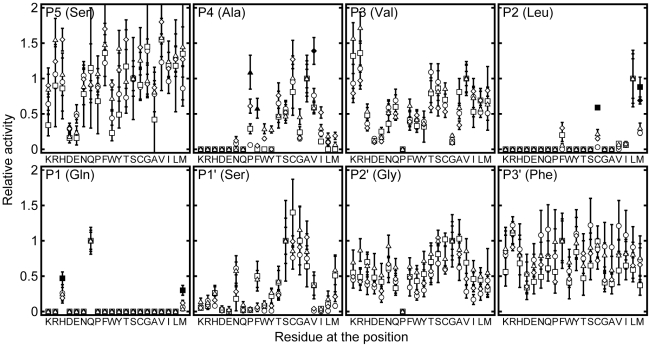
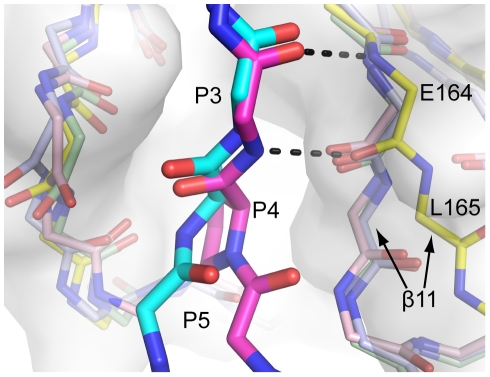
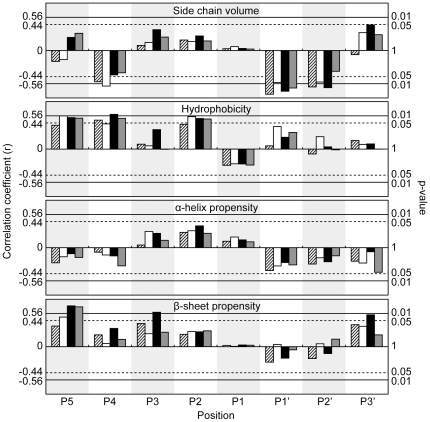
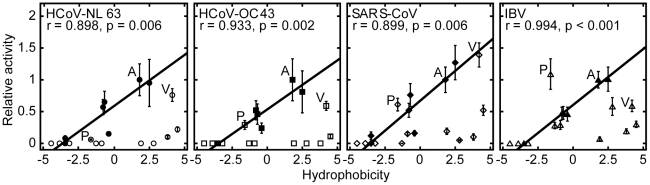
METHODOLOGY/PRINCIPAL FINDINGS: Here, we profiled the substrate specificities of 3CL(pro) from human CoV NL63 (group 1), human CoV OC43 (group 2a), severe acute respiratory syndrome coronavirus (SARS-CoV) (group 2b) and infectious bronchitis virus (IBV) (group 3), by measuring their activity against a substrate library of 19 × 8 of variants with single substitutions at P5 to P3' positions. The results were correlated with structural properties like side chain volume, hydrophobicity, and secondary structure propensities of substituting residues. All 3CL(pro) prefer Gln at P1 position, Leu at P2 position, basic residues at P3 position, small hydrophobic residues at P4 position, and small residues at P1' and P2' positions. Despite 3CL(pro) from different groups of CoVs share many similarities in substrate specificities, differences in substrate specificities were observed at P4 positions, with IBV 3CL(pro) prefers P4-Pro and SARS-CoV 3CL(pro) prefers P4-Val. By combining the most favorable residues at P3 to P5 positions, we identified super-active substrate sequences 'VARLQ↓SGF' that can be cleaved efficiently by all 3CL(pro) with relative activity of 1.7 to 3.2, and 'VPRLQ↓SGF' that can be cleaved specifically by IBV 3CL(pro) with relative activity of 4.3.
CONCLUSIONS/SIGNIFICANCE: The comprehensive substrate specificities of 3CL(pro) from each of the group 1, 2a, 2b, and 3 CoVs have been profiled in this study, which may provide insights into a rational design of broad-spectrum peptidomimetic inhibitors targeting the proteases.
冠状病毒(CoV)可根据蛋白序列多样性分为甲型冠状病毒(第 1 组)、乙型冠状病毒(第 2 组)和丙型冠状病毒(第 3 组)。其 3C 样蛋白酶(3CL(pro))可催化病毒复制的多蛋白的蛋白水解加工,是抗冠状病毒感染的潜在靶点。
方法/主要发现:在这里,我们通过测量其对 P5 到 P3' 位置具有单个取代的 19×8 变体底物库的活性,对来自人冠状病毒 NL63(第 1 组)、人冠状病毒 OC43(第 2a 组)、严重急性呼吸综合征冠状病毒(SARS-CoV)(第 2b 组)和传染性支气管炎病毒(IBV)(第 3 组)的 3CL(pro)的底物特异性进行了分析。结果与取代残基的侧链体积、疏水性和二级结构倾向等结构特性相关。所有 3CL(pro)均优先选择 P1 位的 Gln、P2 位的 Leu、P3 位的碱性残基、P4 位的小疏水性残基以及 P1'和 P2'位的小残基。尽管不同组 CoV 的 3CL(pro)在底物特异性上有许多相似之处,但在 P4 位置观察到了底物特异性的差异,其中 IBV 3CL(pro)优先选择 P4-Pro,而 SARS-CoV 3CL(pro)优先选择 P4-Val。通过组合 P3 到 P5 位置的最佳残基,我们鉴定出了超活性的底物序列“VARLQ↓SGF”,所有 3CL(pro)均可有效地切割该序列,相对活性为 1.7 到 3.2,以及“VPRLQ↓SGF”,该序列可被 IBV 3CL(pro)特异性切割,相对活性为 4.3。
结论/意义:本研究对每组 1、2a、2b 和 3 CoV 的 3CL(pro)的综合底物特异性进行了分析,这可能为靶向蛋白酶的广谱肽拟肽抑制剂的合理设计提供了思路。