Departments of Internal Medicine, Tongji Hospital, Tongji Medical College, Huazhong University of Science and Technology, Wuhan, China.
PLoS One. 2011;6(11):e27294. doi: 10.1371/journal.pone.0027294. Epub 2011 Nov 2.
Long-term β-adrenergic receptor (β-AR) blockade reduces mortality in patients with heart failure. Chronic sympathetic hyperactivity in heart failure causes sustained β-AR activation, and this can deplete Ca(2+) in endoplasmic reticulum (ER) leading to ER stress and subsequent apoptosis. We tested the effect of β-AR blockers on ER stress pathway in experimental model of heart failure.
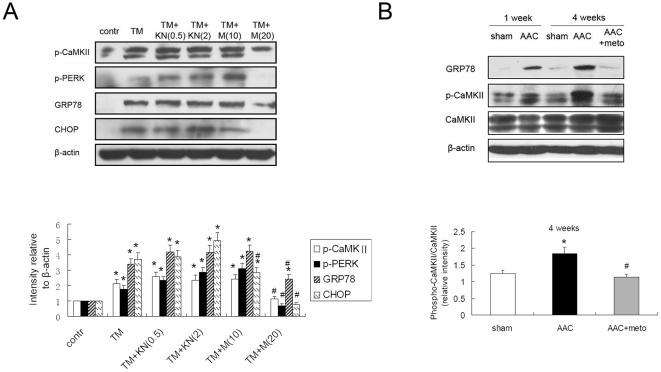
ER chaperones were markedly increased in failing hearts of patients with end-stage heart failure. In Sprague-Dawley rats, cardiac hypertrophy and heart failure was induced by abdominal aortic constriction or isoproterenol subcutaneous injection. Oral β-AR blockers treatment was performed in therapy groups. Cardiac remodeling and left ventricular function were analyzed in rats failing hearts. After 4 or 8 weeks of banding, rats developed cardiac hypertrophy and failure. Cardiac expression of ER chaperones was significantly increased. Similar to the findings above, sustained isoproterenol infusion for 2 weeks induced cardiac hypertrophy and failure with increased ER chaperones and apoptosis in hearts. β-AR blockers treatment markedly attenuated these pathological changes and reduced ER stress and apoptosis in failing hearts. On the other hand, β-AR agonist isoproterenol induced ER stress and apoptosis in cultured cardiomyocytes. β-AR blockers largely prevented ER stress and protected myocytes against apoptosis. And β-AR blockade significantly suppressed the overactivation of CaMKII in isoproterenol-stimulated cardiomyocytes and failing hearts in rats.
Our results demonstrated that ER stress occurred in failing hearts and this could be reversed by β-AR blockade. Alleviation of ER stress may be an important mechanism underlying the therapeutic effect of β-AR blockers on heart failure.
长期β-肾上腺素能受体(β-AR)阻断可降低心力衰竭患者的死亡率。心力衰竭中慢性交感神经活性亢进导致β-AR持续激活,这会耗尽内质网(ER)中的 Ca(2+),导致 ER 应激和随后的细胞凋亡。我们测试了β-AR 阻滞剂对心力衰竭实验模型中 ER 应激途径的影响。
终末期心力衰竭患者衰竭心脏中的 ER 伴侣明显增加。在 Sprague-Dawley 大鼠中,通过腹主动脉缩窄或异丙肾上腺素皮下注射诱导心脏肥大和心力衰竭。在治疗组中进行口服β-AR 阻滞剂治疗。在大鼠衰竭心脏中分析心脏重构和左心室功能。在捆绑后 4 或 8 周,大鼠发生心脏肥大和衰竭。心脏 ER 伴侣的表达明显增加。与上述发现相似,持续异丙肾上腺素输注 2 周可诱导心脏肥大和衰竭,导致 ER 伴侣和心脏中的细胞凋亡增加。β-AR 阻滞剂治疗可显著减轻这些病理变化,减少衰竭心脏中的 ER 应激和细胞凋亡。另一方面,β-AR 激动剂异丙肾上腺素在培养的心肌细胞中诱导 ER 应激和细胞凋亡。β-AR 阻滞剂在很大程度上防止了 ER 应激,并保护心肌细胞免受凋亡。β-AR 阻断还显著抑制了异丙肾上腺素刺激的心肌细胞和大鼠衰竭心脏中过度激活的 CaMKII。
我们的结果表明,ER 应激发生在衰竭的心脏中,β-AR 阻断可逆转这种应激。减轻 ER 应激可能是β-AR 阻滞剂治疗心力衰竭的重要机制。