National Center for STD Control, Chinese Academy of Medical Sciences and Peking Union Medical College Institute of Dermatology, Nanjing, China.
PLoS Negl Trop Dis. 2011 Nov;5(11):e1273. doi: 10.1371/journal.pntd.0001273. Epub 2011 Nov 8.
Syphilis is resurgent in many regions of the world. Molecular typing is a robust tool for investigating strain diversity and epidemiology. This study aimed to review original research on molecular typing of Treponema pallidum (T. pallidum) with three objectives: (1) to determine specimen types most suitable for molecular typing; (2) to determine T. pallidum subtype distribution across geographic areas; and (3) to summarize available information on subtypes associated with neurosyphilis and macrolide resistance.
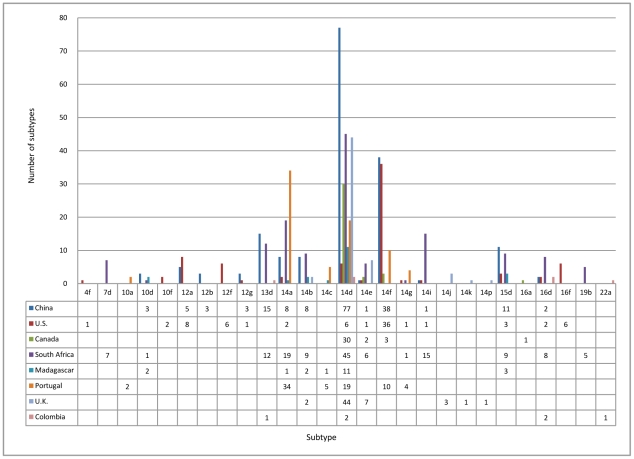
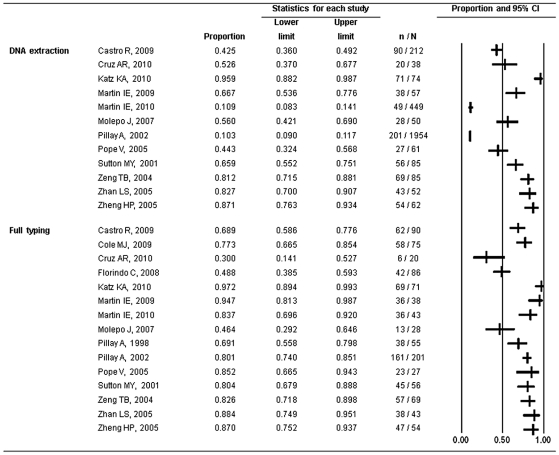
METHODOLOGY/PRINCIPAL FINDINGS: Two researchers independently searched five databases from 1998 through 2010, assessed for eligibility and study quality, and extracted data. Search terms included "Treponema pallidum," or "syphilis," combined with the subject headings "molecular," "subtyping," "typing," "genotype," and "epidemiology." Sixteen eligible studies were included. Publication bias was not statistically significant by the Begg rank correlation test. Medians, inter-quartile ranges, and 95% confidence intervals were determined for DNA extraction and full typing efficiency. A random-effects model was used to perform subgroup analyses to reduce obvious between-study heterogeneity. Primary and secondary lesions and ear lobe blood specimens had an average higher yield of T. pallidum DNA (83.0% vs. 28.2%, χ(2) = 247.6, p<0.001) and an average higher efficiency of full molecular typing (80.9% vs. 43.1%, χ(2) = 102.3, p<0.001) compared to plasma, whole blood, and cerebrospinal fluid. A pooled analysis of subtype distribution based on country location showed that 14d was the most common subtype, and subtype distribution varied across geographic areas. Subtype data associated with macrolide resistance and neurosyphilis were limited.
CONCLUSIONS/SIGNIFICANCE: Primary lesion was a better specimen for obtaining T. pallidum DNA than blood. There was wide geographic variation in T. pallidum subtypes. More research is needed on the relationship between clinical presentation and subtype, and further validation of ear lobe blood for obtaining T. pallidum DNA would be useful for future molecular studies of syphilis.
梅毒在世界许多地区死灰复燃。分子分型是研究菌株多样性和流行病学的有力工具。本研究旨在回顾梅毒螺旋体(T. pallidum)的分子分型的原始研究,目的有三:(1)确定最适合分子分型的标本类型;(2)确定地理区域内 T. pallidum 亚型的分布情况;(3)总结有关神经梅毒和大环内酯类耐药性相关亚型的现有信息。
方法/主要发现:两名研究人员于 1998 年至 2010 年期间独立检索了五个数据库,评估其纳入标准和研究质量,并提取数据。检索词包括“Treponema pallidum”或“syphilis”,与“molecular”、“subtyping”、“typing”、“genotype”和“epidemiology”等主题词相结合。共有 16 项符合条件的研究被纳入。贝叶斯等级相关检验表明发表偏倚无统计学意义。采用中位数、四分位数间距和 95%置信区间确定 DNA 提取和完全分型效率。采用随机效应模型进行亚组分析,以减少明显的研究间异质性。原发性和继发性皮损及耳垂血标本的梅毒螺旋体 DNA 产量平均较高(83.0%比 28.2%,χ(2) = 247.6,p < 0.001),完全分子分型的效率平均较高(80.9%比 43.1%,χ(2) = 102.3,p < 0.001),与血浆、全血和脑脊液相比。根据国家地理位置的亚组分析显示,14d 是最常见的亚型,地理区域的亚型分布存在差异。与大环内酯类耐药和神经梅毒相关的亚型数据有限。
结论/意义:原发性皮损是获取梅毒螺旋体 DNA 的较优标本,优于血液。T. pallidum 亚型在地理上存在广泛差异。需要进一步研究临床特征与亚型之间的关系,耳垂血获取梅毒螺旋体 DNA 的进一步验证,将有助于梅毒的未来分子研究。