Sarrafzadegan Nizal, Gharipour Mojgan, Ramezani Mohammad Arash, Rabiei Katayoun, Zolfaghar Behzad, Tavassoli Ali Akbar, Boshtam Maryam, Zarfeshani Sonia, Khosravi Alireza, Yousefi Alireza
Professor of Medicine, Isfahan Cardiovascular Research Institute, Isfahan University of Medical Sciences, Isfahan, Iran.
J Res Med Sci. 2011 Mar;16(3):254-61.
To investigate the association between Metabolic syndrome (MetS) and Health related quality of life (QoL) in Iranian population.
We used data from the post-intervention phase of Isfahan Healthy Heart Program (IHHP), a community trial for cardiovascular disease (CVD) prevention and control. We recruited 9570 healthy adults, aged ≥ 19 years who were randomly selected using multistage random sampling method. World Health Organization QoL questionnaire (WHOQOL-BREF) which contains 26 items was used to assess QoL. It assesses four domains of QoL; Physical health, Psychological health, Social relationship and Environmental issues. MetS was defined based on ATP III criteria.
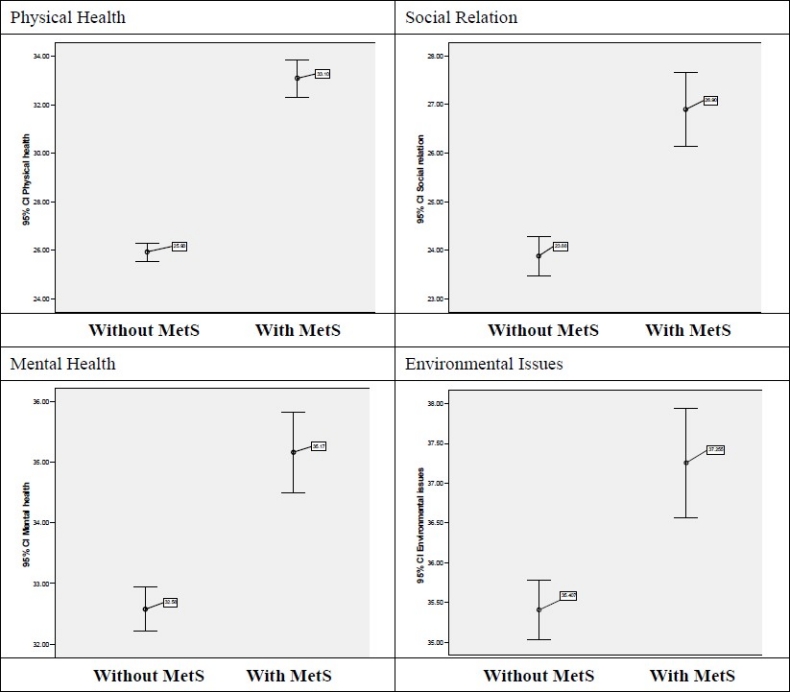
The mean age of participants was 38.8±15.6 years (mean ± SD) and the prevalence of MetS was 22.5%. From all participant 18.2% were illiterate and 13.2% had university educational level. Two way multivariate analyses of covariance (MANCOVA) test after adjusting age showed significant difference between women with and without Mets in regard to physical health and social relations domains, while none of QoL domains was different in men with Mets in comparison to men without it.
After adjusting the role of socio-demographic factors as components of QoL score, no association was observed between QoL domains and MetS in men, while only social relations and physical health scores were higher in women with Mets compared to those without Mets. Other variety of health-related QoL assessment tools or definitions of MetS may show different relationship in the Iranian socio-cultural context.
调查伊朗人群中代谢综合征(MetS)与健康相关生活质量(QoL)之间的关联。
我们使用了伊斯法罕健康心脏项目(IHHP)干预后阶段的数据,这是一项预防和控制心血管疾病(CVD)的社区试验。我们招募了9570名年龄≥19岁的健康成年人,他们是通过多阶段随机抽样方法随机选取的。使用包含26个条目的世界卫生组织生活质量问卷(WHOQOL-BREF)来评估生活质量。它评估生活质量的四个领域:身体健康、心理健康、社会关系和环境问题。代谢综合征根据ATP III标准定义。
参与者的平均年龄为38.8±15.6岁(平均值±标准差),代谢综合征的患病率为22.5%。所有参与者中,18.2%为文盲,13.2%具有大学教育水平。调整年龄后的双向多变量协方差分析(MANCOVA)测试显示,患有和未患有代谢综合征的女性在身体健康和社会关系领域存在显著差异,而患有代谢综合征的男性与未患代谢综合征的男性相比,在任何生活质量领域均无差异。
在调整社会人口学因素作为生活质量得分组成部分的作用后,未观察到男性生活质量领域与代谢综合征之间存在关联,而患有代谢综合征的女性与未患代谢综合征的女性相比,仅社会关系和身体健康得分较高。在伊朗社会文化背景下,其他各种与健康相关的生活质量评估工具或代谢综合征的定义可能显示出不同的关系。